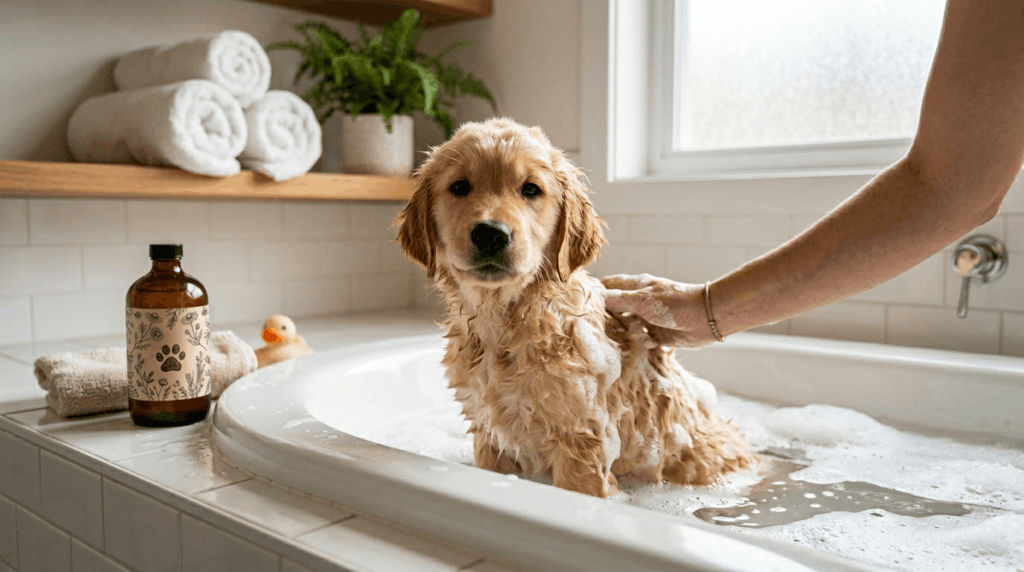
How to Make Bath Time Less Stressful With the Right Puppy Shampoo and Technique
Bath time anxiety in puppies is almost always a learned response, not an innate one. The first few baths set the pattern. A puppy that finds early bath experiences frightening, cold, or overwhelming will develop an association between bathing and distress that becomes progressively harder to undo the longer it’s reinforced.
A puppy whose early baths are calm, brief, and associated with positive outcomes tends to become a dog that tolerates or even enjoys bathing with no particular drama.
The shampoo is one variable in this, and not always the most important one. But it’s the variable that determines whether the experience is physically comfortable or irritating, which feeds directly into whether the puppy’s overall association with bathing is positive or negative. Getting both right, the shampoo and the technique, from the first bath significantly improves the chances of having an easy time with bathing for the dog’s entire life.
Why Puppy Skin Needs a Different Shampoo
Puppy skin is genuinely different from adult dog skin in ways that make the shampoo choice more consequential than it would be for an adult.
The skin barrier in young puppies, particularly those under twelve weeks, is still developing its full protective function. The barrier’s job is to retain moisture and keep irritants out. When it’s compromised by a shampoo that’s too harsh or has the wrong pH, the skin becomes more reactive, more prone to dryness, and more likely to respond to the next irritant exposure.
This is one of the mechanisms behind the generalised skin sensitivity that some dogs develop and carry into adulthood: early exposure to inappropriate products can prime the skin’s inflammatory response in ways that persist.
A puppy shampoo should be pH-balanced for canine skin, which is less acidic than human skin and requires a different formulation to maintain the skin barrier correctly. Human shampoos, including baby shampoos that many owners assume are gentle enough for puppies, are formulated for human pH and can disrupt the canine skin barrier even if they don’t produce an immediate visible reaction.
Fragrance is the other primary variable. Puppies are more sensitive to fragrance compounds than adult dogs, and heavy fragrance in a shampoo is one of the more common causes of post-bath itching and skin reactivity. Fragrance-free or lightly scented puppy shampoos reduce this risk substantially.
The Technique Matters as Much as the Product
A gentle puppy shampoo applied in a way that terrifies the puppy achieves very little. The technique is at least as important as the product, and for many puppies it matters more.
Temperature is the first consideration. Puppy body temperature regulation isn’t fully developed, and water that feels comfortably warm to human hands can still chill a small puppy if the session runs long. Water that’s genuinely lukewarm, slightly warm rather than warm, and a bath that’s kept brief, under ten minutes for a routine maintenance bath, keeps thermal stress minimal.
The approach to wetting down matters. A puppy that gets water in its face during the first bath often retains a strong aversion to having water near its head that’s difficult to desensitise later.
Wet the body first, avoid the face and ears entirely or address them very carefully with a damp cloth rather than running water, and make a deliberate point of keeping the experience of water away from the head as minimal as possible in early baths.
Restraint is a common mistake. Holding a puppy firmly still during a bath teaches the puppy that bathing is something unpleasant to escape from. The goal is to keep the puppy in the bath primarily through engagement and distraction rather than physical restraint. Treats, lick mats fixed to the side of the bath, or ongoing verbal engagement give the puppy something to do and something to be rewarded for rather than something to resist.
Building the Association Over Time
The first few baths shouldn’t try to achieve a perfectly clean puppy. They should try to achieve a puppy that ends the bath experience in a calm or neutral state rather than a distressed one.
This might mean a first “bath” that’s just standing in a few centimetres of lukewarm water while being given treats, without any shampoo at all. Then a second session that introduces wetting. Then one that introduces a small amount of puppy shampoo. The gradual build reduces the number of novel stimuli in any single session and gives the puppy time to habituate to each element before the next is introduced.
Counterintuitively, ending the bath session while the puppy is still calm and before it becomes distressed produces better long-term outcomes than completing a full wash at the cost of a distressed puppy. An incomplete bath that ends positively is better than a complete bath that ends with the puppy shaking in fear.
After the Bath
Drying is a part of the bath experience that often gets less attention than it deserves. A puppy that’s cold, wet, and shivering after a bath is associating the whole experience with discomfort rather than with positive outcomes.
Towel dry immediately and thoroughly. For puppies with longer coats, a low-heat dryer at a distance, or simply keeping them warm and dry until the coat dries naturally in a warm room, prevents the chill that undermines the positive association built during the bath itself.
The treat that comes at the end of drying, rather than just at the end of the bath, reinforces that the whole process, from bath to dry, has positive outcomes. That complete association is what produces a dog that walks calmly into the bathroom rather than one that has to be carried.
The right puppy shampoo creates the physical comfort. The right technique creates the emotional one. Both are necessary, and getting both right early is considerably easier than rehabilitating a dog that has spent years associating baths with something to fear.