How to Choose the Right LLM Using an AI Model Leaderboard
There are more capable language models available today than ever — GPT-5.5, Claude Opus 4.8, Gemini 3, Qwen3, DeepSeek V4, and dozens more — and that abundance is its own problem. Most teams either default to a familiar brand or freeze in analysis paralysis. There’s a better way: use an AI model leaderboard as a structured decision tool. A board like OrcaRouter, which ranks 200+ models on real traffic and blind votes, turns “which model?” into a repeatable checklist.
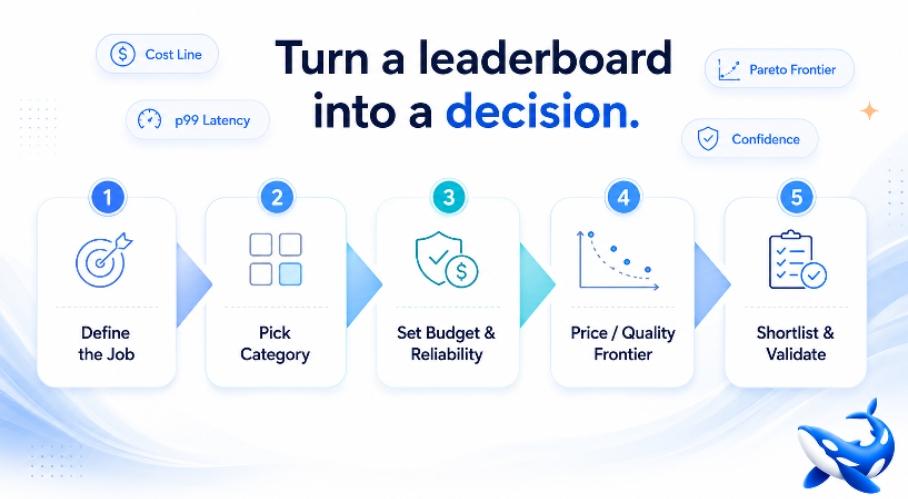
This article gives you a five-step framework for turning a live AI model leaderboard into a confident model choice.
Step 1: Start from the job, not the model
The biggest mistake is starting with “which model is best?” instead of “what am I building?” Define the job first:
• Task type — coding, math, reasoning, summarization, chat?
• Volume — a handful of requests a day, or millions?
• Latency sensitivity — a live chatbot, or an overnight batch job?
• Budget — what can you afford per million tokens at your scale?
Write these down before you open any ranking. They’re the filter for everything that follows.
Step 2: Go to the right sub-board
Skip the overall ranking and jump to the matching category — a mid-pack all-rounder might be the outright leader for coding. A good AI model leaderboard lets you compare models by capability — coding, math, reasoning — with a per-axis profile showing where each model beats or trails the field median. Read the profile, not just the position.

Step 3: Draw your budget and reliability lines
Apply two hard filters using the operational columns.
Budget line. Set a ceiling on cost per million tokens and ignore everything above it — no matter how smart.
Reliability line. For anything user-facing, set a minimum success rate and a maximum tolerable p99 latency. A brilliant model that times out on 5% of requests loses to a slightly less clever one that always responds.
These two lines usually eliminate most of the field in seconds.
Step 4: Use the intelligence-vs-price frontier
Among your survivors, the smartest tool is the quality-vs-cost view. Plotting quality against price reveals the Pareto frontier — the best quality at each price point. Any model *below* that curve is beaten by something both cheaper and better, so discard it.
This step routinely surprises people: an open-weight model on the frontier delivering near-flagship quality at a quarter of the cost. The frontier turns “which is smartest?” into “which gives me the most quality per dollar?”

Step 5: Shortlist two or three and validate
Never bet everything on rank #1. On a well-built board, #1 and #4 often have *overlapping* confidence bands — meaning they’re statistically tied. So take your top two or three from the frontier and:
• Check the confidence intervals. If they overlap, let cost or latency break the tie.
• Look at the trend. Has a candidate’s rating been sliding? A board that tracks ratings over time will flag a quiet regression.
• Run your own small test. Send each finalist a batch of *your* real prompts.
A worked example
Building a high-volume, latency-critical coding assistant:
1. Job: coding, millions of requests, latency-critical, mid-tier budget.
2. Sub-board: open the coding category.
3. Filters: cap cost; require >99% success rate and a p99 under two seconds.
4. Frontier: pick the two highest-quality models on the price/quality curve.
5. Validate: their bands overlap, so test both on real code prompts and pick the cheaper, faster one.
Don’t set it and forget it
New models ship constantly, and existing ones update silently. Re-run this framework monthly using a leaderboard built on *live* data, so you catch both new challengers and quiet regressions.
The takeaway
An AI model leaderboard is far more than a bragging-rights chart — used well, it’s a decision framework. Start from the job, filter by category, draw your budget and reliability lines, find the price/quality frontier, and validate your shortlist. Do that, and you’ll read an AI model leaderboard with the confidence of someone reading evidence, not marketing.