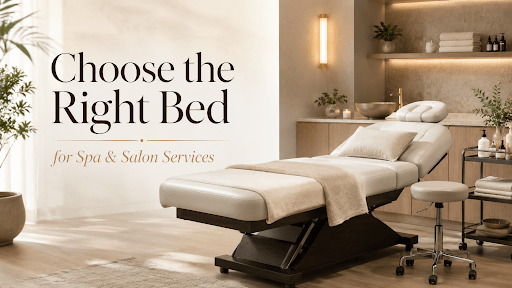
How to Choose the Right Bed for Spa and Salon Services
A client may forget the exact brand of serum used during a facial, but they will rarely forget how the treatment made them feel. Comfort, support, and relaxation tend to define the overall memory of a spa or salon experience.
In most treatments, the bed quietly shapes that experience more than any other piece of equipment. It is where clients spend the most time, and where professionals perform the majority of their work.
For this reason, choosing a spa or salon bed should never be treated as a simple furniture purchase. A well-designed bed supports the client’s body, protects the technician’s posture, improves workflow efficiency, and adapts to the actual services being delivered.
Choosing Between Spa and Beauty Beds Starts With Your Service Menu
Not every treatment room requires the same type of bed. A massage room, facial studio, lash space, waxing area, and spa wellness environment all place different demands on equipment.
When evaluating options such as a professional beauty spa bed, it is more effective to think in terms of treatment scenarios rather than product categories.
A lash extension bed must support long periods of stillness. A massage bed must remain stable under pressure. A facial bed should allow smooth adjustments without interrupting the treatment flow.
Foam Density and Upholstery Quality Define Long-Term Comfort
Comfort is often underestimated because clients rarely describe it in technical terms. They may not mention foam density or material layers, but they will immediately feel whether the bed provides proper support throughout the session.
If you want a deeper understanding of how materials affect long-term performance, it is worth exploring this breakdown of denier fabric and foam density in massage beds.
The internal structure of the bed plays a critical role in durability. Foam density, upholstery quality, padding thickness, and frame design all determine whether the surface remains supportive after months of repeated use.
Technician Access Shapes the Entire Service Experience
A treatment bed is not designed only for clients. It also directly affects the professionals performing the service.
Massage therapists need space to work from both sides of the bed. Estheticians require close access to the client’s face while keeping tools within reach. Lash artists depend on stable positioning for long-duration precision work.
Even small design details — height adjustment, backrest control, and working clearance — can significantly influence daily workflow efficiency.
Cleaning Should Be Considered Before Purchase
Every spa and salon bed is exposed to oils, lotions, skincare products, disinfectants, and continuous client turnover. For that reason, cleaning should be part of the selection process rather than an afterthought.
Different service environments create different material requirements. Massage beds frequently come into contact with oils, while facial beds are exposed to skincare products and steam.
A deeper understanding of material durability can also be found through the technical breakdown of the beauty spa bed material structure and design standards.
Think Beyond the Initial Purchase Price
Price is often one of the first considerations when outfitting a new salon or spa. However, the lowest upfront cost does not always translate into the lowest long-term expense.
A more useful evaluation is functional fit:
- Does the bed support the primary service in the room?
- Can clients remain comfortable for the full duration of treatment?
- Can technicians work without unnecessary strain?
- Is it easy to clean and maintain between appointments?
- Will it remain reliable after months of continuous use?
A well-chosen massage bed, spa bed, or salon bed does not need to be overly complex. It simply needs to support the service, protect the client experience, and remain dependable in real commercial conditions.