How Mobile Command Center Trailers Are Reshaping Emergency and Field Operations
When a crisis unfolds — whether a natural disaster, a large-scale public safety event, or a military field deployment — the ability to establish a fully operational command hub within minutes can mean the difference between a coordinated response and complete chaos. Mobile command infrastructure has evolved dramatically over the past two decades, moving far beyond simple communication vans into sophisticated, purpose-built environments that rival permanent facilities in capability. Understanding what drives this evolution, and who is building these solutions, is essential for agencies and organizations that depend on rapid, reliable deployment.
The Growing Demand for Deployable Command Infrastructure
The frequency and complexity of large-scale emergencies have increased substantially in recent years. From wildfire coordination across multiple jurisdictions to federal law enforcement operations spanning hundreds of miles, the need for mobile command infrastructure is no longer a niche requirement — it is a core operational necessity. Emergency management agencies, military branches, and government contractors are all investing heavily in deployable solutions that can be transported to any location and become fully functional within a short setup window.
Traditional fixed command centers, while powerful, are inherently limited by geography. When an incident occurs far from a permanent facility, response teams lose critical time traveling back and forth for briefings, equipment, and coordination. A mobile solution eliminates that bottleneck entirely, placing decision-makers and communication systems directly at the point of need.
What Modern Command Trailers Must Deliver
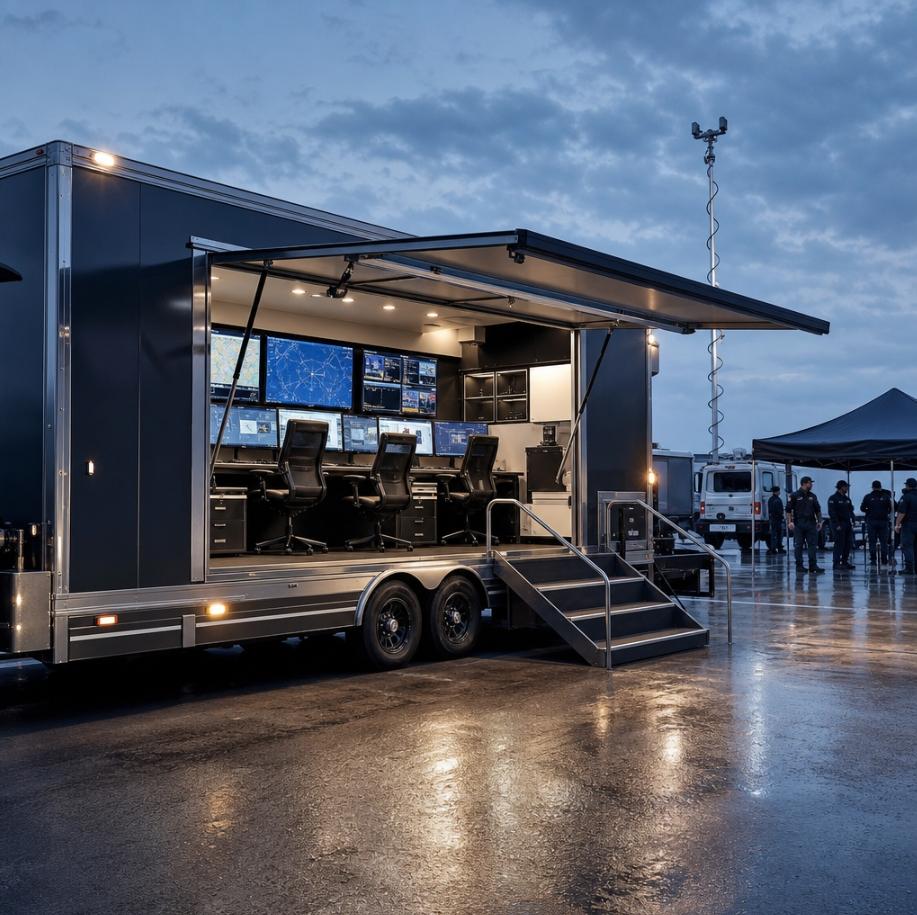
Today’s mobile command units are expected to perform at an exceptionally high standard. They must house advanced communication arrays, satellite uplinks, video surveillance integration, climate control systems, and ergonomic workstations — all within a structure that can withstand rough terrain, extreme weather, and the rigors of long-distance transport. The engineering challenge is significant: every component must be ruggedized, every system must be redundant, and the overall design must allow rapid deployment without sacrificing operational integrity.
Beyond the technical specifications, these units must also meet strict government and military standards. Compliance with MIL-SPEC requirements, GSA schedules, and agency-specific procurement guidelines adds another layer of complexity to the design and fabrication process. Only manufacturers with deep experience in government contracting and industrial fabrication are equipped to meet these demands consistently.
Craftsmen Industries: A Leader in Mobile Command Fabrication
Among the companies operating in this specialized space, Craftsmen Industries has established a strong reputation for delivering high-quality, custom-engineered solutions to military, aerospace, and government clients. Their expertise in designing and manufacturing mobile command center trailers and vehicles reflects decades of hands-on experience with the unique demands of field-deployable infrastructure. Each unit is built to client specifications, incorporating the precise systems, layouts, and compliance requirements that government and defense agencies require. The result is a finished product that functions as a true force multiplier in the field.
Custom Engineering as a Competitive Advantage
What separates elite fabricators from commodity manufacturers in this space is the ability to engineer truly custom solutions. No two deployments are identical. A FEMA disaster response unit has fundamentally different requirements than a military intelligence coordination vehicle or a federal law enforcement mobile operations center. The best manufacturers approach each project as a unique engineering challenge, working closely with the client’s operational and technical teams to develop a solution that fits the mission precisely.
This level of customization extends to structural design, interior layout, power systems, exterior finishes, and even branding. Some agencies require low-profile, unmarked exteriors for sensitive operations, while others need highly visible, clearly branded units for public-facing emergency response. The fabricator must be capable of executing both with equal precision.
Branding and Visual Identity in Government Vehicles
One often-overlooked dimension of mobile command center design is the role of visual identity and exterior graphics. For public safety agencies, the appearance of a command vehicle communicates authority, professionalism, and organizational identity to both the public and partner agencies on scene. High-quality vehicle graphics, color schemes, and insignia are not merely cosmetic — they serve a functional communication purpose in multi-agency environments where rapid visual identification is critical.
The intersection of functional design and visual communication is a rich area of study. Institutions focused on design education, such as those showcasing innovative graphic design projects from emerging student talent, highlight how visual problem-solving principles apply across industries — including the design of vehicles and operational equipment that must communicate clearly under pressure.
The Psychology of Command Vehicle Design
Research in environmental and operational psychology suggests that the physical environment in which decisions are made has a measurable impact on cognitive performance. Command center designers increasingly incorporate principles of ergonomics, lighting optimization, and spatial organization to reduce cognitive load on operators working in high-stress conditions. A well-designed interior layout minimizes unnecessary movement, reduces visual clutter, and ensures that critical systems are always within easy reach. These design decisions, while invisible to outside observers, directly influence the quality of decisions made inside the vehicle.
Procurement Strategy and Budget Considerations
For agencies navigating the procurement process, budget management is a persistent challenge. Acquiring a custom-fabricated mobile command unit represents a significant capital investment, and procurement officers must balance capability requirements against fiscal constraints. One effective approach is to prioritize modular design — building a core unit with the infrastructure to support future upgrades rather than attempting to incorporate every possible feature at the outset.
Agencies can also benefit from exploring creative procurement strategies that maximize value without compromising quality. For organizations looking to stretch their operational budgets further, resources on cost-effective strategies that deliver strong results without overspending offer transferable insights applicable to government procurement planning and vendor relationship management.
Long-Term Value Over Upfront Cost
Experienced procurement professionals understand that the lowest bid rarely represents the best value in specialized fabrication. A mobile command unit that fails to meet operational requirements — or that requires costly modifications after delivery — ultimately costs far more than a properly engineered solution delivered on time and to specification. Evaluating vendors on the basis of demonstrated experience, past performance, and engineering capability is a more reliable path to long-term value than price alone.
The Future of Mobile Command Technology
Looking ahead, the capabilities embedded in mobile command units will continue to expand. Autonomous vehicle integration, AI-assisted situational awareness tools, advanced cybersecurity architecture, and next-generation satellite communication systems are all on the near-term horizon. Fabricators who invest in staying ahead of these technological curves will be best positioned to serve the evolving needs of government and military clients.
The demand for deployable, self-sufficient command infrastructure is not a temporary trend — it reflects a permanent shift in how agencies approach operational readiness. As threats become more complex and geographically dispersed, the ability to project command capability anywhere, at any time, will remain a strategic priority for defense, emergency management, and law enforcement organizations worldwide.
Conclusion
Mobile command center trailers and vehicles represent one of the most technically demanding categories in industrial fabrication. They require the convergence of structural engineering, systems integration, regulatory compliance, and operational design — all executed to the exacting standards of government and military clients. As the operational landscape continues to evolve, the organizations that invest in purpose-built, expertly fabricated mobile command infrastructure will be the ones best equipped to respond effectively when it matters most. Choosing the right fabrication partner is not simply a procurement decision — it is a strategic investment in operational capability.