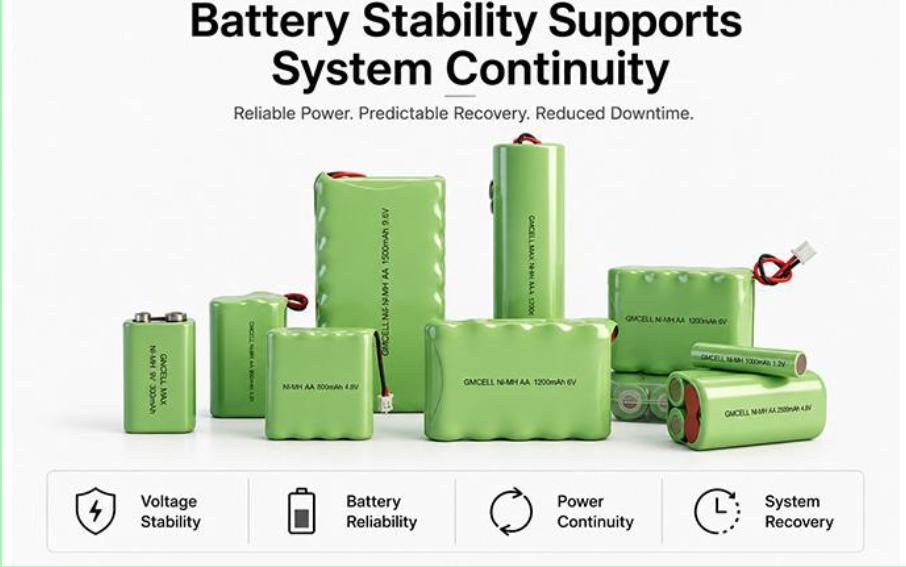
How GMCELL Improves Battery Stability in Industrial Power Systems
Modern *industrial power systems* depend on more than electricity alone. Controllers, sensors, communication modules, industrial PCs, and embedded devices all require stable power behavior to operate reliably.
In many industrial environments, unexpected downtime is not caused by a complete power outage. It often begins with *voltage stability* issues, battery degradation, unstable backup performance, or small power fluctuations that gradually affect system recovery, data retention, and operational continuity.
This is why *battery stability* matters. A stable battery helps maintain predictable voltage, supports critical settings, protects system memory, and reduces the risk of unexpected interruptions. For organizations that rely on long-term *power continuity*, *battery reliability* is no longer just a technical specification — it is part of operational risk management.
Capacity Is Not the Whole Story
Why Battery Stability Matters More Than Capacity
When people compare batteries, they often start with *battery capacity* — how many milliamp-hours or watt-hours a battery can store. That number is useful, but in *industrial electronics*, it is rarely the only factor that determines whether a system performs reliably.
Engineers usually look deeper. They care about whether the battery can deliver stable voltage under load, whether internal resistance remains controlled over time, whether performance stays predictable after repeated cycles, and whether the system can recover correctly after an unexpected power event.
This is where *battery stability* becomes more important than headline capacity. A high-capacity battery that suffers from voltage drop, inconsistent discharge behavior, or premature aging can still create reliability risks. A stable battery supports *battery reliability* by helping industrial systems operate, pause, and restart with fewer surprises.

Stability Factor
Voltage Consistency
Stability Factor
Internal Resistance
Stability Factor
Cycle Predictability
Stability Factor
Recovery Reliability
In industrial environments, capacity tells you how much energy a battery may hold. Stability tells you whether that energy can support predictable operation when the system actually depends on it.
Where Instability Begins
Common Causes of Battery Instability
*Battery instability* rarely happens overnight. In most *industrial power systems*, it develops slowly through temperature stress, uneven cell behavior, poor charging conditions, and long-term aging. By the time a battery visibly fails, the system may already have experienced voltage drift, reduced backup time, or weaker recovery performance.
Understanding these causes helps engineering and maintenance teams move beyond simple replacement schedules. It also explains why *battery reliability* depends on more than nominal capacity. Stable performance comes from controlling the factors that affect *battery degradation*, voltage behavior, and long-term pack consistency.

Cause
Temperature Stress
Industrial cabinets, outdoor equipment, telecom sites, and factory systems often face wide temperature swings. Heat accelerates chemical aging, while cold conditions can increase resistance and trigger *voltage fluctuation* under load.
Cause
Cell Variations
A battery pack is only as stable as its weakest cell. When cells age at different speeds, the pack may lose *battery consistency* even when total capacity still appears acceptable. This is why *cell matching* matters before pack assembly.
Cause
Improper Charging
Long-term float charging, repeated overcharging, or unsuitable charging profiles can raise internal stress over time. In industrial backup applications, charging control affects not only runtime but also long-term *battery lifespan*.
Cause
Aging Effects
As batteries age, capacity gradually decreases and internal resistance increases. The result is often weaker voltage support, shorter backup duration, and less predictable recovery when the system needs stable power most.
Battery instability is usually not a single failure point. It is the combined result of environment, cell variation, charging behavior, and aging — all of which must be managed before they become system-level reliability risks.
From Battery Behavior to System Risk
How Battery Instability Affects Industrial Systems
In industrial environments, battery problems are rarely isolated. A small drop in *voltage stability* can affect control logic, communication modules, emergency systems, and monitoring devices. What begins as battery drift may quickly become a *power quality* issue across the equipment it supports.
The risk is not always a dramatic shutdown. More often, it appears as data loss, parameter reset, communication failure, monitoring error, or delayed recovery after a *power interruption* or *voltage sag*.
PLC
Program loss or unexpected restart after unstable backup power.
HMI
Parameter loss, display errors, or incorrect operating status.
IoT Gateway
Communication interruption, data gaps, or delayed reconnection.
Medical Equipment
Monitoring errors or unreliable device recovery during backup operation.
Security Systems
Alarm failure, access control disruption, or emergency lighting failure.
For industrial systems, battery instability is not just a battery problem. It is a continuity problem, a data integrity problem, and eventually a business risk.
Improving Stability Before Failure Happens
Key Factors That Improve Battery Stability
Improving *battery stability* is not achieved by choosing a larger battery alone. It requires better *battery management*, stronger pack consistency, controlled charging behavior, and validation under the real conditions where the battery will operate.
For industrial buyers, this means looking beyond the data sheet. A stable pack should be designed around load behavior, temperature exposure, expected standby time, charging method, and the system’s required recovery profile.

Stability Factor
Cell Matching
A battery pack is only as stable as its weakest cell. Concepts such as *cell balancing* and active balancing show why cell-to-cell variation matters. Before pack assembly, careful *cell matching* helps reduce voltage drift and improves long-term pack behavior. This is especially important for industrial applications using NiMH Batteries, where consistency supports predictable backup performance.
Stability Factor
Pack Design Validation
*Battery testing* should reflect the real operating environment, not only ideal laboratory conditions. Practical validation includes actual load testing, cycle testing, and temperature testing. This helps confirm whether a pack can maintain stable output across the conditions expected in industrial use.
Stability Factor
Charge and Discharge Control
Stable performance depends on how the battery is charged, discharged, and maintained over time. Proper charge windows, discharge limits, and *battery monitoring* help slow degradation and reduce the risk of unstable voltage behavior during backup operation.
Stability Factor
Application-Based Engineering
A PLC backup battery, a medical monitoring battery, and a remote sensor battery do not face the same operating demands. An effective *custom battery pack* should be designed around the application, not forced into a generic specification. This is why OEM NiMH Battery Packs are often used when industrial systems require stable voltage, reliable recovery, and long-term pack consistency.
Battery stability is not a single feature. It is the result of matching cells correctly, validating the pack under real conditions, controlling charge and discharge behavior, and designing around the application itself.
Detecting Risk Before Failure
Battery Testing and Predictive Maintenance
Battery failure often begins years before it becomes visible. In many *industrial power systems*, a battery may still appear functional during normal operation, while its ability to support stable backup power is already declining.
This is why *battery testing* and *battery monitoring* matter. By checking voltage, capacity, internal resistance, and temperature over time, maintenance teams can identify early signs of degradation before they become unexpected downtime. In this sense, *predictive maintenance* is not just about replacing batteries earlier — it is about protecting system continuity.
Monitor
Voltage
Voltage trends help reveal whether the battery can still support stable output during standby, startup, or backup operation.
Monitor
Capacity
Capacity checks show how much usable energy remains, especially after years of cycling, storage, or standby charging.
Monitor
Internal Resistance
Rising internal resistance often appears before complete failure and can cause voltage drop when the system needs power most.
Monitor
Temperature
Temperature records help identify environmental stress that may shorten battery life or accelerate hidden degradation.
A failed battery is usually the final symptom. The real warning signs often appear earlier through voltage drift, capacity loss, rising resistance, and temperature stress.
Where Stable Batteries Matter
Industrial Applications That Depend on Battery Stability
Different *industrial battery applications* depend on battery stability in different ways. Some systems need memory retention. Some need safe shutdown. Others need communication continuity, monitoring accuracy, or emergency operation during a power event.
This is why *backup battery systems* cannot be selected only by capacity. In real industrial environments, battery choice must match the system’s operating risk, recovery requirements, standby conditions, and long-term reliability expectations.

| Application | Why Stability Matters | Typical Risk |
| PLC Systems | Supports program retention and reliable restart after unstable power. | Program loss or unexpected reset. |
| Industrial Controllers | Maintains control logic, settings, and safe recovery behavior. | Parameter loss or process interruption. |
| Telecom Equipment | Keeps communication equipment available during temporary power events. | Signal loss or service interruption. |
| Medical Devices | Supports monitoring accuracy and dependable device recovery. | Monitoring errors or unstable operation. |
| Security Systems | Protects alarms, access control, and emergency functions. | Alarm failure or access disruption. |
| Remote Monitoring | Maintains data collection in locations with unstable or limited power. | Data gaps or delayed reporting. |
| Industrial IoT | Supports connected sensors, gateways, and edge devices. | Communication failure or device downtime. |
The role of *backup power systems* is not only to provide extra runtime. In many industrial applications, the real goal is to preserve control, communication, recovery, and operational confidence.
Continuity Depends on Recovery
Why Stable Backup Power Is Essential for System Continuity
Power interruptions are difficult to eliminate completely. What industrial teams can control is how well the system responds when interruption happens. This is where *backup battery systems* become part of a broader *power continuity* strategy.
Stable backup power helps equipment preserve settings, maintain communication, support controlled shutdown, and recover correctly after unstable power events. For organizations evaluating Backup Power Solutions, the real question is not only how long the battery can run, but whether it can help the system return to a predictable operating state.
Data Retention
Stable backup power helps protect parameters, logs, timestamps, and operating records during unexpected interruptions.
Controlled Shutdown
Instead of failing suddenly, critical devices can enter a safer shutdown sequence and reduce recovery risk.
Communication Continuity
Sensors, gateways, and monitoring devices can keep reporting long enough to avoid blind spots.
System Recovery
The goal is not just temporary runtime. The goal is predictable restart, stable recovery, and fewer surprises after power returns.
Long-Term Reliability Approach
How GMCELL Approaches Long-Term Battery Reliability
For industrial applications, long-term battery performance depends on discipline before the battery reaches the field. GMCell approaches *battery reliability* through material selection, cell screening, quality control, validation testing, and application-based engineering.
The purpose is not simply to deliver a battery with a rated capacity. The purpose is to support stable behavior over time, reduce variation between cells, and help industrial customers build *backup power systems* that match real operating conditions.
Quality Control
Production control helps reduce hidden variation and supports more predictable battery behavior across batches.
Material Selection
Stable materials and consistent sourcing help support long-term performance in demanding industrial environments.
Cell Screening
Screening and matching reduce cell-to-cell variation before assembly, improving pack consistency.
Validation Testing
Load, cycle, and temperature testing help confirm that battery packs can perform under practical operating conditions.
Application Engineering
Battery design should reflect the application’s load, charging method, standby time, temperature exposure, and recovery needs.
Manufacturing Experience
Global manufacturing experience helps translate industrial requirements into more practical battery pack decisions.
Stability Is a Reliability Strategy, Not Just a Battery Specification
Industrial organizations often invest heavily in automation, monitoring, connectivity, and digital infrastructure. Yet many reliability problems still begin with a small power component that receives little attention until it fails. *Battery stability* changes that perspective. It connects voltage behavior, battery aging, backup performance, maintenance planning, and system recovery into one reliability strategy. When batteries are selected, tested, and engineered around real operating conditions, they do more than provide emergency power. They help protect data, reduce downtime, support *power continuity*, and make industrial systems more predictable over time.
Frequently Asked Questions
Battery Stability in Industrial Power Systems
If you are evaluating *battery stability*, *voltage stability*, or long-term *battery reliability* In industrial systems, these questions help clarify what matters beyond simple capacity.
What is battery stability?
*Battery stability* refers to a battery’s ability to deliver predictable voltage, capacity, internal resistance, and recovery behavior over time. In industrial use, a stable battery does not only store energy; it helps the connected system operate, pause, restart, and recover with fewer unexpected changes.
Why is battery stability important in industrial systems?
Industrial systems often depend on batteries for backup operation, memory retention, communication continuity, and safe recovery. If a battery becomes unstable, the result may be data loss, parameter reset, communication failure, or unexpected downtime. This is why *battery reliability* is often more important than headline capacity in *industrial power systems*.
How does voltage stability affect industrial equipment?
*Voltage stability* affects how reliably equipment can operate under load or during backup events. Voltage sag, voltage fluctuation, or unstable discharge behavior may cause PLC resets, HMI parameter loss, sensor errors, communication interruptions, or poor recovery after a power interruption.
What causes battery instability?
Common causes include temperature stress, cell variation, improper charging, long-term float charging, overcharging, and aging effects. As batteries age, capacity can decline and internal resistance can increase, which may lead to weaker voltage support and shorter *battery lifespan*.
What is cell matching in battery packs?
*Cell matching* means selecting cells with similar voltage, capacity, internal resistance, and performance characteristics before pack assembly. A battery pack is only as stable as its weakest cell, so better matching helps improve pack consistency, reduce imbalance, and support long-term reliability.
How can battery testing improve reliability?
*Battery testing* helps identify early performance changes before visible failure occurs. Testing voltage, capacity, internal resistance, temperature behavior, and cycle performance allows engineering teams to understand whether the battery can still support stable operation under real industrial conditions.
What industries depend most on stable battery systems?
Stable battery systems are important in PLC systems, industrial controllers, telecom equipment, medical devices, security systems, remote monitoring, and Industrial IoT. These *industrial battery applications* often require stable backup power to protect data, communication, monitoring accuracy, and system recovery.
How often should industrial backup batteries be tested?
Testing frequency depends on the application risk, operating temperature, charging method, and required backup function. Critical *backup battery systems* should be checked regularly for voltage, capacity, internal resistance, and visible aging signs so potential failure can be found before the next power event.