How Basketball Shoes Became the Default Language of Street Style
There are very few objects in contemporary culture that manage to mean something in as many different contexts simultaneously as a basketball shoe. On the court they’re performance equipment, engineered for the specific physical demands of a sport that requires explosive movement, lateral agility, and protection across extended periods of high-intensity play. On the street they’re a style statement, a cultural signal, and in some cases a collectible whose value has nothing to do with athletic performance. In music videos, on red carpets, in editorial spreads, and on the feet of people waiting for the subway, they appear as fluently as they do in arenas.
That fluency didn’t happen by accident. It was built through decades of cultural intersections that gave the basketball shoe a meaning beyond its function, and through a design language that turns out to translate across contexts in ways that most other sports footwear simply doesn’t. Understanding how that happened is understanding something real about how culture works, and why certain objects accumulate significance that outlasts the original context they were designed for.
Where It Started: The Court as a Stage
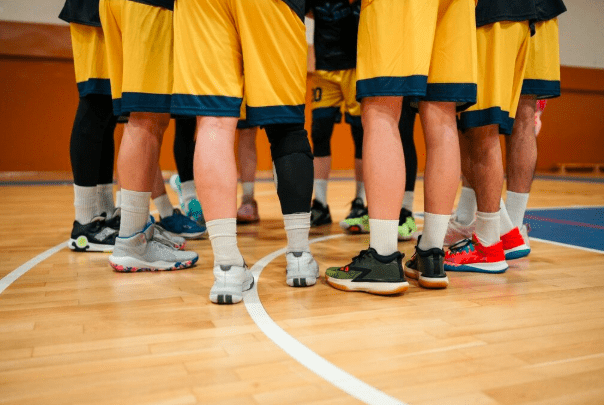
Basketball has always been a sport played at close quarters and in front of people. Unlike sports where participants are spread across large fields or separated from audiences by significant distance, basketball happens in tight, intimate spaces where every movement is visible and every detail is noticed. The shoes players wear are in the sightline of every spectator, every camera, and every opponent across the full duration of a game.
That visibility created conditions for the basketball shoe to function as an expressive object from very early in the sport’s history. Players understood that what was on their feet was part of how they were seen, and shoe manufacturers understood that the court was one of the most effective display environments available for a product worn by the most physically gifted athletes in the world performing at the highest level of their sport.
The shoe became part of the performance in a way that equipment in other sports rarely achieves. A tennis racket, a golf club, a cricket bat, these are tools that most spectators don’t look at closely. A basketball shoe is worn on a body in constant motion, photographed from every angle, and associated directly with the individual who wears it in a way that makes the shoe an extension of the player’s identity rather than simply part of their kit.
The Cultural Moments That Changed Everything
The specific moments that elevated basketball shoes from sporting equipment to cultural artefact are well documented enough to be familiar, but their significance bears revisiting because they explain why the category carries the cultural weight it does rather than simply noting that it does.
The relationship between basketball and hip hop, which developed in New York in the late seventies and through the eighties, produced the first genuine crossover between court footwear and street culture. Basketball shoes were worn by the same communities that were developing hip hop, which meant they appeared in the same spaces, on the same people, and in the same visual language. The shoe became part of the aesthetic of a cultural movement rather than simply the footwear of a sport, and that association gave it a significance that athletic performance alone couldn’t have generated.
The athlete signature shoe model, which produced some of the most culturally significant footwear objects of the late twentieth century, created a direct connection between individual players and specific designs that transformed the purchase of a basketball shoe into an act of personal affiliation. Wearing a particular signature shoe wasn’t just wearing a good basketball shoe. It was aligning yourself with a specific player’s identity, aesthetic, and cultural position in a way that the generic team shoe never could.
For anyone looking to buy basketball boots from PUMA AU, that tradition of athlete-driven design is visible in the current range, where collaborations with players like LaMelo Ball, Tyrese Haliburton, and Scoot Henderson produce footwear that carries individual identity as much as performance specification.
Why the Silhouette Works So Well Off the Court
The design characteristics that make basketball shoes perform on the court turn out to be exactly the characteristics that make them compelling on the street, and that alignment is not coincidental. It reflects something true about why the category translates so naturally across contexts.
Basketball shoes are designed to be seen. The visibility requirement of the court environment means that basketball shoe design has never been shy about visual presence. Midsole height, upper detailing, colourway contrast, and silhouette boldness are all features that were developed for visibility at court level and that translate directly into visual impact on the street. A running shoe is designed to be efficient. A basketball shoe is designed to look as good as it performs, and those are different design briefs with different outcomes.
The proportion of a basketball shoe, with its elevated midsole and substantial build, balances particularly well with the relaxed and oversized fits that have defined the most interesting dressing of the past decade. Where a lower-profile shoe can disappear under wide-leg trousers or an oversized silhouette, a basketball shoe grounds the look in a way that provides visual weight and intention at the base of the outfit. That proportional quality is what makes basketball shoes such consistent choices for people who think carefully about how their outfits work from the ground up.
What the Current Generation Is Doing With It
The current basketball shoe landscape is producing some of the most visually ambitious designs the category has seen, and the generation wearing them is using the footwear with a fluency that reflects decades of accumulated cultural knowledge about what basketball shoes mean and how they function as style objects.
Athlete collaborations have become more genuinely creative than they were in previous eras, with players who have real aesthetic investment in the design process producing footwear that reflects actual personalities rather than names attached to standard designs. The result is a category that keeps generating new visual languages rather than iterating endlessly on established templates.
The relationship between basketball shoes and the broader fashion system has also matured in ways that have changed how the footwear is contextualised. Basketball shoes appear in high fashion editorial, on runways, and in the wardrobes of people whose connection to the sport is minimal but whose understanding of the shoe’s cultural authority is sophisticated. That expansion of the category’s cultural reach has made basketball shoes genuinely universal in a way that even their most optimistic advocates wouldn’t have predicted a generation ago.
Why the Conversation Around Basketball Shoes Never Really Ends
The cultural authority that basketball shoes have accumulated over decades is not the kind that fades when the specific cultural moment that generated it passes. It’s the kind that becomes self-sustaining, where the shoes mean something because they have always meant something, and new generations inherit that meaning and add to it rather than replacing it.
New York understood this earlier than most places, because New York was where the original cultural intersections happened and where the language that gave basketball shoes their meaning was first developed. The shoes that appear on the streets of this city today carry that accumulated significance alongside whatever the current moment is adding to it, which is why the conversation about basketball shoes as style objects never really ends. It just keeps finding new things to say.