Getting Married in New York: Solving the Guest Photo Problem Before It Starts
A New York wedding collects people. Between both families, college friends, the media-world colleagues, and the downtown crowd, a Manhattan reception routinely passes two hundred guests – and most of them arrive with a camera in their pocket. By the end of the night, somewhere between one and two thousand photos of your wedding exist. The couple appears in a fraction of them. The other ninety percent scatter into group chats, camera rolls, and password-protected galleries, and most are never seen again.
The fix is not a bigger photographer package – your photographer has maybe four hours of reception coverage and one angle per moment. Guests collectively hold thousands of hours of coverage: the getting-ready hallway, the bar conversation, the grandmother watching the first dance from the third row. No professional can be in all of those rooms. Treating guest photos as their own mini-project, with the same seriousness you gave the seating chart, is the only way to keep them. Here is where the photos actually go, and the checklist that keeps them together.
Where the photos go to die
Every lost wedding photo follows one of four paths. The photographer’s gallery is the most ironic: it exists, it is beautiful, and it sits behind a login that relatives are too polite to request. The group-chat path is the fastest: a dozen overlapping threads, each photo compressed a little more with every forward, nothing saved at full size. The shared-album path fails more quietly – the link lived on invitation number three of four, and half the guest list never saw it. And the last path is the sweetest loss: the photos that live forever on an aunt’s lock screen, technically saved, practically unreachable.
Notice that none of these are the guest’s fault. Every one of them is a design problem: the system asked too much, arrived too late, or lived in too few places. Couples who blame their friends for not sharing are blaming people who were given no working way to do it – and the proof is that the same guests, given a working method, suddenly deliver hundreds of photos.

The five-part checklist that actually works
1. One link, decided before the invitations print. Every method – hashtag, app, shared album – fails on the same detail: the instruction arrived too late, through too many channels. Choose the single destination for guest photos during planning, not the week of, and put it on the wedding website and the day-of materials alike.
2. Make the ask where guests already look. Centerpiece cards help, but the bar and the coat check are where phones actually come out. Repeat the instruction in at least three physical locations; a single tent card on table seven is a suggestion, not a system.
3. Remove every step that costs a download. This is the rule that separates systems that work from systems that get ignored. At a New York wedding the age range at a single table can run from college roommates to grandparents in their eighties; any method with a learning curve loses someone. Studies of shared-album behavior keep finding the same thing: the percentage of guests who participate collapses with every additional step between taking a photo and sending it.
The test is your least techy uncle: if sharing requires an account, an app store, or a password he did not know last week, that portion of your photos is already gone. The strongest option is a single QR code that opens an upload page directly – tools built for exactly this exist, and https://vowsnaps.com/ is one example: guests scan, upload, done – no account, no app, no instructions longer than a sentence.
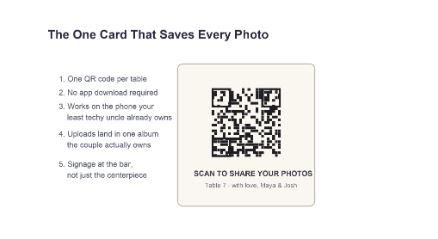
4. Appoint a photo point person who is not the couple. A cousin with the link and one job – nudge tables during cocktail hour – collects more photos than any signage. Give the task to someone who likes being important for a night; it costs you nothing and doubles your yield.
5. Own the album, not the platform. Whatever collects the photos should let the couple download everything at full resolution. A gallery you can view but never export is just the photographer’s-gallery problem with a new logo.
A note on hashtags, since New York couples love them: a wedding hashtag is a lovely keepsake and a terrible collection system. It only reaches guests who already use the platform, it caps uploads at whatever compression the network applies, and a couple searching their own hashtag the next morning finds nine blurry dance-floor videos and a photo of someone’s shoes. Hashtags complement a real collection link; they cannot replace it.
Timing matters more than couples expect. Print the QR cards with the final stationery run, brief the point person at the rehearsal, and mention the album once during the welcome speech – thirty seconds, one sentence, the only announcement of the night guests actually act on. Couples who fold the ask into the toast routinely report collection rates that surprise even their photographers.
Why it matters more in New York
A backyard wedding of forty people can survive group-chat chaos; the guest list is small enough to beg for photos by name later. A two-hundred-guest Manhattan wedding cannot. The people in those photos flew in from three countries for one night, and the couple will never reassemble that room. The photos guests take are the only wide-angle record of who was actually there – and the difference between a working collection system and a broken one is roughly 1,400 photographs.
Planning a New York wedding and building the photo plan early is a one-hour task with a fifteen-year payoff. Choose the destination, print the code, brief the cousin – and let the room photograph itself.