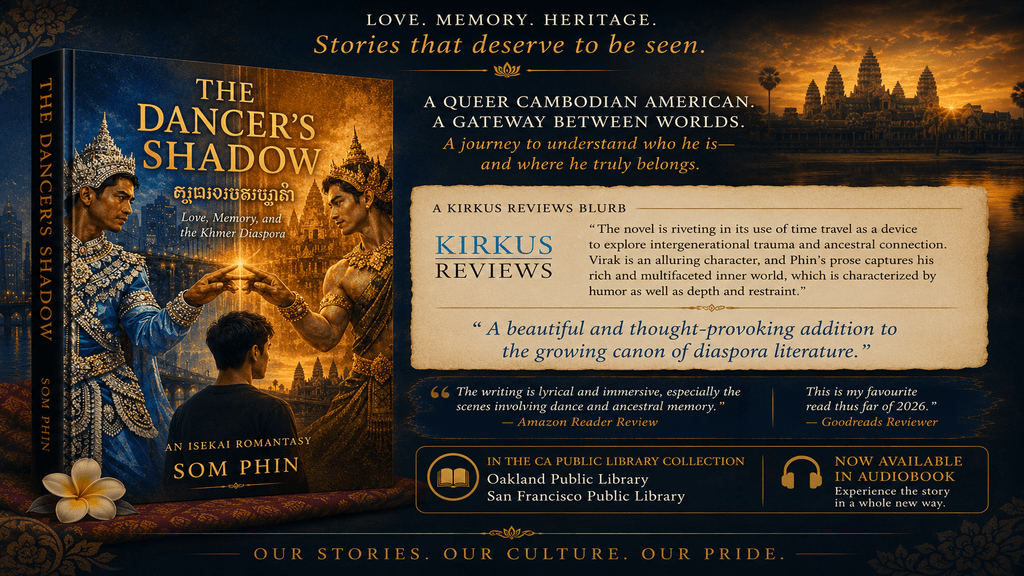
Between Two Worlds: How Som Phin’s The Dancer’s Shadow Reimagines the Search for Home
For someone raised between cultures, the word home can become complicated.
It can describe the place where you were born, the country your parents left behind, the language you understand imperfectly, or the traditions that feel deeply familiar even when you cannot explain all of them. Sometimes home is less a location than a collection of stories inherited from people who remember a world you never knew.
Cambodian-American novelist Som Phin turns that longing into something literal in The Dancer’s Shadow, a time-travel novel about a gay Cambodian-American man searching for a connection to Cambodia and to himself.
Virak Chea lives in modern-day California, caught in a contradiction familiar to many children of diaspora. Cambodia matters deeply to him, yet parts of the culture remain beyond his reach. His Khmer is limited. The older generation carries memories he wants access to but cannot easily obtain. Even within Cambodian spaces, he can feel like an outsider.
Then the impossible happens.
Virak is transported to Cambodia in the 1960s.
Suddenly, the homeland he inherited through memory is no longer abstract. It is alive around him.
When the Imagined Homeland Becomes Real
Time-travel stories often give characters an opportunity to change the past. The Dancer’s Shadow is interested in something more unsettling: what happens when a person finally reaches the past and knows he cannot save it?
Virak arrives in Cambodia before the Khmer Rouge era, encountering a society that has not yet experienced the devastation he knows is coming. He finds ordinary life, humor, relationships, cultural traditions, and people making plans for futures the reader knows may never arrive.
That knowledge changes the fantasy of returning home.
For Phin, portraying Cambodia before the genocide was important because the country’s history did not begin with its destruction.
“When Cambodia appears in stories, especially for people who don’t know much about the country, the Khmer Rouge can become the entire frame,” Phin says. “I wanted Virak to experience Cambodia as a living place first. People are dancing, joking, falling in love, working, arguing, and thinking about tomorrow. The tragedy is that he knows what tomorrow eventually brings.”
That tension gives the novel its emotional weight.
Kirkus Reviews praised the approach, writing that “the novel is riveting in its use of time travel as a device to explore intergenerational trauma and ancestral connection.”
Learning Culture Through the Body
Virak’s connection to Cambodia is not built through history alone.
It also comes through dance.
Khmer classical dance becomes one of the ways he attempts to close the distance between himself and a culture he has long wanted to understand more fully. In the past, dance gives him access to a community and a tradition that cannot be absorbed simply by reading about them.
The body has to learn.
That idea mirrors the experience of cultural inheritance itself. Children of diaspora may inherit pieces of identity through gestures, food, ceremonies, music, language, expectations, and routines long before they understand where those things came from.
Virak’s journey asks what happens when someone who has inherited those fragments is suddenly placed inside the world that shaped them.
The answer is not effortless belonging.
He remains recognizably different. His accent, assumptions, mannerisms, and understanding of social expectations mark him as someone from somewhere else. Even when he looks like the people around him, he does not move through their world exactly as they do.
Home, he discovers, does not automatically recognize you simply because you have spent your life longing for it.
Queerness and the Search for Belonging
Virak’s sexuality adds another layer to that search.
As a gay Cambodian-American man, he is already negotiating multiple identities in the present. Traveling into the past does not simplify them.
The Cambodia he encounters offers cultural intimacy and community, but it also belongs to another era, with its own expectations surrounding sexuality and gender. Virak cannot separate his desire to connect with his heritage from the person he has become in America.
Phin did not want his journey to require choosing one identity over another.
“Sometimes belonging gets presented like a decision,” she says. “Are you Cambodian enough? Are you American enough? Are you too Western? Do you fit what your community expects? Virak keeps looking for the place where all the pieces of him will finally make sense together.”
Romance complicates that search further.
The possibility of love gives Virak another reason to become attached to a world he knows he cannot safely remain inside forever. His growing relationships transform history from something inherited into something personal.
The past stops being a collection of dates.
It becomes people he cares about.
Loving a Place You Cannot Save
That may be the cruelest part of Virak’s journey.
He receives what many descendants of displaced families can only imagine: the chance to see a lost world for himself.
But knowledge travels with him.
He knows what happens to Cambodia after the 1960s. He understands the scale of the violence approaching people who cannot yet imagine it. The closer he becomes to them, the heavier that knowledge grows.
Time travel therefore becomes less about power than helplessness.
Virak can witness. He can love. He can remember.
He cannot make history disappear.
That distinction keeps The Dancer’s Shadow from romanticizing the idea of returning to an ancestral homeland. The past contains beauty, but it is not an uncomplicated refuge. Neither is the present.
Virak’s challenge is ultimately to find a way to live with both.
Kirkus called the novel “a beautiful and thought-provoking addition to the growing canon of diaspora literature.”
A Home Large Enough for Every Version of Yourself
At the beginning of Virak’s journey, identity feels like a question waiting for the correct answer.
Cambodia or America. Past or present. Outsider or insider. The person his community sees or the person he understands himself to be.
His journey gradually suggests that home may not require resolving those contradictions.
For Phin, that is part of what diaspora stories can hold: the possibility that belonging is not always about returning to one perfect place.
Sometimes it means learning to carry several places at once.
Virak crosses time searching for the Cambodia he inherited through other people’s memories. What he finds is more complicated, more alive, and more painful than nostalgia could have prepared him for.
And perhaps that is what finally brings him closer to home.
Not finding a world where he fits perfectly, but understanding that every version of himself is allowed to belong.
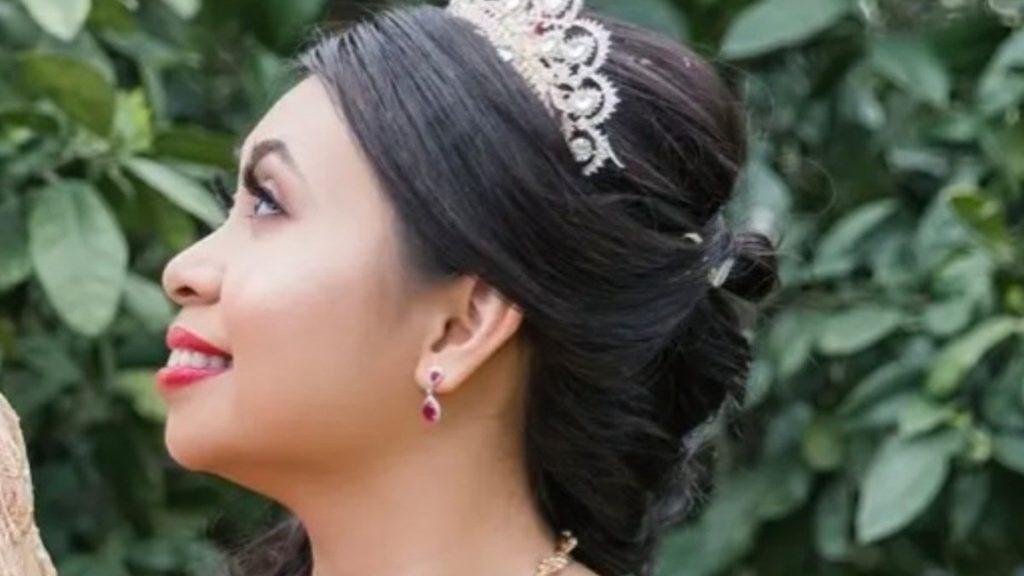
About Som Phin
Som Phin is a Cambodian-American novelist and the author of more than 35 novels spanning historical fiction, literary fiction, fantasy, romance, and speculative fiction. Her work explores Cambodian history, Khmer mythology, diaspora identity, family, cultural memory, love, and belonging.
Readers can learn more about The Dancer’s Shadow and Phin’s other work at somphin.com