Best Internet for Small Business in Newnan Georgia and Peachtree City Corridor
One choppy Zoom call can derail a client pitch. In Newnan and Peachtree City, choosing a business-grade internet line isn’t about headline download speed – it’s about verifying service to your exact suite, locking in an iron-clad SLA, and dodging that year-two price hike. The lineup flips once you cross the county line: published availability data puts Spectrum and WOW! strongest in downtown Newnan, while Xfinity dominates Peachtree City. This guide boils the published rate cards and coverage data into eight clear, use-case winners so you can request ISP quotes with confidence.
Quick answer – best business internet providers by use case
Pressed for time? Start with the cheat sheet below. We matched each ISP to the scenario where it outperforms rivals, then cross-checked price, technology, contract terms, and current published availability data for the corridor.
| Provider | Best-for verdict | Technology | Advertised down / up* | Starting business price† | Contract |
| WOW! Business | Lowest entry price in Newnan | Cable (HFC) or up to 5 Gbps symmetrical | 600 Mbps – 1.2 Gbps down / 51–60 Mbps up (cable) | $65.99 (600 Mbps)‡ | 1- or 3-year |
| AT&T Business Fiber | Strongest symmetrical performance | Fiber-to-the-premises | 300 Mbps – 5 Gbps / equal up | $60 (300 Mbps)§ | None |
| Comcast Business | Widest wired footprint in Peachtree City | Cable or DIA fiber | 300 Mbps / 10–35 Mbps (cable) | $60^ | 12 months + bundle |
| Spectrum Business | No-contract wired option | Cable (coax last mile) | 500 Mbps / 35 Mbps | $65 | None |
| T-Mobile Business Internet | Fastest self-install or backup | 5G fixed wireless | At least 25 Mbps committed; varies with tower load | $35 with voice | None |
| Verizon Business Internet | Longest price guarantee (10 years) | 5G fixed wireless | 100–400 Mbps / 10–25 Mbps | $69 base | None |
| EarthLink Business | One-stop quote for dedicated fiber | Aggregator (various) | Quote only | Quote | Quote |
| Starlink Business | Physically diverse backup path | LEO satellite | 25–100 Mbps / under 10 Mbps after priority data | $55 for 50 GB, plus $30 terminal fee | Month-to-month |
*Speeds are provider-advertised maxima; real-world results vary with location, network load, and equipment.
†Prices exclude taxes, equipment, installation, and post-promo increases.
‡WOW!’s published rate is $65.99 for 600 Mbps and $5/mo more for 1.2 Gigs, quoted against a 3-Year term. Prices exclude taxes, fees and equipment, so ask for the all-in figure in writing.
§AT&T lists 300 Mbps symmetrical at $60 with no equipment fee.
^Comcast’s $60 rate needs Auto Pay, paperless billing and one paid companion service: SecurityEdge Preferred, Wireless Connect or Business Mobile. Base SecurityEdge is included free. The rate steps to $100 in year 2 and $140 in year 3.
Use the table as a launchpad. Need flawless uploads? Head straight to AT&T. Shopping on price inside downtown Newnan? Start with WOW!. Later sections unpack reliability, three-year cost, and corridor coverage so you can sign with confidence.
How we built the scorecard
“Editor’s pick” means little without numbers. We set one pass-fail rule: the service must qualify at the exact street address and suite. If the sales checker says “not available,” that provider earns zero points.
For every address that passed, we weighed seven factors (last updated August 4, 2026) to reach 100 points:
- Reliability and resilience (25 percent). Does the plan back uptime with a service-credit SLA or an automatic fail-over path?
- Upload performance and symmetry (20 percent). Cloud backups and video calls lean on upstream speed, not the headline download.
- Three-year total cost (15 percent). We modeled promo rates, standard rates, equipment, installation, and any required add-ons.
- Local corridor availability (15 percent). Providers serving both Newnan and Peachtree City without gaps scored higher.
- Contract flexibility (10 percent). Month-to-month terms and free relocation beat long commits with steep ETFs.
- Business support and sentiment (10 percent). 24/7 phone lines, U.S. reps, and consistent local feedback add weight.
- Business extras (5 percent). Static IP blocks, built-in security, guest Wi-Fi, and cellular backup earned bonus points.
This framework keeps one flashy promo from hiding slow uploads or a costly contract. In short, we graded each ISP the same way you’d vet any vendor: verify first, then run the numbers twice.
Next, see how those numbers crown our first category winner, WOW! Business.
WOW! Business – best value for many Newnan locations
Running a boutique on Jackson Street or a studio near the Square? WOW! Business usually publishes the corridor’s lowest public price, and right now it even advertises three months of free modem rental on 300 Mbps or faster tiers. That offer appears only after the address checker on its Newnan, Georgia business internet services page verifies coverage to your exact suite.
One corridor fact no national list carries: WOW! publishes its business service area by ZIP, and the list crosses the county line. 30263, 30264, 30265, 30269, 30276, 30277, 30214, 30215, 30216, 30268, 30290 and 30291 cover downtown Newnan, Peachtree City, Senoia, Sharpsburg and Tyrone, Coweta and Fayette on one account. If you run a shop on the Square and a warehouse off GA-74, that is one provider and one contract instead of two markets. Check the list against your own addresses before you shortlist anyone.
Public plans and current pricing
Last verified August 4, 2026
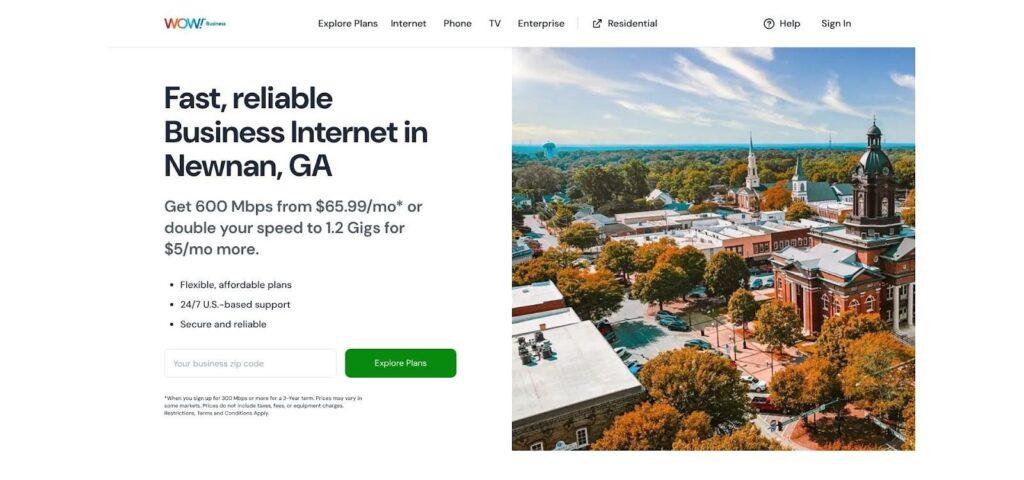
WOW Business Newnan plans and pricing page screenshot.
- 600 Mbps down / 51 Mbps up at $65.99, the entry rate WOW! publishes on its Newnan page
- 1.2 Gbps down / 60 Mbps up at $70.99, described on the page as “$5/mo more”
- 300 Mbps is sold but not priced on the city page; HighSpeedInternet lists it at $49.99, so ask the rep to confirm
Upload figures are the typical speeds WOW! files on its own FCC Broadband Facts labels for these business tiers.
All three tiers require a 1-year or 3-year term agreement and include free professional installation. WOW! does not publish its early-termination formula on the Newnan page; HighSpeedInternet reports it as 75 percent of the remaining monthly service charges, so get the exact figure on your order sheet. Worth knowing before you accept a term: WOW!’s own FCC Broadband Facts labels list no contract requirement and no early-termination fee on all thirteen business plans at the standing rate, which is $89.99 for 600 Mbps. The commitment is what buys the discount. Add equipment, taxes, and fees when you compare the true bill with a no-contract cable offer.
Upload performance and technology
The gigabit plan uploads at 60 Mbps on WOW!’s coax network, with 51 Mbps on the 600 Mbps tier – both the typical figures WOW! files on its own FCC Broadband Facts labels. That is fine for email and 1080p Zoom and slow for daily 4K video pushes, though it sits above the roughly 35 Mbps ceiling the cable competitors in this guide document. An “up to 5-Gig” symmetrical tier unlocks higher speeds, but it follows a separate price sheet.
WOW! advertises 99 percent network reliability; that figure is market-wide, not an automatic service-credit SLA. Ask the rep for the written SLA and escalation contacts before trucks arrive. Two commitments the page does make and most competitors here do not: 24/7 U.S.-based support and a 60-day satisfaction guarantee.
Contracts, promotions, and three-year math
The Newnan page highlights “three months free modem” on 300 Mbps and higher plans. Business data-cap terms vary by contract. Model the extras, too: Whole-Business Wi-Fi hardware ($19.99/mo), static-IP blocks ($14.99/mo), and Wireless Internet Backup ($44.99/mo) all raise the bill. Against Spectrum’s comparable coax plan the two are within about a dollar a month on the published entry rates, $65.99 against $65, so the extras and the contract terms decide it rather than the sticker.
Bottom line: WOW!’s sticker price is real, just not the whole story. Get the quote in writing, set a month-ten reminder, and renegotiate – or switch – before the renewal hike lands.
AT&T Business Fiber – best overall for symmetrical performance
Plans and upfront pricing
Last verified August 4, 2026
- 300 Mbps at $60
- 500 Mbps at $100
- 1 Gbps at $140
- 2 Gbps at $185
- 5 Gbps at $285
Prices include the gateway and online installation, and – unlike most cable offers – there is no annual contract or equipment rental fee.
Why symmetry – and lower latency – matters
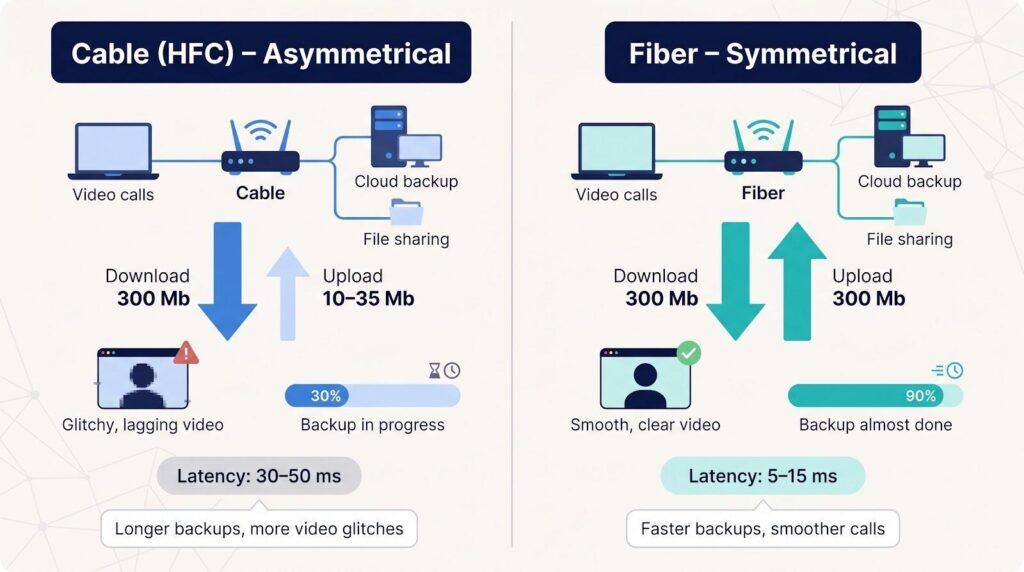
Each tier moves data upstream as fast as it comes down, cutting backup windows and shrinking file-transfer wait times. Fiber’s light-based signal also trims latency, so live video calls land with fewer pauses and tighter lip-sync.
Built-in 5G fail-over (plus one hidden need)
Orders of 1 Gbps and above arrive with an embedded 5G SIM. If a contractor severs the fiber, the gateway shifts to cellular in seconds with no extra hardware. One catch beyond power: the backup hands your network a carrier-assigned dynamic address rather than carrying your wireline public IP across, and speeds can slow past 250 GB, so cameras, VPN tunnels and remote-desktop sessions may drop when it fires. The other catch is power. A small UPS for the modem, firewall, and one checkout terminal, about $80, keeps the backup path alive during an outage.
Availability and current promotions
Current availability data puts AT&T at about 57 percent of Newnan addresses and 73 percent of Peachtree City across fiber, IPBB and 5G combined, so the fiber share at any single suite is lower than either figure. Always run the address checker; if it offers DSL or Internet Air instead, keep shopping.
Online orders waive the standard install fee and ship reward cards worth $300 with Fiber 300, $400 with Fiber 500 and $500 with Fiber 1 Gig or faster. The company will also credit up to $750 in early-termination fees when you switch. Check the current expiry on AT&T’s order page before you plan around it; these offers roll over on short cycles.
With month-to-month billing, no data cap, and symmetrical speed up to 5 Gbps, AT&T Business Fiber stays the corridor’s benchmark when the green checkmark appears at your suite.
Comcast Business – best wired footprint in Peachtree City
Local advantage
Peachtree City is Xfinity territory. Current availability data puts Comcast at about 98 percent of Peachtree City addresses against roughly 9 percent in Newnan, while Spectrum runs the reverse, about 74 percent of Newnan and no Peachtree City presence at all. That reach makes Comcast the default wired pick east of I-85: many suites are already coax-ready, so a Friday signature can turn into a Monday install – something AT&T Fiber or WOW! can’t always match when new conduit is needed.
Coverage is the argument here, not sentiment, and the coverage is one-sided enough to carry the section on its own. If your suite qualifies for both cable and fiber, keep Comcast as the physically diverse backup instead of removing it.
Speeds, bundles, and the three-year bill
The headline “300 Mbps for $60” price lasts only 12 invoices, and only if you enable Auto Pay, go paperless, and carry one paid companion service – SecurityEdge Preferred from $40 a month, Wireless Connect at $35, or Business Mobile. Base SecurityEdge itself costs nothing and is built into every plan. Month 13 jumps to $100; month 25 to $140. Over 36 months that’s about $3,600 before equipment, taxes, or the companion service the discount depends on.
Need more headroom? Shared-cable tiers step to 500 Mbps, 1.25 Gbps, and 2 Gbps, while dedicated fiber (a separate quote) scales to 10 Gbps plus construction fees. All shared tiers stay asymmetrical, so heavy cloud-backup shops should price AT&T Fiber for symmetrical uploads.
Comcast’s new Total Solutions Advantage package rolls internet, SecurityEdge and a Wi-Fi 6 gateway onto one invoice, with Wireless Connect available inside it as a $35 monthly add-on rather than a rolled-in component. That backup link is LTE-speed but keeps PoS and email alive during a cable cut. Compare the bundle to any firewall or endpoint software you already license before signing.
Bottom line: Comcast offers unmatched wired coverage inside Peachtree City, but the convenience carries steep year-two and year-three pricing. Confirm every escalation on the service order and calendar renewal dates so the next hike never catches you off guard.
Spectrum Business – best no-contract wired option
Current plans and the “fiber-powered” asterisk
Prices checked August 4, 2026
- 500 Mbps / 35 Mbps at $65
- 750 Mbps / 35 Mbps at $95
- 1 Gbps / 35 Mbps at $115
All tiers are month-to-month; you can cancel, relocate, or upgrade without an ETF. Spectrum calls the service fiber-powered, but the final drop is coax, so uploads trail true fiber.
Skip Auto Pay and a $10 monthly charge appears. Some packages lock the price for three years, while others float after year one. Even so, the entry rate usually beats Comcast once equipment and bundles are added.
Contract freedom, backup, and support
No annual term means you can bump bandwidth for holiday peaks or leave if a lease falls through. Check the order form: the three-year price guarantee sticks to the location, not the account, so moving suites resets the rate.
Need continuity? Spectrum sells Wireless Internet Backup as a separate battery-powered LTE modem at $20 per month: up to 10 Mbps down, up to four devices, up to eight hours of battery, and cellular speeds reduced after 100 GB in a month. It does not carry your primary public IP across the switch, so cameras and VPN tunnels can drop when it fires. Pair it with a small UPS so the modem, switch, and router stay active when the plaza loses power.
Support scores well on 24/7 phone access. Spectrum publishes no repair-interval commitment on standard business cable, so ask what restoration target and credit apply before you treat it as business-class. For many storefronts, that blend of contract-free agility, reliability, and live help outweighs a slightly cheaper teaser that locks you into a long commitment.
T-Mobile Business Internet – best rapid-install or secondary connection
Why fast installation matters
Lease signed Friday, doors open Monday, IT closet still empty. A T-Mobile fixed-wireless gateway ships overnight, arrives pre-activated, and takes about 15 minutes to stick on a window and power up, with no trenching, permits, or splice crews. For pop-ups, job trailers, or a storefront racing a grand-opening deadline, that turnaround can save the launch.
Plan lineup and five-year guarantee
Prices verified August 4, 2026
- Small Business Grow – $35 when bundled with a qualifying voice line
- Business Advanced – $50 and unlocks a static-IP option for PoS or VPN
- 5G Business Internet – $70 stand-alone; the five-year price guarantee applies to the Grow and Advanced tiers
All tiers are contract-free, ship with a Wi-Fi 7 gateway, and include a 15-day money-back window.
Performance reality check
Throughput depends on tower capacity, and fixed wireless is the one technology where the published range tells you nothing about your own suite. T-Mobile commits to consistent downloads of at least 25 Mbps, and after 1.2 TB of monthly use traffic shifts to a lower priority tier. Latency typically runs 40–60 ms, higher than fiber or cable, so keep this link as backup, not the only lifeline, for real-time apps. Order on the 15-day return window, put the gateway exactly where it will live, and run peak-hour tests before the window closes. That is the only measurement that decides it.
Where it fits best
- Day-one connectivity. Keep staff billing hours while the fiber crew waits on permits.
- Fail-over path. Feed the gateway into your firewall’s dual-WAN port; traffic swings to cellular when cable drops.
- Mobile ops. Food trucks, event vendors, and construction trailers rely on the “plug, power, done” workflow.
Mount the modem near a window and place it on a small UPS; you’ll gain a circuit that ignores local pole damage and most utility outages. In a corridor where storms often clip aerial lines, one prevented outage can pay for the second link in a single day of preserved revenue.
Verizon Business Internet – best long-term price guarantee where 5G qualifies
Plan tiers and the 10-year lock
Prices verified August 4, 2026
- 100 Mbps at $69 (or $35 with a qualifying mobile bundle)
- 200 Mbps at $99 (or $55 bundled)
- 400 Mbps at up to $199 inside strong Ultra Wideband zones
Verizon offers the 10-year price guarantee to new 5G Business Internet customers in select areas on the 100, 200 and 400 Mbps plans. It applies to the base internet access fee, excluding taxes, fees and equipment, and any customer-initiated plan change or address move cancels it. Bundling mobile lowers the rate; it is not what earns the guarantee.
Hardware credits and other strings
The self-install router is repaid through 36 monthly bill credits; cancel early and the remaining credits disappear. Add taxes, fees, and Verizon’s Economic Adjustment Charge to the budget sheet before you sign.
Performance across the corridor
Peachtree City enjoys better 5G Ultra Wideband saturation than downtown Newnan, but both cities show patchy street-level eligibility. Look for the “5GUW” badge in Verizon’s address checker; LTE-only sites max out around 50 Mbps down with tight data buckets. Even on 5G, uploads trail downloads, so daily cloud backups finish slower than on fiber.
Where Verizon shines
- Stable budgeting. Franchise owners and long-term retail leases appreciate a decade-long fixed rate.
- Secondary path. Pair the gateway with a wired circuit for carrier diversity.
- Rural edge sites. When trenching fiber is cost-prohibitive, 5G can bridge the gap quickly.
If the checker lights up green and your workload is browsing, PoS, and SaaS, the 10-year freeze is hard to beat. Otherwise, keep Verizon as backup and chase symmetrical fiber for the primary link.
EarthLink Business – best for one-stop quote shopping
Product families and the fine print that changes the price
Last verified August 4, 2026
EarthLink sells three services under one logo: broadband fiber, dedicated fiber, and fixed wireless. Because the company resells multiple carrier networks – often AT&T, Spectrum, Brightspeed, or regional co-ops – two adjacent suites can receive quotes that differ by hundreds of dollars even when the headline reads “1 Gbps fiber.”
In practice, EarthLink acts as an aggregator. It layers managed routers and add-on software (Directory Listings, Reputation Manager) on top of the underlying circuit. That bundle helps if you need a single vendor across several states, but it is risky if you assume every fiber offer is symmetrical or backed by the same SLA.
Questions to lock down before you sign
- Who owns the last mile?
- Shared broadband or dedicated port?
- Exact SLA target and credit schedule?
- Construction or loop fees in the install line?
Get those answers – and the quoted price – in writing. Sometimes the managed wrapper justifies the markup; other times a direct-carrier contract plus third-party monitoring costs less and delivers a clearer SLA.
Starlink Business – best physically diverse backup path
Priority data plans and hardware costs
Prices verified August 4, 2026
Starlink sidesteps the single-trench problem by sending traffic to low-Earth-orbit satellites, giving you a second carrier and a second physical path.
| Local Priority allowance | Monthly cost | Typical post-priority speed* |
| 50 GB | $55 | 25–100 Mbps down / <10 Mbps up |
| 500 GB | $155 | 25–100 Mbps down / <10 Mbps up |
| 1 TB | $280 | 25–100 Mbps down / <10 Mbps up |
| 2 TB | $530 | 25–100 Mbps down / <10 Mbps up |
*Speeds published by Starlink; real-world results vary with network load and weather. Local Priority also carries a $30 monthly terminal access charge on top of the data bucket, so the 50 GB entry is $85 all-in rather than $55. Median latency in company stats hovers around 40–60 ms, about two to three times higher than fiber but acceptable for PoS and email.
Hardware is the largest variable cost. The standard kit lists at $499, yet most fixed sites choose the Performance Kit (about $1,999) for stronger rain-fade resistance. Self-install works if you have a clear sky view; complex roofs can add $300–$600 in pro labor. Budget a small UPS so the modem and PoS gear stay online when the power blinks.
Starlink’s business SLA provides priority routing during your data window plus credits for outages over stated thresholds. Ask the rep for the current language before you sign.
Use Starlink as the path-diverse circuit that keeps payments and cloud access alive when a backhoe severs every terrestrial line on the block, and keep wired fiber or cable as the daily workhorse.
Other providers to keep on the radar
Viasat and Hughesnet – last resort for remote addresses
Specs pulled August 4, 2026 from current plan pages
Viasat tops out near 150 Mbps down and Hughesnet near 100, both with about 4 Mbps up, and real-world latency hovers 600 ms+. “Unlimited” plans throttle after a few hundred gigabytes, so they fit only where no wired, 5G, or Starlink signal reaches, usually rural Coweta farmland, not the business parks along GA-34.
XNET fixed wireless – verify before you buy
Aggregator sites advertise up to 2 Gbps coverage for roughly half of Newnan, but we found no official business plan, SLA, or price sheet. Until XNET publishes commercial terms, or you secure them in writing, treat it as a lead, not a locked-in choice.
Municipal myths
Fayette County’s 911 fiber extension and Georgia’s BEAD planning process do not translate to retail service. No city in the corridor sells broadband to businesses today, and no public filing commits to doing so within the next 12 months.
Bottom line: If a wired or 5G carrier already covers your suite, start there. Keep satellite and unvetted fixed-wireless brands as contingency links, not primary circuits.
Newnan versus Peachtree City – why your street address changes everything
Drive 20 miles up Highway 74 and the broadband pecking order flips. In downtown Newnan, Spectrum and WOW! trucks crowd the alleys; inside Peachtree City you’ll spot Comcast vans at nearly every strip mall. AT&T spans the corridor, yet its fiber strands weave in and out – present on one block, gone the next.
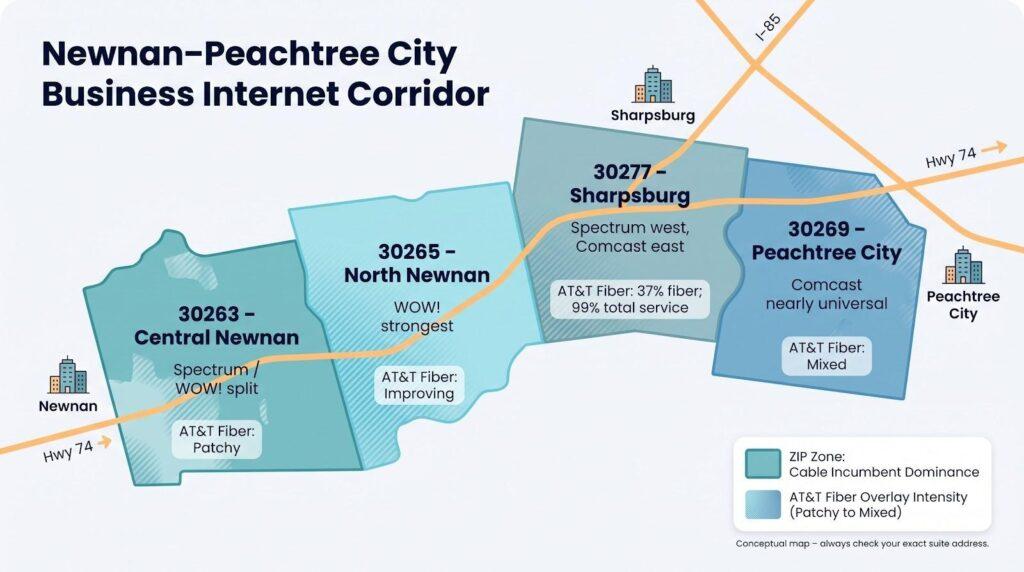
| ZIP code | Likely cable incumbent | AT&T fiber presence* | Notable quirks |
| 30263 (central Newnan) | Spectrum / WOW! split | Patchy | Comcast appears only in a few legacy pockets |
| 30265 (north Newnan) | WOW! strongest | Improving | Spectrum is the broadest cable footprint across Newnan as a whole |
| 30269 (Peachtree City) | Comcast nearly universal | Mixed – FTTP gaps remain | WOW! publishes 30269 and current data puts it near 22 percent; Spectrum almost disappears |
| 30277 (Sharpsburg) | Spectrum west, Comcast east | Patchy fiber, wider IPBB and 5G coverage | True overlap market; run dual address checks |
*Coverage is directional, drawn from current published availability data at town level rather than by suite. No public dataset resolves business-class service to a single address, which is why the checker beats the map every time.
What that means in practice
- Move one exit, lose your promo. ISPs treat Newnan, Peachtree City, and Sharpsburg as separate operating zones, so contract discounts may not travel with you.
- Verify before you lease. “Fiber-ready” often means fiber in the street, not in the suite. Run each provider’s checker for the exact suite, floor, and unit.
- Sharpsburg is a bargaining chip. Comcast and Spectrum overlap there, so you can sometimes pit them against each other, and keep AT&T as backup.
Provider maps are directional only. The green checkmark you see after entering the full address is the coverage that counts. Five minutes on each checker today beats five weeks untangling construction delays after move-in.
Fiber, cable, 5G or satellite – which transport fits your workflow?
Choosing a provider is really choosing a transport layer; physics, not billing, dictates upload speed, latency, and outage risk.
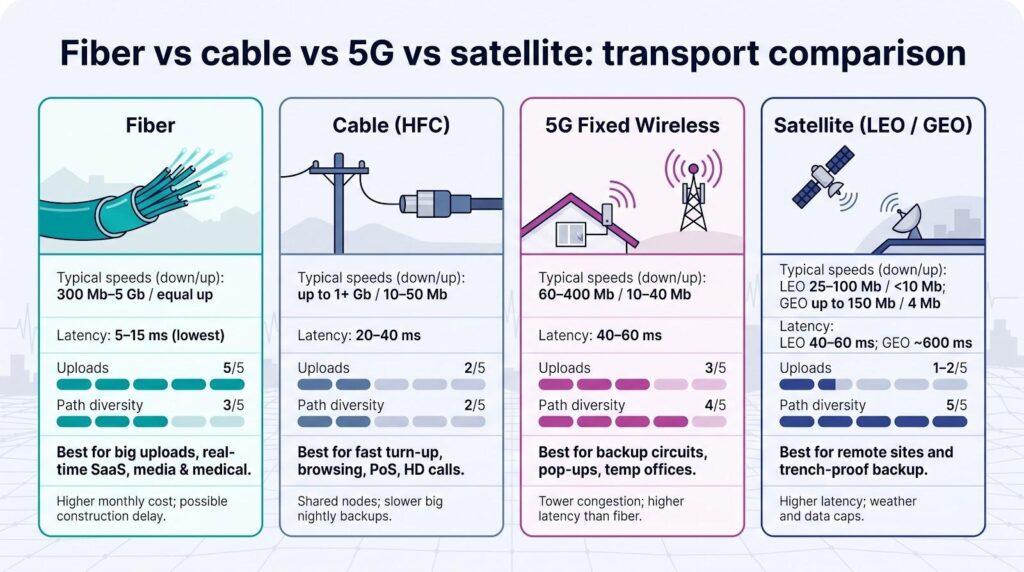
Fiber. Light through glass keeps latency in the 5–15 ms range and delivers symmetrical uploads. Perfect for big cloud backups, live video render farms, or latency-sensitive SaaS. Expect higher monthly rates and, if construction is required, a longer lead time.
Cable (HFC). Widely available and quick to install. Download often tops 1 Gbps, but uploads sit in the 10–60 Mbps range and shared nodes can slow at peak hours. Good for browsing, PoS, and HD calls; less ideal for nightly 200-GB project pushes.
5G fixed wireless. Plug-in speed. Carriers commit to a floor rather than a range – T-Mobile’s business floor is 25 Mbps down – and real throughput swings with tower load, distance and wall construction, at roughly 40–60 ms latency. Great for backup circuits, pop-ups, or temp offices; risky as the sole link if low-latency uptime is mission-critical.
LEO satellite. Starlink’s low-Earth-orbit path diversity sidesteps pole cuts. Median speeds hover 25–100 Mbps down / <10 Mbps up after priority data, with about 40–60 ms latency. GEO satellites such as Viasat and Hughesnet still sit near 600 ms and serve only the most remote sites.
Quick match-up
Need flawless uploads? Choose fiber.
Need fast turn-up at a familiar price? Cable fits.
Need instant fail-over or pop-up service? 5G works.
Need a link immune to pole damage? Add satellite.
How much internet speed does your business need?
Bandwidth depends on workflow, not square footage. Use the tiers below (last reviewed August 4, 2026) as a starting point.
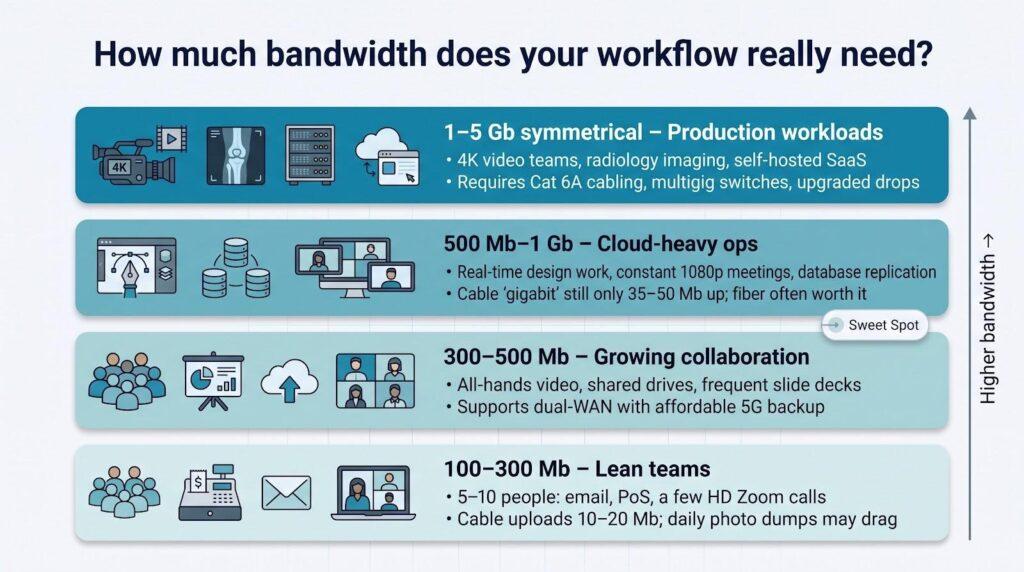
100–300 Mbps: lean teams
A 5–10-person office can handle cloud email, PoS, half-a-dozen HD Zoom calls, and nightly document backups. Cable uploads sit 10–20 Mbps, so daily photo dumps or Dropbox syncs may drag; step up to fiber if uploads matter.
300–500 Mbps: growing collaboration
Beyond a dozen staff, 300–500 Mbps keeps slide decks, all-hands video, and shared drives from colliding. Cable uploads rise to 20–40 Mbps, still below fiber. This tier supports dual-WAN with an affordable 5G backup while avoiding gigabit sticker shock.
500 Mbps–1 Gbps: cloud-heavy ops
Real-time Adobe work, constant 1080p meetings, and database replication hum when each desktop can burst above 500 Mbps. Cable “gigabit” plans still offer only 35–60 Mbps up; symmetrical fiber at about $140 per month often pays for itself in saved wait time.
1–5 Gbps symmetrical: production workloads
At 1 Gbps up/down, video teams scrub 4K footage from cloud buckets, and radiologists pull multi-gig DICOM files in seconds. 2–5 Gbps adds headroom for render farms and on-site servers. Budget for Cat 6A cabling, multigig switches, and $80–$120 per drop upgrades. AT&T’s 5 Gbps fiber works out to roughly $0.06 per megabit, but only if that extra speed shortens billable hours.
Quick rule:
- Email + PoS? 100–300 Mbps.
- Design teams? 300–500 Mbps.
- All-day cloud collaboration? 500 Mbps–1 Gbps.
- Media, medical, or self-hosted SaaS? 1 Gbps+ symmetrical.
Reliability: what “business-class” should really include
Raw speed turns heads, but uptime and recovery keep revenue flowing. Marketing copy that touts “99.9 percent reliability” usually reflects historical availability, not a contractual promise. Ask for the written Service Level Agreement (SLA) and look for language such as “One day of credit for every 30 minutes of outage beyond four per quarter.” Anything vaguer leaves you negotiating credits instead of serving customers.
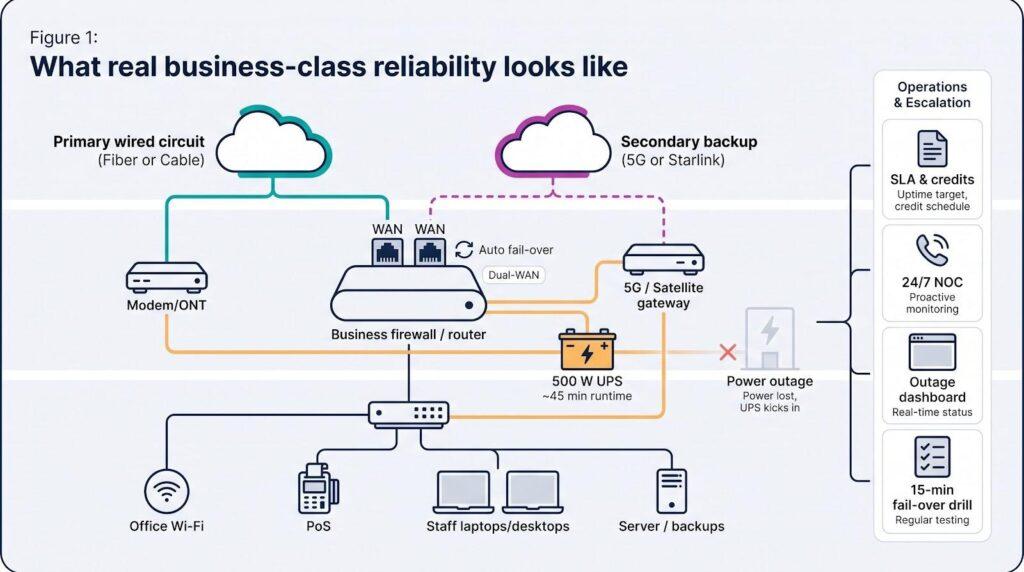
Even the best SLA fails if you rely on a single circuit. Use a dual-WAN design: a wired primary plus a path-diverse backup (5G or Starlink works for most corridor businesses). Modern firewalls fail over automatically, so staff barely notice the switch.
Power is the silent failure point. Cellular gateways, switches, and access points die without an uninterruptible power supply. A 500-watt UPS, about $140, buys roughly 45 minutes of clean runtime – long enough for a generator to start or the utility to swap feeds.
Finally, map escalation before trouble hits: store the provider’s NOC number, bookmark the outage dashboard, and run a 15-minute fail-over drill during business hours. A quick test today feels heroic when a contractor severs the main line tomorrow.
Three-year cost comparison: the hidden-fee reality check
Intro rates win headlines, yet year-two surprises hit the ledger. The figures below model a 36-month term (prices verified August 4, 2026) and capture promo cliffs, required bundles, equipment, installation, and Auto Pay conditions.
- Comcast. $60 intro → $100 in month 13 → $140 in month 25, and the $60 rate holds only while you carry a paid companion service. Internet line alone: about $3,600 before taxes and gear.
- WOW!. The $65.99 entry rate and the $70.99 gigabit rate both come with a Price-Lock Guarantee limited to the contract period. Free install helps, but Whole-Business Wi-Fi gear ($19.99/mo) and static-IP blocks ($14.99/mo) add up. A typical coax plan with one static IP lands near $3,000 over 36 months.
- Spectrum. No ETF, but a $10 monthly charge applies without Auto Pay. Packages with a three-year price guarantee hold at $65–$115; after month 36 they float to the then-current rate. Still the steadiest coax bill inside Newnan’s footprint.
- AT&T Fiber. Linear pricing with no contract, no equipment fee, and no promo cliff. $60, $100, or $140 today equals the same figure in month 30. Reward cards offset part of year 1, and in-market moves trigger free relocation instead of new construction fees.
Bottom line: drop every rate, fee, and bundle into a spreadsheet before you sign. The lowest sticker often morphs into mid-pack value once the calendar flips.
Before signing: the five-minute quote checklist
Slow down and capture the basics; five minutes now can save weeks of support calls later.
- Exact address and suite. Screenshot the provider’s checker; screenshots beat verbal “should be fine” promises.
- Technology and symmetry. Note whether the quote is fiber, coax, fixed wireless, or satellite, plus the exact down/up speeds.
- Contract term and post-promo price. Write the renewal rate and early-termination fee where you can see them later.
- SLA and escalation path. Record the uptime target, credit schedule, and 24/7 NOC number.
- Installation timeline and construction fees. Ask about permits, trenching, and any “conditional” charges in footnotes.
- Power and fail-over. Confirm UPS recommendations and whether the quote includes, or allows, a secondary circuit.
Print the sheet, walk through it with each sales rep, and file the answers in your project binder. When bids look similar, these points usually reveal the real winner.
Conclusion
Your street decides more of this than your budget does, so run every checker on the exact suite before you read another comparison, this one included.
If the AT&T checker turns green, AT&T Business Fiber is the corridor benchmark: symmetrical from 300 Mbps at $60, no contract, no equipment fee, and the same number in month 30 that you paid in month one. Inside Peachtree City, Comcast is usually the only wire that reaches, and the trade is the step to $100 in year two and $140 in year three plus a paid companion service to hold the $60. In downtown Newnan the cable fight is closer than the stickers suggest: WOW! at $65.99 and Spectrum at $65 are within a dollar, so it comes down to WOW!’s published 51 to 60 Mbps uploads, 24/7 U.S.-based support and 60-day guarantee against Spectrum’s freedom from any term at all. WOW! is also the one provider here that publishes its footprint by ZIP across both counties, which matters if you run addresses on both sides of the line.
Everything else is a supporting cast with a specific job. T-Mobile and Verizon get you online this week or give you a second carrier. Starlink gives you a path no backhoe can cut. EarthLink is worth a call only if you need one vendor across several states. Satellite from Viasat or Hughesnet is a last resort for addresses the rest cannot reach.
Print the checklist above, walk it through with each rep, and get the three numbers that actually move in writing: the provisioned upload at your suite, the rate the month after the term ends, and what the static IP and the backup path add.