5 Best Executive Search Firms for AI Leadership Roles: The Production vs Pilots Test
AI hiring has a scale problem. McKinsey’s 2025 State of AI survey finds that 88 percent of organizations now use AI in at least one business function, yet nearly two thirds have not yet begun scaling it beyond pilots. Boards need operators, not evangelists: leaders who have shipped models, managed risk, and moved real KPIs. In this guide, you’ll discover the five executive search firms best equipped to deliver that calibre of AI leader, along with a checklist you can use to verify every claim before you wire a retainer.
Why AI Leadership Searches Fail Before the First Candidate Is Contacted
Titles look tidy on an org chart, yet they hide chaos.
One company advertises for a Chief AI Officer who will “own the future of generative AI.”
Another recycles the same description under a VP Machine Learning label.
Meanwhile, nearly half of the AI leaders in Heidrick’s 2025 survey say their organization simply reclassified an existing position to include AI responsibilities.
When the target keeps shifting, recruiters aim at different bull’s-eyes.
Some present brilliant researchers who thrive on patents.
Others surface product-led technologists, or transformation specialists who run change programs but never ship code.
All look impressive on paper, yet only one profile fits the business need.
That mismatch starts a costly chain reaction:
- Stakeholders debate the job after interviews, not before.
- Search timelines stretch, then stall.
- Top candidates sense the uncertainty and walk.
The remedy is painfully simple: clarify the mandate before money changes hands.
A credible search partner challenges scope, reporting lines, and first-year KPIs during kickoff, not after resumes arrive.
If that conversation feels too comfortable, you probably hired the wrong firm.
Key takeaway? A vague brief guarantees a vague slate. Nail the role first, or risk paying a premium for polite confusion.
The Production vs. Pilots Test
Plenty of executives can recite an AI vision. Far fewer have wrestled a model into day-to-day operations, survived the compliance gauntlet, and watched real users adopt it.
That last group is rare for a reason. Heidrick’s 2025 study found that data quality, security, and regulatory friction remain the biggest blockers to scale, leaving most companies stuck in early implementation phases. Only a sliver have cracked the code on full production.
We use the Production vs. Pilots Test to separate search partners, and candidates, who have crossed that finish line from those still warming up.
What “production” really looks like
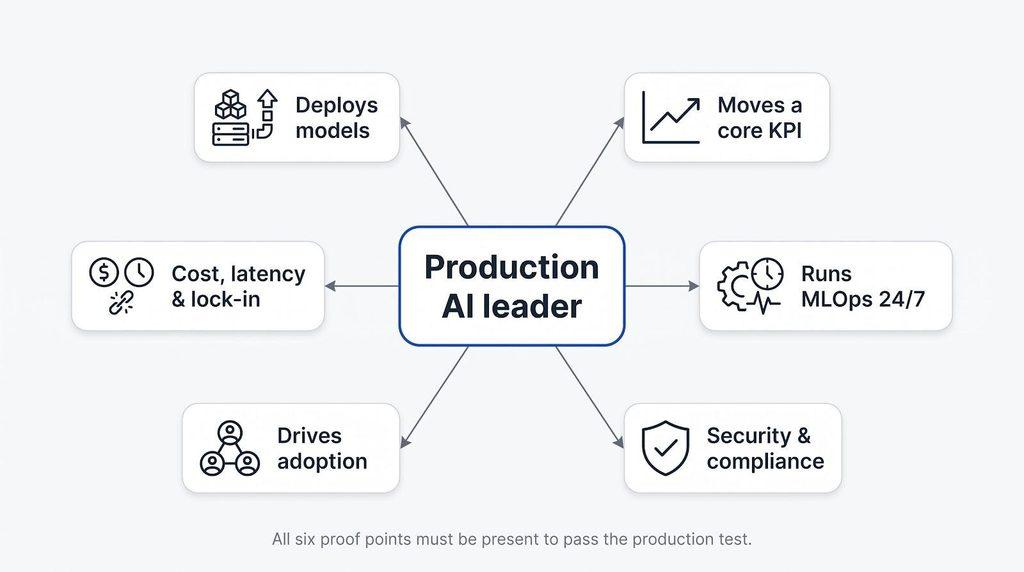
A leader passes the test when they can point to six tangible outcomes:
- Models deployed into live, repeatable workflows
- Measurable impact on revenue, margin, risk, or productivity
- Ongoing monitoring and MLOps in place, not just a hand-off deck
- Security, privacy, and compliance signed off by risk teams
- Adoption metrics that show real user uptake, not demo day applause
- Clear cost, latency, and vendor controls that keep the CFO calm
Hit those markers and we have evidence, not hype.
Spotting a pilots-only résumé
Red flags appear fast:
- Endless proofs of concept but zero sustained users
- Strategy ownership without production accountability
- KPI talk confined to “engagement” or “learning,” never dollars saved or earned
- Governance listed under “future plans” rather than “dashboard live”
When you apply this lens to search firms, the questions change. We stop asking how many AI leaders they know and start asking how many have shipped, scaled, and still remain in role a year later.
That shift, from volume to verifiable value, drives the ranking that follows.
How we evaluated the best AI executive search firms
Most rankings obsess over the largest databases or the flashiest LinkedIn posts; those metrics rarely predict whether a recruiter can land an AI leader who ships working models. We flipped the lens and built an outcome-first scorecard.
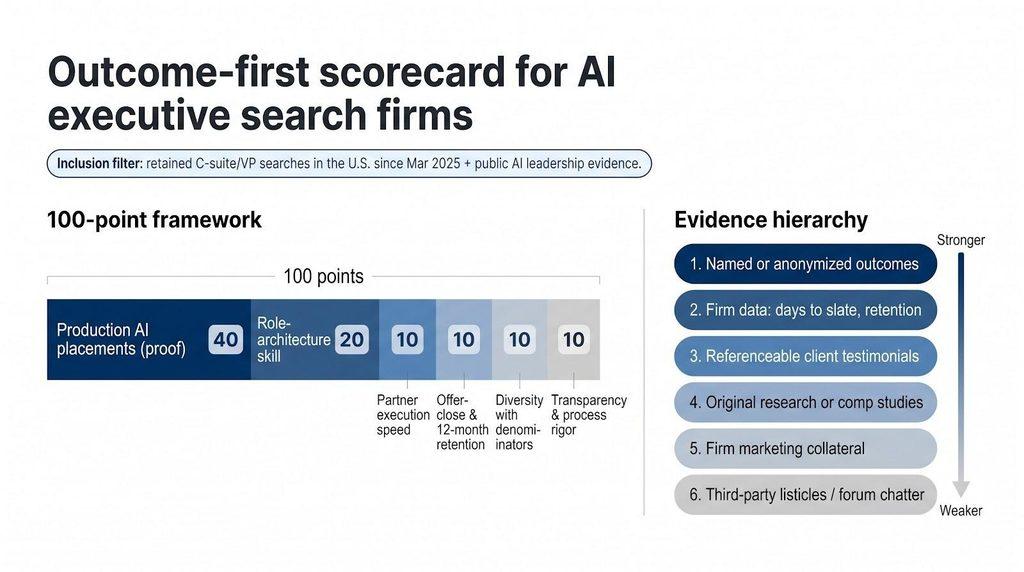
Inclusion filter
A firm had to 1) run retained C-suite or VP searches in the United States since March 2025 and 2) show public evidence of AI leadership placements. Directories, contingency shops, and marketing-only lists were out.
100-point framework
| Criterion | Weight |
| Production AI placements (proof) | 40 |
| Role-architecture skill | 20 |
| Partner execution speed | 10 |
| Offer-close and 12-month retention | 10 |
| Diversity with denominators | 10 |
| Transparency and process rigor | 10 |
Evidence hierarchy
- Named or anonymized placement outcomes with dates and metrics
- Firm-supplied data (days to slate, acceptance rate, retention)
- Referenceable client testimonials
- Original market research or compensation studies
- Firm marketing collateral
- Third-party listicles or forum chatter
Only five firms met the bar. The next sections map each one to the hiring scenario where it excels, note watch-outs, and give you the questions to ask before you sign a retainer. Our goal is a shortlist based on verifiable results, not verbal fireworks.
The best AI executive search firms at a glance
Need a quick snapshot before your board meeting? The grid below lines up each finalist so you can spot the right fit in seconds.
| Firm | Best for | Typical company stage | Public AI evidence | Geographic strength | Key differentiator | Watch-out |
| SPMB | Production-oriented tech and growth businesses | Venture-backed startups → public tech companies; established corporations adopting AI | 10-plus-year AI/ML practice inside a firm closing hundreds of C-level searches a year | North America, especially Silicon Valley | Hybrid technical-plus-business leadership focus | Confirm recent named AI placements and off-limits list |
| Heidrick & Struggles | Global enterprises tackling operating-model change | Fortune 500 and multinationals | First global AI practice (2012); 2025 survey featured 318 AI/data executives | Worldwide with deep U.S. coverage | Combines search with governance and org-design advisory | Verify partner bandwidth and conflict-of-interest clarity |
| True Search | AI-native and venture-backed companies across the stack | Seed → late-stage VC | 480+ AI-related leadership placements; 275+ in 2025 | U.S. coasts, major EU hubs | Rapid, high-volume startup track record | Ask for exec-level vs. broader leadership split |
| Riviera Partners | Frontier-model and infrastructure startups | Seed → pre-IPO | 2026 acquisition of Lateral Labs; serves Scale AI, Runway, others | Bay Area and emerging AI clusters | Deep technical network in cutting-edge AI | Clarify who leads the search post-acquisition |
| ZRG | Cross-industry AI and data mandates with flexible talent models | Fortune 500, PE-backed and venture-backed companies | New AI/Data sector head appointed April 2025 | North America; growing EMEA footprint | Mix of retained, interim and advisory options | Request recent AI placement data and case studies |
Use this table as a filter, not a finale. The next sections explain where each firm shines and how you can pressure-test their claims before you wire a retainer.
1. SPMB: best for production-oriented tech and growth companies
SPMB has spent more than 40 years moving leaders between venture-backed disruptors and the public-company icons they become. Its dedicated AI and machine-learning practice brings more than a decade of AI and ML search experience, placing C-level and VP leaders at early-stage AI startups, big tech and long-established corporations, while a sister Physical AI and Technology practice covers robotics and autonomous systems (SPMB AI and machine-learning practice). The team distills those lessons in its guide to AI executive search, outlining three leadership archetypes (Chief AI Officer, VP of Data Science and AI, and an AI-fluent CTO) and when each one delivers the biggest return. SPMB also documents a 50-day kickoff-to-close on a public-company C-suite search, against a retained-search benchmark it puts at 90 to 120 days, which is what our partner execution speed criterion rewards (SPMB on placement cycle time).
Mapping your mandate to that framework before kickoff can trim weeks from calibration and sharpen the KPIs you require every finalist to prove.
Why it fits the production test: SPMB’s sweet spot runs from venture-backed AI startups through public technology companies, plus long-established corporations using AI to stay competitive. The firm screens for what it calls hybrid expertise: a deeply technical background, a current read on the AI stack, and the leadership breadth to run multidisciplinary teams, which is exactly the operator profile boards need to close the pilots-to-production gap.
Due-diligence checklist
- Request three anonymized AI leadership searches closed since March 2025, plus the median days to the first calibrated slate
- Review diversity, offer-acceptance, and 12-month retention metrics
- Obtain the current off-limits list to gauge candidate reach
If those numbers line up, you’ll have a partner fluent in engineering realities, board expectations, and, most important, production AI.
2. Heidrick & Struggles: best for global-enterprise AI transformation
Heidrick & Struggles launched the first global AI executive-search practice in 2012. Its 2025 Data, Analytics, and Artificial Intelligence Officers Compensation Survey captured responses from 318 executives on how companies structure, govern, and reward AI leadership, giving the firm a data backbone most rivals can’t match.
Large enterprises tap that insight to sharpen fuzzy mandates. Heidrick teams often rewrite job specs, map decision rights, and tie KPIs to governance frameworks before sourcing a single candidate. Boards value the discipline; executives appreciate the clarity.
The firm earns its fee when it tackles the messy middle of transformation: global supply chains, regulated markets, and multi-country privacy regimes. Search is paired with operating-model advice so the new leader lands inside guardrails, not quicksand.
Due-diligence checklist
- Confirm which partner will run your search and their current caseload
- Request the median days to the first calibrated slate (Heidrick doesn’t publish this)
- Review off-limits conflicts and ensure at least one post-2025 AI placement anchors each credential claim
If those answers check out, you’ll gain a partner fluent in scale, risk, and board politics, the trio that often derails enterprise AI.
3. True Search: best for AI-native and venture-backed companies
Born in the venture ecosystem, True Search moves at the speed of Series-A board meetings. The firm reports placing more than 480 AI-industry leaders, 275-plus of them in 2025 alone, giving its partners a real-time view of emerging talent and compensation.
Founders value two things: pace and pattern-matching. A calibrated slate often lands before the next board call, thanks to partners embedded in early-stage communities and investor networks. With so many technical searches under its belt, True spots equity trends long before public datasets do.
Due-diligence checklist
- Ask how many of the 480+ placements were retained C-suite searches versus VP or director roles
- Request examples where the hired leader moved AI from pilot to production and confirm 12-month retention
- Review off-limits conflicts within your investor syndicate
Choose True when you need a builder who can scale with the company. Turn to Heidrick or ZRG for board-level governance or cross-border compliance.
4. Riviera Partners: best for frontier-AI and technical leadership
Riviera Partners thrives where scaling a model means inventing new tooling, not configuring off-the-shelf stacks. In June 2026 it bought boutique recruiter Lateral Labs, whose client list includes Scale AI, Runway, and Cursor. The deal pairs Lateral’s trust-network access with Riviera’s process discipline and proprietary sourcing tech.
Why it passes the production test
- Deep technical fluency. Partners can debate tokenization or LLM-evaluation rigs without outside translators.
- Market-rate offers. Riviera publishes AI leader pay data drawn from its own searches, so its partners walk in knowing what frontier talent costs and what an offer needs to look like to close.
- Founder empathy. The team knows a slipped GPU-cluster milestone can kill a round, so speed and calibration outrank slide-deck polish.
Due-diligence checklist
- Confirm who will run your search and how the Lateral Labs team integrates
- Ask for named executive placements closed since March 2025 (not engineer hires) and 12-month retention
- Verify off-limits conflicts inside the frontier-AI ecosystem
If those answers line up, Riviera connects you to one of the tightest talent pools in AI, leaders already shipping tomorrow’s models instead of just talking about them.
5. ZRG: best emerging cross-industry challenger
ZRG spent two decades just under the Big Five’s radar, then signaled its ambitions in April 2025 by hiring Deepali Vyas to launch the firm’s AI & Data sector, a move announced in a GlobeNewswire release. Vyas brings 25 years of cross-industry search covering healthcare, financial services, and industrial markets where compliance headaches rival the tech challenges.
Why it can bridge pilots to production
- Flexible talent models. Retained search, interim, and embedded-talent options give CEOs a single door, whether they need a permanent CAIO or a six-month architect to stabilize a pilot.
- Smaller client book than the Big Five. Off-limits conflicts are typically lighter than at the largest firms, so ask for the conflict map and expect a wider pool.
- Cross-sector reach. Vyas’s network spans regulated industries where production barriers are high.
Due-diligence checklist
- Ask for named executive placements (not data-governance leads) closed since March 2025, plus the median days to the first slate, offer-acceptance rate, and 12-month retention
- Clarify partner caseload; rapid growth can stretch resources
- Confirm that the assessment toolkit probes MLOps, governance, and adoption, not just résumé keywords
Choose ZRG if you’re too big for a startup boutique yet want sharper focus than a global incumbent. If you need decades of AI search pedigree or deep board-level advisory, Heidrick remains the safer bet.
Which AI search firm fits your hiring scenario?
Use the grid below as a matchmaking shortcut, then give two or three finalists the same draft mandate and the same evidence request to see who answers fastest and clearest.
| Hiring situation | First firms to evaluate |
| Venture-backed company hiring its first production-AI leader | SPMB, True Search |
| Frontier-model, infrastructure, or developer-tool startup | Riviera Partners, True Search |
| Fortune 500 enterprise establishing AI accountability | Heidrick & Struggles, ZRG |
| Robotics, autonomy, or physical-AI scale-up | SPMB, Riviera Partners |
| Regulated healthcare or financial-services transformation | Heidrick & Struggles, ZRG |
| Global board seeking an operating-model redesign with governance overlay | Heidrick & Struggles |
| Building a broader data-plus-AI leadership bench | True Search (sidebar: Harnham for specialist depth) |
Treat this list as a launchpad, not a verdict. Compare each firm line for line using your ten evidence questions; the one with hard data and rapid answers usually wins, and so do you.
Choose the AI role before you choose the recruiter
Job titles can hide very different missions. If you hire the wrong archetype, even the best search partner will deliver an expensive mismatch.
Start with the outcome, not the label:
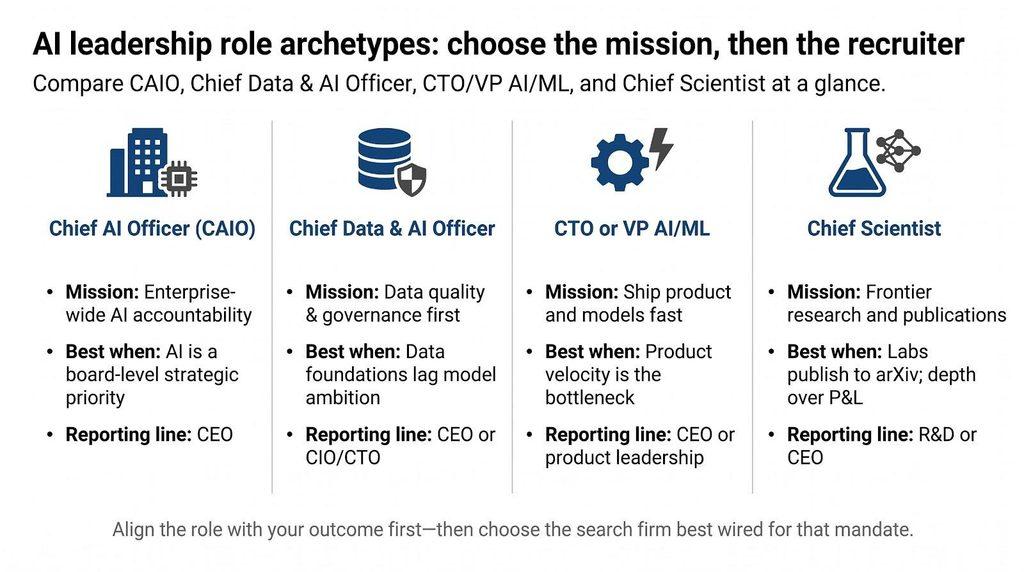
- Chief AI Officer (CAIO): Enterprise-wide accountability; reports to the CEO; owns capital allocation and works with the CFO and CISO.
- Chief Data & AI Officer: Best when data quality and governance outrank model innovation.
- CTO or VP AI/ML: When product velocity is the bottleneck, a hands-on builder often moves faster than adding a new C-suite layer.
- Chief Scientist: Research-heavy labs that publish to arXiv need peer-recognized technical gravity more than P&L ownership.
Each mandate shifts the recruiter pool. SPMB and Riviera excel at product-engineering roles; Heidrick shines when governance and board visibility matter; True is ideal for a first anchor hire who will build the team.
Practical tip: Draft a one-page scorecard with success metrics, decision rights, and year-one milestones before you brief recruiters. If they can’t improve that document, keep looking; they’re pitching, not partnering.
Ten questions that expose a pilots-only search firm
Most recruiters can sound convincing on a capabilities call. To separate storytellers from shippers, ask every firm the same ten questions and grade the answers side by side.
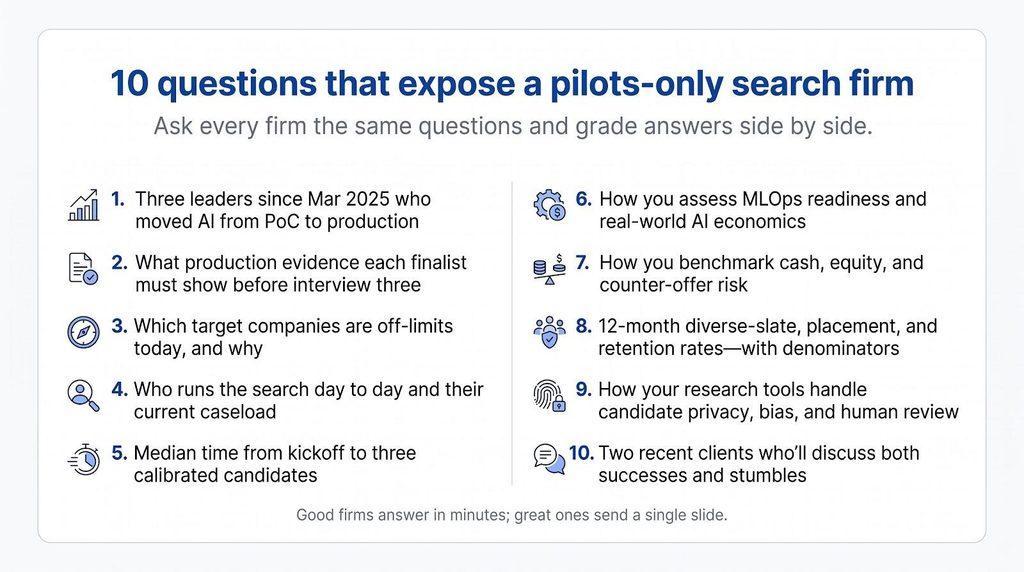
- Which three leaders have you placed since March 2025 who moved AI from proof of concept into production?
- What production evidence will each finalist need to provide before interview three?
- Which target companies are off-limits because of existing clients or prior placements?
- Who will run the search day to day, and how many active assignments does that partner handle right now?
- What is your median time from kickoff to three calibrated candidates?
- How do you assess MLOps readiness, monitoring, and real-world AI economics?
- How do you benchmark cash, equity, and counter-offer risk in today’s AI market?
- Over the past 12 months, what were your diverse-slate, placement, and 12-month retention rates (please include denominators)?
- How do your research tools manage candidate privacy and bias, and where does human review step in?
- Name two recent clients willing to discuss both successes and stumbles on a comparable search.
Good firms answer in minutes; great ones send a single slide. Late, vague, or defensive replies signal an expensive detour you can happily avoid.
How to verify that an AI executive has shipped
Great recruiters narrow the field, but you still need to confirm every claim. A polished deck proves nothing unless the candidate turned code into cash.
During the interview, ask each finalist to walk you through one production deployment:
- Business problem and why AI was the right tool
- Baseline vs. final metrics, and who verified the change
- Data readiness and ownership hurdles they overcame
- Production architecture, monitoring, and incident handling
- Adoption tactics that moved users from “interesting” to “indispensable”
Listen for specifics: numbers, systems, and names. Vague answers usually signal pilot purgatory.
References seal the deal. Gather a full 360° view:
- Product or engineering peer who saw the trade-offs
- Business stakeholder who owned the KPI lift
- Direct report who experienced the leadership style
- Risk, legal, or security partner who tested governance under pressure
All four voices should describe the same reality. When the stories align, you’ve found an operator who delivers, not just a visionary who talks about value.
Fees, timelines, off-limits, and guarantees
Fees
Retained search typically costs one-third of expected first-year cash compensation, paid in thirds at kickoff, shortlist, and offer. Some firms include equity in the base; others don’t. Ask for the exact formula in writing and whether research, travel, or assessment tools add extra charges.
Timelines
Break the clock into: 1) role calibration, 2) market mapping, 3) first calibrated slate, 4) finalist assessment, and 5) close. Ignore the average “time-to-fill” metric; client pauses can skew it. Track:
- Days to first calibrated candidates
- Days from finalist stage to accepted offer
High performers publish both.
Off-limits
These rules protect you from being poached but also shrink your candidate pool. Request the current list before you sign. If more than 30 percent of ideal targets are blocked, keep shopping.
Guarantees
Standard is a replacement search at no additional fee if the hire leaves or is let go for performance within the first 12 months. Clarify exclusions; restructures, relocation refusals, or comp changes often void the promise. Ask what percentage of placements the firm has replaced in the past two years; lower is better than a generous guarantee never used.
Lock down these four points early and you’ll avoid most invoice and timing disputes. That frees everyone to focus on the only metric that matters: a leader in seat, shipping production AI.
Red flags when evaluating “top” AI executive recruiters
Spot these early and you’ll save months of polite frustration.
- Title confusion. If the firm can’t distinguish a research leader from a platform architect, expect a flood of mismatched résumés.
- Vanity metrics. LinkedIn followers and database size say nothing about credibility; ask for time to first calibrated slate, backed by numbers.
- Too-good speed promises. “Twelve perfect candidates in ten days” usually hides a spray-and-pray approach; quality shortlists are small and hard-won.
- Shallow assessment. If no one can explain how they score governance, MLOps, and cost control, risk sits ahead.
- Statistical fog. “Forty percent diverse placements” is meaningless without denominators and role level; transparent firms publish both.
Treat any one of these as a potential deal-breaker, because recruiters who miss the basics rarely land leaders who move AI from concept to cash.
Frequently Asked Questions
What is the best executive search firm for AI leadership roles?
It depends on your situation. Early-stage startups lean toward SPMB or True; global enterprises favor Heidrick; frontier AI builders gravitate to Riviera; cross-industry transformers look at ZRG. Match the firm to your mandate, then test evidence, not marketing copy.
How do AI executive recruiters find passive candidates?
The top search partners work relationships, not just databases. They track researchers by paper citations, monitor GitHub activity, attend invite-only meetups, and call investors, ex-bosses, and board members for back-channel referrals. Gen-AI sourcing tools speed the mapping, but trust opens the door.
Does every company need a Chief AI Officer?
No. Ownership matters more than title. In some firms the CTO or CDAO already owns AI at scale. Hire a CAIO only when enterprise-wide accountability, capital allocation, and governance demand a dedicated seat at the table.
How long does an AI executive search take?
Plan on 12 to 18 weeks from kickoff to accepted offer, assuming the role is scoped and compensation ranges are firm. The fastest metric to watch is days to first calibrated slate; great firms hit that inside 30 to 45 days.
What should a recruiter assess beyond technical skill?
Production economics, risk controls, adoption tactics, change leadership, and team-building chops. A brilliant model that never scales is just an expensive science project.
Can AI recruiting software replace a retained search firm?
Software excels at mapping and first-pass outreach. It still struggles with mandate calibration, confidential persuasion, reference triangulation, and offer closing. Treat tools as accelerators, not substitutes.
What evidence should we request before signing a retainer?
Comparable placements since 2025, partner caseload, off-limits list, sample scorecard, median days to slate, acceptance and retention rates, diversity denominators, and two referenceable clients. Accept nothing less.
With those answers in hand, you are ready to move from curiosity to confident action.
Conclusion
The firms above earn their place on one test: leaders who have shipped AI into production, not pilots. SPMB, Heidrick and Struggles, True Search, Riviera Partners and ZRG each pass it for a different kind of company, and the fit section tells you which. Choose the role before the recruiter, run the ten questions on every shortlist, and verify the production claims yourself before the offer goes out.