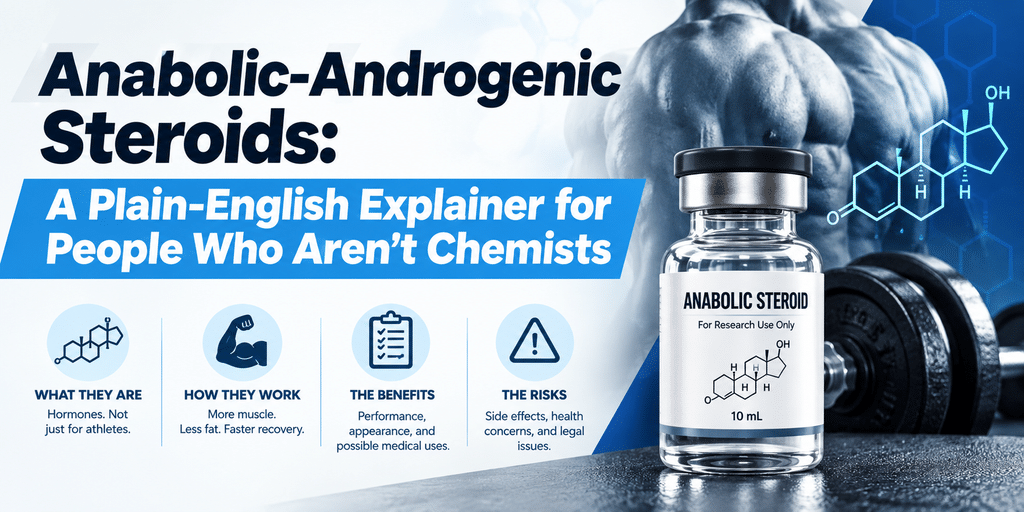
Anabolic-Androgenic Steroids: A Plain-English Explainer for People Who Aren’t Chemists
Guest contribution. The author writes about drugs, sport and public health. This article is editorial commentary, not medical advice. If you have a question about your own health or medication, that is a conversation for a clinician.
Most writing about anabolic steroids falls into one of two camps. There is the clinical literature, which is precise, dense, and written for people who already know the vocabulary. And there is the marketing, which is confident, simplistic, and written to sell something. Between the two sits a large number of people who want a straight answer to a simple question and cannot find one.
This is that answer, in ordinary language: what the term means, who actually uses these drugs, what the research says about the risks, and where the genuine uncertainty sits. It is deliberately not a how-to, and there is no dosing information in it — that belongs to a clinician, not an article.
What the words mean
The full term is anabolic-androgenic steroids, usually shortened to AAS, and the two halves describe two different families of effect that the same molecule produces.
Anabolic means tissue-building. Androgenic means masculinising — voice, body and facial hair, skin, prostate, and the feedback signal that tells the body to stop making its own testosterone.
Every drug in this class does both, in some proportion, and that proportion is what the marketing has spent forty years arguing about. A compound described as “highly anabolic, mildly androgenic” is making a claim about a ratio measured in animal assays decades ago, where the growth of one muscle was compared against the growth of a prostate in rats. The figure has been repeated so often that it now reads as a product specification. It is closer to a marketing number, and the androgenic effects scale with dose across the entire class regardless of what the ratio says.
The related phrase anabolic hormones simply refers to hormones that build tissue. Testosterone, growth hormone and insulin are the body’s own. They are not exotic; they are the normal signalling that maintains muscle, bone and organ tissue, which is exactly why interfering with them has consequences beyond the gym.
Why people use them
The reasons are less mysterious than the moralising suggests, and understanding them is necessary to talking about the risks sensibly.
The dominant motive is appearance, not sport. Muscle growth and fat loss are the outcomes people are buying, and the physique standards that drive demand are set by images rather than by competition. For a smaller group — competitive bodybuilders, strength athletes, and people in sports where size and recovery matter — the motive is performance and the culture of the sport is a powerful influence. A third group uses them for recovery from injury or because they believe, sometimes correctly and sometimes not, that their natural testosterone is low. That demand is what an anavar for sale in usa listing is really aimed at, which is why the marketing in this category is written for appearance rather than for any clinical indication.
It is worth saying plainly that all of these are ordinary human motives. The interesting questions are not about why people want the result, but about what they are told it will cost them — which is usually less than the evidence supports.
Who actually uses them
Prevalence estimates vary with how the question is asked, and the honest summary is that use is uncommon in the general population and common in specific subcultures.
Large-scale analysis puts lifetime use among men at roughly 3% in the general population, with lower figures among women. In the gym-going and bodybuilding population the numbers are an order of magnitude higher — a recent meta-analysis put prevalence in the bodybuilder subgroup at around 17%. The pattern that emerges from the age-of-onset data is that AAS use typically begins later than most illicit drug use, in the early-to-mid twenties rather than in adolescence, and that many users are otherwise employed, educated and not involved with other drugs.
That last point matters for how the risk is discussed. This is not a population at the margins. It is a population that reads about health, trains deliberately, and often believes it is managing the risks — which makes the quality of the information available to it a public health question rather than a moral one.
What the evidence says about harm
Here the picture is clearer than the internet suggests, and worse than the marketing admits.
Cardiovascular effects
This is the best-documented and most serious area. A large 2025 cohort study published in Circulation found a strong association between AAS use and cardiovascular disease, including a substantially elevated risk of heart attack. That followed an earlier American Heart Association review of cardiovascular toxicity in illicit AAS users, which documented structural changes to the heart — notably left ventricular hypertrophy, a thickening of the heart muscle — along with raised blood pressure and adverse changes to cholesterol, specifically lower HDL and higher LDL.
The mechanism is not subtle. These are changes to the organ doing the pumping, and the effect on blood lipids is the opposite of what cardiovascular prevention aims for. Because the changes develop silently and reversibly-ish rather than acutely, they are easy to ignore during use and difficult to ignore a decade later.
Hormonal effects, including after stopping
Exogenous androgens suppress the body’s own testosterone production through negative feedback. That part is predictable and well understood. What is less widely appreciated is what happens when use stops.
Two frequently cited studies are worth knowing. One found that long-term AAS users who had discontinued use showed prolonged hypogonadal symptoms — low testosterone effects persisting well beyond the expected recovery window. Another, a case-control study, found decreased testosterone levels and hypogonadal symptoms in former users years after cessation. A more recent review of recovery suggests that most people do recover, with testosterone normalising over months and gonadotropin function within three to six months, while a meaningful subset experiences prolonged hypogonadism.
The honest reading is: recovery is the norm, it is slower than most users expect, and it is not universal. The phrase “it comes back” is usually true and occasionally false, and there is no way to know in advance which group you would be in.
Liver effects
Not all AAS carry the same hepatic risk, and the distinction is structural rather than a matter of dose. Almost all oral anabolic steroids are modified with a chemical group that lets them survive digestion, and that same modification is what places the load on the liver.
This is the clearest case where a widely repeated belief is simply wrong: oral AAS are not gentler than injectables because the doses are smaller. The dose is smaller because the compound is more bioavailable by that route. The liver is doing the work of that difference.
Psychological and other effects
Mood changes, irritability and aggression are widely reported and remain genuinely contested in the literature — study designs struggle to separate the drug from the personality and the context. Dependence is better documented than most people assume, with withdrawal characterised by low mood, fatigue and loss of libido. Acne, hair loss in genetically predisposed individuals, and breast tissue growth from oestrogen conversion are also well recognised.
The legal picture, briefly
In the United States, anabolic steroids are Schedule III controlled substances under federal law, and possession without a valid prescription is illegal. The United Kingdom places most of them in Class C of the Misuse of Drugs Act, where possession is an offence. Australia, Canada and most of the European Union operate prescription-only regimes with their own penalties, and the detail varies enough that “is it legal” has a different answer in each. In competitive sport, use is prohibited by the World Anti-Doping Agency, and detection windows for some compounds extend months beyond the point at which any effect has worn off.
One distinction gets lost in all of this, and it matters. Prescribed testosterone therapy is a legitimate medical treatment for clinically diagnosed hypogonadism, supervised by a clinician, at doses intended to restore normal levels rather than exceed them. Non-medical use is a different practice with different doses, different compounds and a different risk profile. They share a molecule and almost nothing else, and collapsing the two — in either direction — produces bad arguments on both sides.
Because these compounds cannot be sold lawfully as medicines without authorisation, a large share of the market sells them as research materials with a “not for human consumption” label. That label is a legal position, not a quality statement — and it means the identity, purity and sterility of what is in the vial has been verified by nobody. Listings that invite you to buy steroids online under that label are selling an unapproved product, and the label is doing legal work rather than quality work.
Why the research is thinner than you would expect
A reasonable person might assume that drugs used by millions would be thoroughly studied. They are not, and the reasons are structural.
There is no manufacturer funding long-term safety research on compounds whose medical use is narrow and whose main market is non-medical. Clinical trials in this area run into ethical and legal obstacles. Users are a hidden population who often do not disclose use to their doctors, so the natural history of long-term use has to be assembled from relatively small cohorts followed over years. And the published literature is dominated by studies of high-dose, long-duration users, which tells you a great deal about the extremes and rather less about the median.
The result is a field where the direction of the serious risks is well established — cardiovascular disease, hormonal suppression, hepatic injury with oral compounds — while the dose-response relationship, the individual variation and the long-term prognosis remain genuinely uncertain. Anyone who tells you the science is settled, in either direction, is describing their position rather than the evidence.
There is a measurement problem on top of all that. Prevalence surveys rely on people disclosing illegal drug use to a researcher, which produces systematic under-reporting, while clinical cohorts recruit from the people who present to doctors — which over-represents the ones who have problems. Both distortions are well known and neither is fully correctable, which is why every figure in this article comes with a range rather than a number.
The vocabulary problem
The language around these drugs does a lot of quiet work, and it is worth decoding before you read anything else about them.
A “cycle” is a defined period of use, and the word carries an implicit claim that the practice is bounded and planned. “Blast and cruise” describes an approach with no off-ramp at all, dressed in terminology that sounds like a training programme. “Post-cycle therapy” names a recovery protocol for a problem the cycle created, and it has acquired a reputation for reliability that the withdrawal research above does not support.
The most consequential misuse is “TRT”. Testosterone replacement therapy is a specific clinical intervention for diagnosed hypogonadism, with monitoring and a target range. The term has been stretched to cover doses far above replacement levels, which blurs the distinction made earlier in this article and makes a medical-sounding frame available to a practice that is not medical.
For anyone who ends up in a consulting room, the practical point is that precision helps. A clinician can work with “I have used testosterone enanthate for eight months at a dose I sourced myself”. They cannot do much with “I’m on TRT”, because it describes two very different things and only one of them is being monitored. The same precision applies to provenance: a pharmacy prescription and a testosterone enanthate for sale listing differ in more than price, and only one of them tells a clinician anything.
Four beliefs worth retiring
“It’s basically just testosterone.” Testosterone is the reference compound, and it is still a Schedule III drug with cardiovascular and endocrine effects. Being the baseline does not make it benign.
“Orals are milder.” The opposite is closer to true for liver load, for the structural reason described above.
“Recovery always happens after you stop.” Usually, over months, and not always. The studies above are the reason that “usually” is doing real work in that sentence.
“Everyone knows someone who used for years and is fine.” They may well be. Cardiovascular changes are largely silent, so “fine” in this context usually means “no symptoms yet”, and the cohort studies are measuring what symptoms cannot show.
What harm reduction actually looks like
This article does not encourage use, and there is no version of it that should. But the evidence that people use these drugs regardless is overwhelming, and the pragmatic question is what reduces damage among people who do.
The clinical answer is straightforward, if unglamorous: monitoring rather than guesswork. Blood pressure, blood lipids, liver function and testosterone are the markers a doctor would want to see, before and during and after. Cardiovascular risk is not something a user can feel, which is precisely why it needs measuring. And any unexplained chest pain, breathlessness or palpitations during or after a period of use is a medical emergency rather than something to monitor at home.
The other piece is disclosure. Because the compounds are unapproved and often bought online, a clinician who does not know they are being used cannot factor them into anything — and the patient who conceals use to avoid a lecture is the one who ends up with a workup that misses the actual cause.
Where to read more
The specific terminology — how the different esters behave, what the family names refer to, what the numbers on a product listing actually mean — is covered in more detail in this plain-English overview of anabolic steroids, which is the closest thing to a plain-language reference on the vocabulary.
For the clinical side, the Circulation cohort study and the American Heart Association review cited below are both readable by a non-specialist, which is not something that can be said of most of this literature.
The bottom line
Anabolic-androgenic steroids are a class of prescription medicines that build tissue and masculinise at the same time, used by roughly 3% of men at some point in their lives and by something like five times that proportion of bodybuilders. The serious risks are documented and cardiovascular in nature, the hormonal consequences outlast the period of use more often than users expect, and the long-term prognosis for typical — rather than extreme — use is genuinely under-researched.
The information environment around them is worse than the drugs. Marketing undersells the risks, scare coverage overstates the certainty, and the people in the middle are left to assemble an understanding from a vendor page and a forum thread. Reading the cohort studies is dull. It is also the only place the answer actually lives.