AI Landscaping Design in 2026: From Trendy Renders to Yard-Ready Planning On AI-Yard-Design.com
Two years ago, “AI landscape design” was easy to dismiss: slick images, fragile demos, and outputs that ignored real constraints. In 2026, the useful part of the category is narrower and more honest: tools that help people compare directions early, share a visual everyone recognizes, and iterate before hardscape and planting commitments get expensive. The real question is no longer whether AI can decorate a yard—it is whether it can keep you anchored to your slope, your boundaries, your climate, and your maintenance reality. Outdoor projects still fail where they always have: misalignment. Families debate in adjectives. Contractors ask practical questions that expose missing decisions. Nurseries hear “modern” or “low maintenance” without an image that maps to spacing, mature size, and water needs. Late clarity buys rework.
What “mature” AI landscape design looks like now
Across the serious end of the market, a few patterns show up again and again: Photo-grounded workflows. Credible tools start from a real outdoor photograph—or a sample used to learn the interface—because yards are not abstract. They are constrained by the house relationship, property edges, mature trees, existing paving, circulation habits, and sun you already know from living there. Zone-aware briefs. Front yards, backyards, patios, side yards, gardens, and pool surrounds imply different priorities. Products that collapse everything into one generic “garden” button produce generic confusion. Layered refinement. Outdoor design moves in passes: circulation and hardscape logic, planting structure, accents. Tools that only “regenerate from scratch” waste the user’s time. Scale honesty. A home lot is not a campus. Residential visualization should not pretend to be urban planning. None of this replaces drainage thinking, permitting, or professional construction documents. The value is front-end clarity: fewer expensive misunderstandings while you still have room to pivot.
AI Yard Design Studio in that context
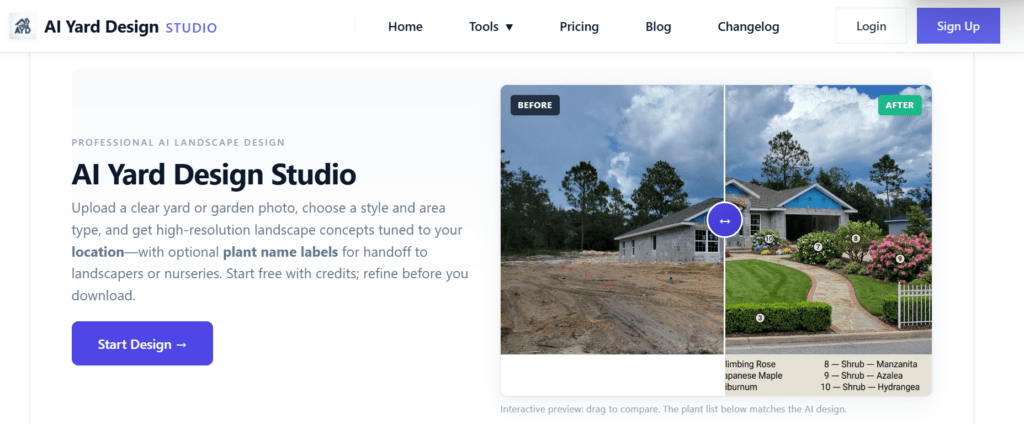
AI Yard Design Studio is built for that practical definition: AI landscape design that starts from your yard or garden photo, organizes choices by outdoor zone, and supports fine-tuning so you can adjust layers instead of throwing away a mostly-right concept. On the residential side, you upload a contextual image, choose the area you are improving, set a coherent design direction, add optional elements, and write additional requirements the way you would brief a professional—privacy screening, pet paths, maintenance tolerance, what must be preserved, and what you refuse. Optional location context steers planting palettes and materials toward outcomes that feel more appropriate where you live. Treat it as a realism lever, not a guarantee: invasive risk, mature size, winter hardiness, and nursery availability still need human verification. After generation, fine-tuning helps you adjust pathway materials, planting emphasis, common outdoor amenities, and targeted edits through custom instructions—matching how real projects evolve.
Specialty lanes: why backyards deserve a dedicated workflow
A common mistake in AI landscape design is treating a backyard like a single generic “garden mood.” Backyards are living infrastructure for a household: dining, play, pets, gathering, storage paths, shade, and the quiet politics of who gets which corner of the lawn. That is why a dedicated backyard entry point matters. When your primary job is how the rear yard functions—not curb appeal, not a narrow side corridor—you get better prompts and more relevant layouts by starting with AI backyard design on the AI Backyard Design Generator: choose the function that matches real life (outdoor dining, fire pit and gathering, play, pet-friendly zones, and more), add optional natural and built elements, include location when climate-appropriate planting matters, then generate and refine. The same studio still supports other residential lanes—front yard, patio and terrace, side yard, garden retreat, pool surrounds—so users are not forced through the wrong front door for the wrong problem.
Large-scale landscape: same brand, different scale
When the project is bigger than a home lot—parks, campuses, commercial grounds, streetscapes—AI Yard Design Studio points users to a large-scale AI landscape workflow. The goal is brief accuracy: a backyard refresh should not be hacked through a site-scale tool, and a public realm study should not be forced through a residential backyard form.
What responsible tools still won’t claim
Even as models improve, the category has limits worth stating:
- Site truth (drainage, compaction, utilities, codes) still belongs to people who walk the property.
- Plant labels on images are for conversation starters, not authoritative IDs.
- Style without constraints still produces pretty ambiguity—briefs beat vibes.
Products that say this plainly tend to earn more trust—and drive better outcomes—than products that imply a render is a permit.
A practical workflow for your next session
- Photograph the space with honest context—edges, trees, paving, house relationship.
- Pick the correct lane: use AI backyard design when the rear yard’s function is the core problem.
- Write requirements like a brief: non-negotiables, refusals, maintenance reality.
- Add location if plant believability matters.
- Run Quick preview to compare directions; use Best quality when you need a sharper shareable concept.
- Fine-tune in layers and verify assumptions with local expertise.
Conclusion: the state of the art is alignment, not automation
AI landscape design in 2026 is less about instant miracles and more about speed of agreement: turning outdoor goals into visuals people can point at, critique, and refine while changes are still cheap. AI Yard Design Studio fits that moment with photo-grounded generation, zone-aware residential workflows, a dedicated backyard function-first path, staged quality, transparent credits, and honest separation between home-scale work and large sites. If you start with a truthful photo, choose the right lane—including AI backyard design when the rear yard is the project—and iterate deliberately, you are using the category where it actually helps: not replacing your yard, but helping you see it clearly enough to improve it.