A CLASSIC ROCK TRUE STORY
The stories that fill classic rock memoirs often begin with famous names, backstage encounters, and the excesses of the music business. Ira Blacker’s story began much more simply, with small promotions, hustling for opportunities, and the realization that he could draw a crowd.
One night in 1962 at the Golden Slipper in Glen Cove, L.I., New York, what was supposed to be Blacker’s first event turned into a packed house, with over twelve hundred people paying to get in. That was the first time he understood that he could build something, organize something, and make it work on a scale that got people’s attention. Even his father, who rarely approved of anything he did, stood there in disbelief at what his son had pulled off.
That night changed the way Blacker looked at his future. He wasn’t just promoting an event anymore. He was beginning to understand what was possible.
FROM HUSTLE TO CONTROL
Things moved quickly after that. Blacker went from promoting events to managing bands, and one of his first serious moves was taking on The Emeralds, whom he had just arranged to perform at the Silver Knight in Hewlett, L.I., New York.
When, in 1964, the Silver Knight, where Blacker was promoting shows and buying talent, got shut down overnight, padlocked, with its assets seized and the whole operation gone, he had a decision to make. He could walk away, or he could figure out how to keep the band and himself working.
Blacker sat down with the musicians and told them that if they didn’t have a place to play, he would find them one. And that’s what he did.
He went from club to club, selling the band, making deals, and learning how to keep things moving when circumstances were working against him. There was no instruction manual, no established structure to fall back on, and nobody waiting to explain how the business worked. The lessons came from doing the work, and sometimes from getting his head handed to him.
What started as a hustle was turning into a career. Blacker was learning that knowing how to make a deal was important, but knowing how to keep one alive when everything went wrong was just as valuable.
LIFE AMONG THE PROS AND THE SHARKS
For Blacker, stepping into Associated Booking Corporation was like walking into the major leagues without a helmet.
This wasn’t the scrappy world of local promotions anymore. The players were seasoned, the money was bigger, and the consequences were real. He was suddenly operating among people who had spent years making deals, building careers, and protecting their positions.
It was also a world where established professionals, hustlers, and mob-connected players shared the same air. Blacker soon became acclimated and, after only a few weeks, had become the most prominent agent working there. He was setting a rate for bookings beyond the other agents, and his first two signings were Rod Stewart and the Faces, and Savoy Brown.
Not every deal followed a conventional path. Understanding who was on the other side of the table could be just as important as knowing what was being negotiated. A conversation might sound perfectly ordinary, but the real meaning could be in what wasn’t being said.
Reading people was essential. Blacker had to understand leverage, recognize when the balance of power was shifting, and know when to speak and when to keep his mouth shut. He wasn’t intimidated. He found his footing quickly.
The mob and rock personalities were larger than life, but Blacker came to understand that the music business wasn’t simply about talent, records, concerts, or even money. It was about relationships, timing, influence, and the ability to navigate a room full of people who didn’t necessarily want the same thing. And sometimes those people had very different ways of getting what they wanted.
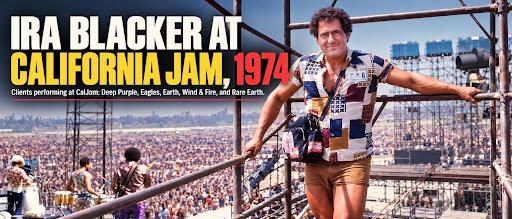
After three and a half years at ABC, Blacker left with Rod Stewart and the Faces, Savoy Brown, and his other clients to found American Talent International, where he also represented Deep Purple, the Eagles, ZZ Top, and many other major rock acts.
THE BUSINESS BEHIND THE ROCK AND ROLL
People love to talk about sex, drugs, and rock and roll as though that explains the entire industry. It doesn’t. Those things were certainly part of the landscape, but they weren’t what made the business run.
Behind the stage lights and famous faces was an entirely different world. Careers were being shaped through negotiations, personal relationships, calculated risks, and decisions that audiences would never know had taken place. Some of the people involved were brilliant professionals. Others were sharks. A few managed to be both.
The longer Blacker worked in that environment, the more he understood that success wasn’t simply a matter of representing the right act or negotiating the biggest deal. It meant knowing the people, understanding their motivations, and recognizing that the person with the most impressive title wasn’t necessarily the one holding the power.
The music was what brought everybody together. The business was what determined where things went from there. And while the public saw the performers, Blacker was learning what happened in the rooms where decisions were made, opportunities were created, and fortunes could change direction in a single conversation.
Looking back, it wasn’t the famous names alone that made those years extraordinary. It was the people behind the names, the deals nobody saw, and the peculiar collection of characters who helped shape rock and roll history.
That’s the part of the story that has always interested Blacker most. Not just who was onstage, but who was making things happen behind it.
And if there’s anything worth preserving in a classic rock memoir, Blacker’s own story, told in Once A King, Now A Prince, demonstrates that it’s what really went on when the music stopped and the business began.