Why your face looks more symmetrical in some photos
In one selfie, your nose looks centred. Swipe to the next and the tip seems a little to one side. One cheek looks wider, too. A slight turn of the head can do both, even when your eyes stay level and you’re looking into the lens.
Watch what happens to the nose
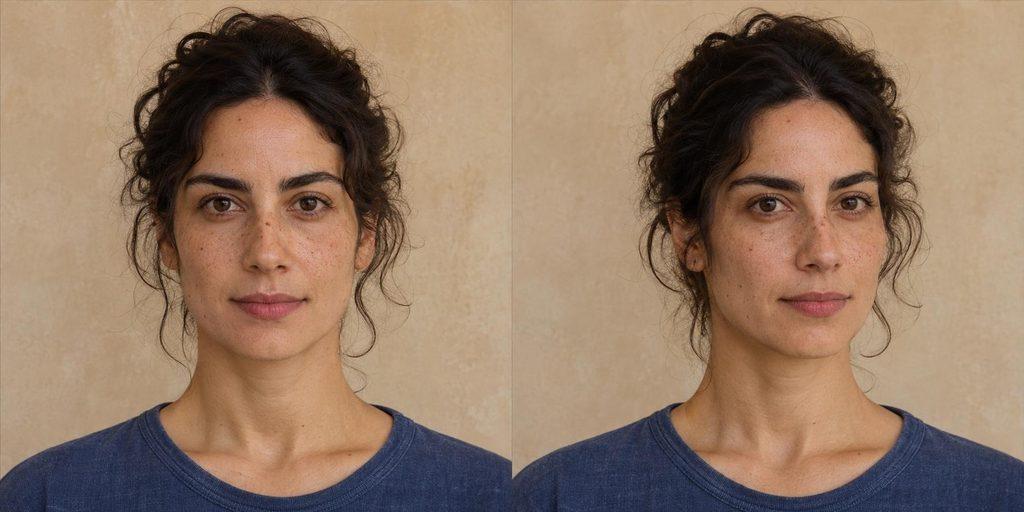
In the portrait on the right, imagine drawing a vertical line down from each outer eye corner. Where does the tip of the nose fall between them? Now look at the portrait on the left. Your nose sits forward of your eyes, so a sideways turn shifts its position against them in a flat picture. Rotating the finished photo in your editor can level the eyes, but it can’t bring the far cheek back into view.
Researchers at the University of Dundee tested this effect with five volunteers. They photographed each person straight on and at angles up to 20 degrees on either side, then estimated where the upper front teeth lined up with the middle of the face. The farther people turned, the larger the measurement errors generally became.
What a small turn changes
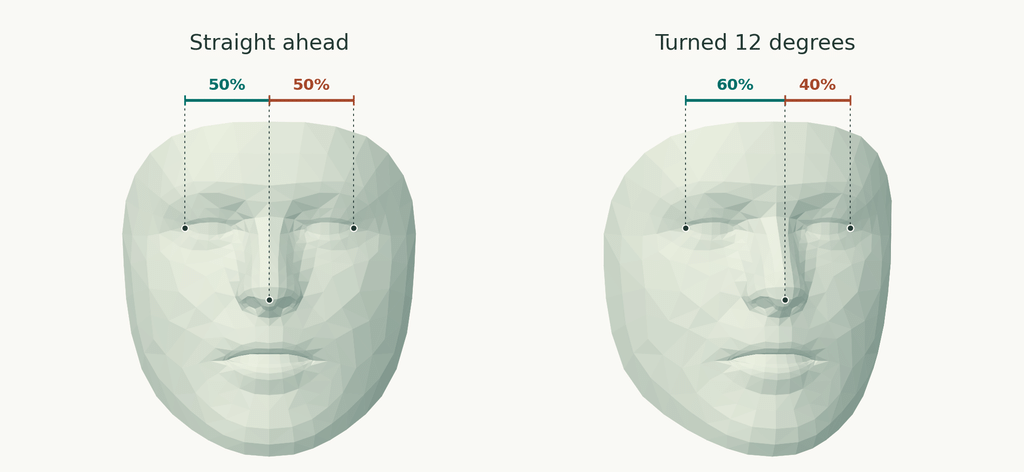
To isolate the effect of angle, we turned a single 3D face model 12 degrees and kept the virtual camera still. Seen head-on, its nose tip fell halfway between its outer eye corners. After the turn, the nose sat about 60% of the way across that same span. Only the viewing angle changed.
Try it with two photos
Prop your phone at eye level about a metre away and set the timer. Face a window for even light, tuck back any hair covering your cheeks and switch off beauty filters. Keep the phone in the same spot for both shots.
For the first photo, point your nose at the lens. For the second, keep your shoulders still and turn your nose a little towards one shoulder, as though you’ve just begun to shake your head. Keep the same expression. Swipe between the two pictures and watch one thing at a time, first the nose tip, then the outline of the far cheek.
You can compare the two images one at a time with GlowUp Face’s facial symmetry test. Compare the centreline reading, which describes how the forehead, nose and chin line up in each picture. If the overall scores are close, check the marks around the nose on the tool’s map. A shift you can see in one feature may make little difference to the whole-face score.
Which photo should you keep? If you’re showing a brow stylist where an arch seems uneven, send the straight-on shot so they can see both sides from the same angle. For a profile picture, you might like the way the turned shot brings one cheekbone into the light. That’s a good reason to keep it.