The hidden variables behind RF microneedling treatment results
A smoother cheek in a clinic photo can be tempting when you’re considering RF microneedling. Your goal might be softer edges around acne scars, while someone else wants less visible fine lines or firmer skin along the jaw. Even when two people describe the same concern, their skin and treatment histories can leave them looking for different changes.
In a clinic’s before-and-after gallery, “results” might mean a tighter feeling, a change the clinician measures, or a shadow hidden by the lighting. When a photo catches your eye, find out what changed and how it was assessed. Bring your own concern to the consultation, along with your treatment history, and agree on a realistic improvement you can track.
Start with the change you want
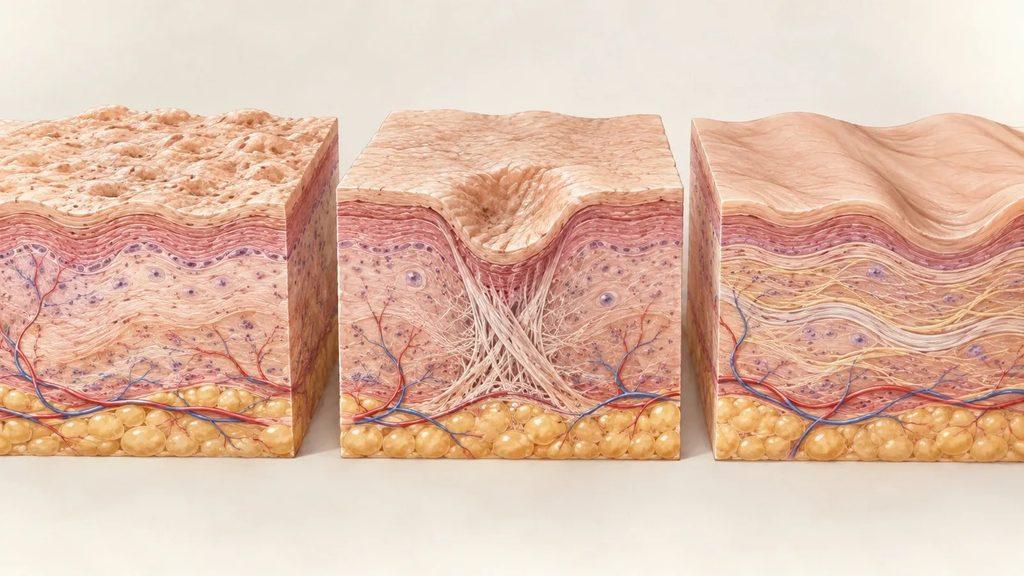
Conceptual illustration of surface roughness, a depressed acne scar, and mild skin laxity.
When you say “uneven skin,” show the clinician exactly what you mean. A flat mark left by acne is a change in color. An indented scar is a change in skin structure. Surface roughness and mild looseness need different assessments, too. Have the clinician name the concern and explain which change they will track.
Professional RF microneedling devices use needle electrodes to deliver radiofrequency energy and heat tissue in and under the skin. Your clinician should explain why this approach suits the problem you’ve described. If mild looseness is your concern, they also need to consider whether changes in deeper facial volume help explain what you see.
Responses differed by scar type in a 2022 study by Fusano and Bencini. The researchers treated 11 patients with atrophic acne scars over four monthly sessions and assessed them one month after the final visit. A study that small can’t predict your result. For your own plan, the clinician needs to identify your scar types and explain which changes they will track.
Find out what your treatment involves
Find out which device the clinic will use and what it is authorized to treat. The clinician should explain, in ordinary language, how the needle design, energy pattern, treatment depth, and area treated suit your skin concern, facial anatomy, and medical history. These details should be in your treatment plan. The trained clinician performing the procedure should choose the settings.
Discuss the risks before you agree to treatment. In its October 15, 2025 safety communication, the US Food and Drug Administration warned about reported serious complications with certain uses of RF microneedling, including burns, scarring, fat loss, disfigurement, and nerve damage. The agency advises seeking care from licensed healthcare providers trained and experienced in the procedure. You should know who will perform your treatment, what training they have, and why they recommend this approach for your skin.
Give your skin time and track the dates
Redness, tenderness, and swelling are early reactions to discuss with your clinician. Temporary swelling changes the appearance of lines and contours, which limits what a photo taken straight after treatment tells you about a lasting result. For any “after” photo, check how many days or months have passed since the last procedure. Agree on separate follow-ups to check recovery and assess the result.
In a 2024 randomized split-face study, Liu and colleagues treated 21 participants with one vacuum-assisted RF microneedling system over three monthly sessions. They evaluated the participants’ skin at one, three, and six months. Those dates describe how the researchers followed that group with that system. They don’t set a recovery or results timetable for every patient.
Your skin tone, previous pigmentation changes, and any current inflammation also belong in the risk assessment and follow-up plan. Tell the clinician about them, and review how your skin responds after each visit. If redness, pain, or swelling worsens or worries you, get a medical assessment promptly, without waiting for the planned cosmetic review.
Ask what happened between the photos
Check how much treatment took place between the photos. A first appointment, the end of a course, and a maintenance visit show different stages of care. Find out whether you’re seeing one session or a full series. Check what skincare they used during that time and whether they started a prescription retinoid, had laser treatment, or received another aesthetic procedure. When other treatments were used, you can’t attribute smoother texture or firmer contours to RF microneedling alone.
Keep your own record of session dates, other procedures and skincare, and the exact device used at each visit. Manufacturers such as Fotromed publish product information about professional RF microneedling systems, which can help you identify the equipment in your notes. Your clinician should explain the evidence for using that system in your treatment plan.
Make the photos worth comparing
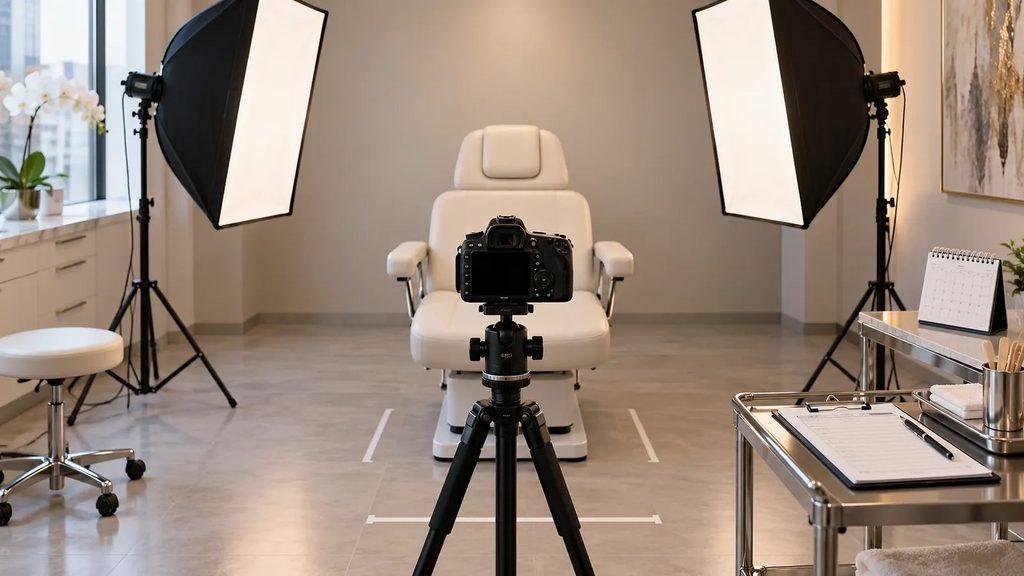
A fixed camera position and consistent lighting make follow-up photographs easier to compare.
Strong overhead or side lighting casts deep shadows inside depressed acne scars. In soft light from the front, the same indentations can look much shallower. A slight chin tilt, a closer camera, a small smile, or a little makeup can also make texture look smoother or mildly loose skin look firmer. A photo can be genuine and still be hard to compare with another taken under different conditions.
For their 2025 paper on standardized facial photography, Zheng and colleagues kept the lighting, camera distance, and head position consistent. They used a tripod and required participants to remove makeup. The authors also noted that assessing skin texture and contour needs brighter, more diffuse lighting than they used in their head-positioning tests.
Look for the same light direction, camera distance, head angle, and expression in the clinic photos you’re shown. Both should show bare skin. Matching conditions help you see what changed, though the images alone can’t establish which treatment caused the change.
Conclusion: agree on a plan before you book
Before you book, ask for a short written plan that names your skin concern and the improvement you’re aiming for. It should explain the proposed treatment and its risks, and when and how you’ll review progress. Your starting skin condition, the procedure itself, healing time, and other treatments all affect how you judge the result. Matching photographs give you a more useful record of any change.
Have the clinic take baseline photos before your first session. At follow-ups, use the same lighting, camera distance, angle, and expression. Record other procedures and skincare along the way. Then you and the clinician can compare what has changed with the goal you agreed on and decide whether to adjust the plan.