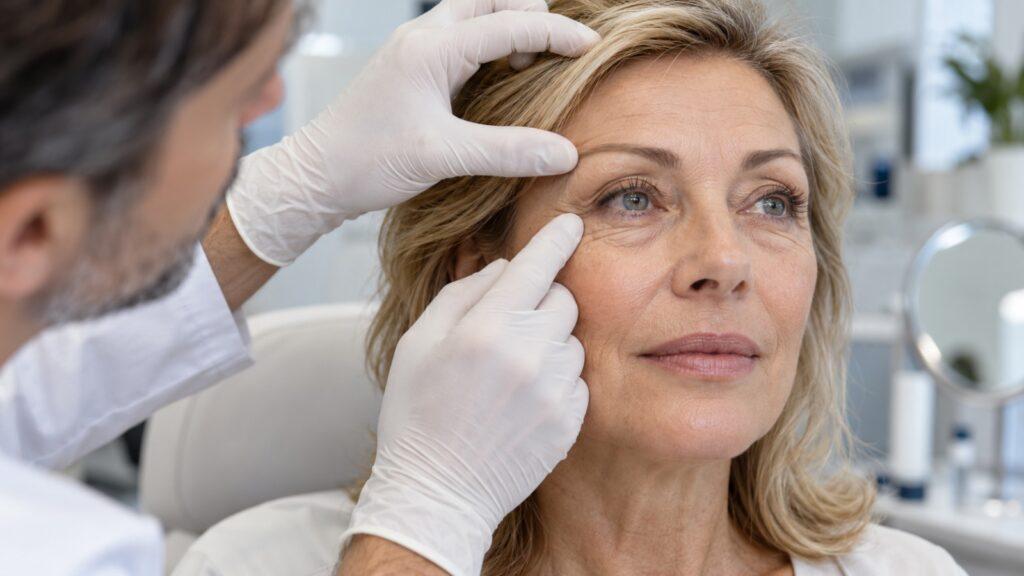
Blepharoplasty and Aging: Understanding Changes Around the Eyes
The eyes are almost always the first place anyone notices a change, and usually the first place we notice it on ourselves. Not dramatically, and rarely overnight. It arrives as a sense that photographs have started to read differently, or that a face in the mirror at the end of a long week looks a little further along than it used to. Understanding what is actually happening there makes the whole thing considerably less unsettling.
It is also worth knowing that these changes are measurable rather than purely subjective. The American Academy of Ophthalmology identifies superior visual field loss of at least 12 degrees, or 24 percent, as a threshold at which upper eyelid surgery is likely to improve vision. In Henderson, this distinction helps clarify the difference between looking tired and experiencing measurable visual impairment.
Why the Eye Area Changes First
Two pieces of anatomy explain almost all of it, and neither has much to do with how well you have looked after yourself.
The Thinnest Skin You Own
Eyelid skin is the thinnest anywhere on the body, a fraction of the thickness of the skin on your cheek. It also has very little underlying fat to cushion it and sits over a muscle that contracts every few seconds for your entire life. Thin, mobile, and endlessly folded is simply not a combination that holds its shape indefinitely, regardless of what you put on it at night.
Fat That Moves Rather Than Disappears
The second half is less intuitive. The small fat pads around the eye socket are held in place by a membrane that gradually weakens. The fat does not vanish, it shifts forward and downward. This is why under-eye bags often look worse in the morning or after a salty dinner, and why they are not something a cream can reach. The material causing them sits beneath the muscle, not on the skin.
What Changes, and Roughly in What Order
The sequence varies, but it tends to follow a recognisable pattern across the decades:
- Fine lines at the outer corner, often appearing first in the thirties.
- A gradual hollowing beneath the lower lid, which reads as shadow rather than a line.
- Fullness or puffiness below the eye as the fat pads drift forward.
- Loosening of the upper lid skin, which eventually rests on the lashes.
Not everyone experiences all four, and genetics decide the timing far more than lifestyle does.
Where Appearance Ends and Function Begins
Most people live comfortably in the cosmetic half of this and never need to think further. The shift happens quietly. Upper lid skin loosens far enough to encroach on the top of the visual field, and because the brain adapts, you compensate without noticing. Lifting the eyebrows to read. Tilting the chin up slightly to see a traffic light. By the time someone points it out, the habit is usually years old. That compensation is the clue, not the appearance of the lid itself.
What Surgery Addresses, and What It Leaves Alone
This is where expectations matter. Eyelid surgery removes or repositions skin and fat. It does not change pigmentation, it does not smooth fine lines on its own, and it cannot lift a brow that has descended, which is a separate matter entirely. Getting those distinctions right is really the whole job of a first consultation, and it is why that conversation matters more than people expect going in.
Anyone researching blepharoplasty in Henderson or anywhere else should expect an assessment that separates these layers before anything is recommended, rather than a quick look and a standard recommendation. Engineered Aesthetics, a practice in Henderson, Nevada, is led by Dr. Nitin Engineer, a board-certified surgeon, and that kind of assessment is exactly what a credentialed consultation is built to do.
Why There Is Less Urgency Than It Feels
Unlike a good deal of cosmetic work, this one does not reward hurrying.
- No window closes, and the changes progress slowly enough that waiting a year rarely costs anything.
- Results tend to hold for a long time, often a decade or considerably more for the upper lid.
- That durability comes down to simple anatomy: the skin removed does not grow back.
- The sensible approach is to understand what is happening and note whether you have started compensating.
From there, the decision can rest on something more solid than a bad photograph.
The Takeaway
What happens around the eyes is structural, largely inherited, and almost entirely out of your hands, which is oddly freeing once you accept it. None of it demands action on its own. But knowing the difference between skin, fat, muscle and brow turns a vague unease into a specific question, and specific questions are the ones a consultation can actually answer.
That distinction matters more than it sounds like it should, since most of the anxiety here comes from not knowing which layer is actually responsible for what you’re seeing. That is a far better position to make a decision from than squinting at your own reflection and guessing.