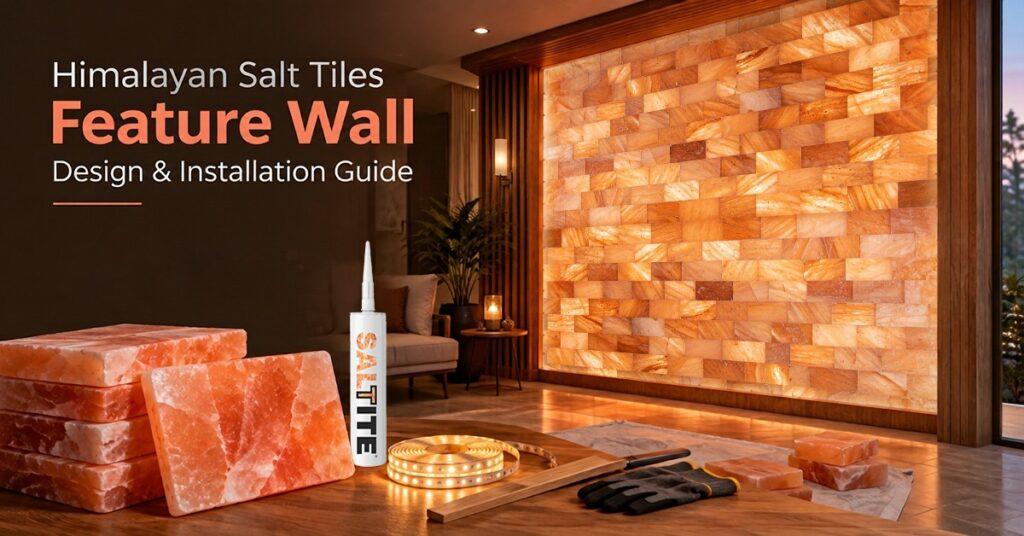
Himalayan Salt Tiles Feature Wall: Design & Installation Guide
Himalayan Salt Tiles create a distinctive decorative wall by combining natural rock salt with architectural design and, when desired, concealed LED lighting. A Himalayan Salt Tile Feature Wall is best suited to controlled interior environments where the substrate can support the material and moisture can be managed.
In this article, we will discuss, with real-world examples, tile size, weight, coverage, structural support, adhesive, installation, backlighting, moisture protection, applications, and costs.
What Is a Himalayan Salt Tile Feature Wall?
Himalayan salt tile feature walls are decorative interior walls that are made of 100% pure and natural Himalayan rock-salt tiles (usually with hidden LED light behind the tiles). The salt is the large, visible architectural surface, and backlighting can significantly amplify its natural color, texture, and translucency.
Himalayan Salt Tiles are available in a variety of sizes and thicknesses, but this varies by supplier as well, depending on the application. Pink Salt Wall now provides its regular dimensions Himalayan Pink Salt Tile at 8 × 4 × 1 inches, with a noted weight of ~2.6 lb per tile.
Himalayan Salt Tile Feature Wall Installation with or without backlighting ,the correct system is determined by tile specification, total wall load and bonding product; substrate quality, lighting design, electrical access conditions, and local environmental conditions.
How to Choose Himalayan Salt Tiles for a Feature Wall
Important factors to select Himalayan Salt Tiles for a feature Salt Wall: the wall area, Thickness, Total weight, all looks and apparent physical characteristics, system chosen (bonding system or substrate), Environment & Lighting design.
Before purchasing, verify:
● Tile length and width
● Tile thickness
● Weight per tile
● Package quantity
● Wall coverage
● Surface finish
● Natural color variation
● Edge finish
● Recommended bonding product
● Installation instructions
● Moisture limitations
● Availability
● Current price
Tile Size and Thickness
Most commonly used sizes of salt tiles that are currently listed by Pink Salt Wall are 8 × 4 × 1-inch tiles, 8 × 4 × 0.75-inch tiles, and a larger 12 × 4 × 1-inch tile. Tile size should ensure wall coverage, joint layout, installation time, and visual scale — as well as the amount of tiles required — while thickness directly relates to a dead load on walls once finished.
The most important numbers for a feature wall are tile area, quantity, coverage and weight.
For an 8 × 4-inch tile:
8 × 4 = 32 square inches
There are 144 square inches in one square foot:
32 ÷ 144 = 0.2222 sq. ft. per tile
Therefore:
1 tile ≈ 0.222 sq. ft.
and:
For the specific 8 × 4 × 1-inch tiles, the approximate tile-only quantities are:
| Quantity ( 8 × 4 × 1-inch tiles) | Approx. Coverage | Approx. Tile Weight |
| 10 tiles | 2.22 sq. ft. | 26 lb |
| 20 tiles | 4.44 sq. ft. | 52 lb |
| 50 tiles | 11.11 sq. ft. | 130 lb |
| 1,000 tiles | 222 sq. ft. | 2,600 lb |
Before ordering, confirm:
● Exact tile dimensions
● Thickness
● Weight per tile
● Package quantity
● Coverage per package
● Surface finish
● Recommended bonding system
● Current supplier specifications
Color and Natural Variation
Himalayan Salt Tiles are naturally color- and surface-varied; therefore, individual tiles should not be expected to have the same coloration, translucency, texture, or mineral appearance. Pink Salt Wall currently describes its standard tiles as having natural pink and earthy tones.
Variation may occur in:
● Pink intensity
● Orange or earthy tones
● Translucency
● Mineral appearance
● Surface texture
● Edge appearance
Where is Himalayan Salt Feature Walls Used?
Himalayan salt wall is typically utilized as aesthetic indoor features in homes, saunas/spas/wellness rooms/interior hospitality applications, and various commercial interiors where the material can be protected from excess moisture.
| Application | Typical Placement |
| Homes | Accent walls and decorative interior features |
| Home saunas | Suitable rear or side decorative walls |
| Spas | Reception and relaxation areas |
| Wellness centers | Meditation and relaxation spaces |
| Hotels and resorts | Lobby, spa, and hospitality interiors |
| Yoga studios | Decorative feature areas |
| Commercial interiors | Reception and branded feature walls |
| Salt-room interiors | Decorative wall surfaces alongside appropriate equipment |
Actually, the suitability of a location is determined by saturation levels, and condensation occurs if too much water comes into direct contact with many types of surfaces.
A decorative Himalayan salt wall should not automatically mean being called a true active salt-therapy system.
A decorative wall and professional salt therapy equipment are different components with different purposes.
How to Plan the Wall Before Installation
Planning the wall involves measuring its area, picking up the specific Himalayan Salt Tile specification for this space, calculating how many salt tiles you will need in total, and finding out approximately what total material weight they can hold — as well as other aspects such as support needs before installation, lighting, bonding, moisture control, etc.
Use this formula to calculate wall area:
Wall area = width × height
Subtract significant openings such as doors and windows where appropriate.
Before ordering:
● Measure the finished wall.
● Select tile dimensions and thickness.
● Calculate the required tile quantity.
● Calculate approximate tile weight.
● Allow for cuts and installation waste.
● Decide whether backlighting is required.
● Plan the LED cavity.
● Plan electrical access.
● Inspect the substrate.
● Determine the load path.
● Confirm the bonding system.
● Review manufacturer instructions.
● Order a physical sample when appropriate.
Dry layout provides the installer a chance to assess tile registration, jointing, color distribution, and corners/edges/cuts prior to permanent adhesion.
What Backing and Support Does a Salt-Tile Wall Need?
A salt-tile wall needs a substrate and structural support capable of carrying the complete installed load; standard drywall should not automatically be assumed to support a large Himalayan Salt Tile installation.
The reason is the material’s weight. You have approximately 2.6 lb per average Pink Salt Wall tile; 100 tiles = 260 lb before adhesive, backer, framing, fasteners, & lighting. Installation of 500 tiles looks like around 1,300 lb of salt alone.
Depending on the building and wall assembly, planning may require consideration of:
● Wall studs
● Structural framing
● Suitable backing panels
● Fastener locations
● Substrate condition
● Load distribution
● Deflection
● Lighting cavity
● Electrical access
● Maintenance access
The corresponding support method depends on the construction already built and on which salt-tile installation system it is.
Installation on large commercial, hospitality and residential walls should be considered only after a contract or qualified building professional has assessed the wall.
How to Install Himalayan Salt Tiles
Apply Himalayan Salt Tiles in accordance with directions from the tile suppliers and the bonding-product manufacturer. Typically, the sequence of operations consists of substrate preparation, pre-structural preparation, dry layout, bonding, alignment, curing, and final inspection.
A typical salt wall installation sequence is:
- Inspect and measure the wall : Ensure the substrate is clean, sound, stable, and dry.
- Prepare the backing/substrate: Install Backing or Framing
- Preparation of lighting: All LED positions, wiring paths, and access should all be in place before the wall is covered.
- Prepare to Bond: Pre-Lay the Tiles Before Permanent Bonding
- Set a level reference: Start from a precise level of baseline measurements.
- Making use of the Permitted Bonding Product: Use the Saltite adhesive recommended for installing the tile.
- Lay the tiles: Follow the layout you chose.
- Monitor alignment: Constantly check courses, joints, corners, and edges.
- Clean with caution: Carefully follow the cleaning instructions provided by the adhesive manufacturer.
- Curing: Follow curing times and conditions as specified
- Inspect: Bonding, alignment, appearance, lighting, and accessible components to inspect.
Pink Salt Wall currently sells Saltite, a transparent, low-odor, solvent-free bonding product intended for salt bricks, tiles, and blocks. Its current listed price is $28.99 per unit, with stated coverage of up to 30 salt bricks, although actual coverage can vary with application method and surface conditions.
How to Backlight a Himalayan Salt Wall
Backlighting Himalayan Salt Tiles involves an LED system mounted behind the tiles to ensure light reaches the translucent salt layer while minimizing hotspots, shadows, and uneven illumination.
The warm architectural lighting leads to warm-white LED illumination generally selected. About 2700K–3000K can be a good color temperature, but how it will look at the very end depends on many factors such as salt, type of LED used, spacing between LEDs, diffusion to the cavity, and the surface behind.
Plan:
● LED position
● LED spacing
● Lighting cavity
● Diffusion
● Backing surface
● Power supply or driver
● Wiring route
● Heat management
● Maintenance access
● Electrical requirements
The cavity depth you need is not something that a single measurement can provide. This is based on tile thickness, LED type/brightness/spacing/diffusion/backing/wall construction.
Test Section you plan to complete a big installation, do it from the test section in advance. Testing helps the installer spot hotspots, shadows, and jagged brightness beforehand so as not to have its walls permanently closed. This includes using electrical components suited for the environment and complying with relevant local prerequisites of practice.
Compatible with the environment, and maintenance should be in line with any relevant local necessities.
How to Protect Salt Tiles From Moisture
The salt crystals would absorb moisture, so Himalayan salt tiles should not be exposed to water bodies directly. Himalayan salt has hygroscopic features
Potential moisture-related problems include:
● Surface wetting
● Salt residue
● Softening or deterioration under unsuitable conditions
● Bonding problems
● Changes in appearance
Protect the wall by:
● Keeping direct water away.
● Controlling indoor humidity.
● Preventing persistent condensation.
● Maintaining suitable ventilation.
● Using dehumidification where necessary.
● Avoiding wet cleaning.
● Following supplier-specific cleaning instructions.
● Investigating white powdery residue before removing it.
What Does a Himalayan Salt Tile Feature Wall Cost?
The price of the Himalayan Salt Tile Feature Wall includes the cost of tile; adhesive; structural backing; framing and LED lighting; electrical; delivery/shipping; waste, and installation labour. Pink Salt Wall lists the following prices for its standard 8 × 4 × 1-inch Himalayan Pink Salt Tiles
| Package | Current Listed Price |
| 1 tile | $19 |
| 10 tiles | $98 |
| 20 tiles | $138 |
| 50 tiles | $335 |
| 100 tiles | $620 |
| 200 tiles | $1,200 |
| 500 tiles | $2,750 |
| 1,000 tiles | $5,000 |
These figures are supplier-listed product prices checked in 2026 and can change.
Prices of individually listed materials on Pink Salt Wall
Per Saltite price : $28
Per tile price: $19
30 feet LED light price: $ 69.99
Pink Salt Wall also lists bundled tile packages that include Saltite:
| Listed Package Included | Cost | Area Coverage |
| 100 tiles + 3 Saltites: | $680 | 22.2 sq. ft |
| 200 tiles + 6 Saltites | $1,299 | 44.4 sq. ft |
| 500 tiles + 17 Saltites: | $2,999 | 111.11 sq. ft |
The bundled prices should not be confused with tile-only packages because the bundle includes Saltite.
A complete installed-wall budget should also include:
● Adhesive
● Structural backing
● Framing
● Fasteners
● LED lighting
● Driver or power supply
● Electrical installation
● Labor
● Shipping or freight
● Cutting and installation waste
● Maintenance access
This means the price of your tiles cannot be compared to fully-installed feature-wall prices. Use this to measure the wall area exactly and check current pricing, availability & shipping for your supplier before placing an order.
Feature Wall Ideas by Project Type
To get the full benefit out of your Himalayan Salt Tile Feature Wall, ensure that you have the right tile layout, lighting plan, and that it is placed in the room contextually to the guiding intentions for wanting your room to behave a specific way.
| Project | Common Placement | Design Priority |
| Home sauna | Rear or side wall | Warm visual effect and moisture control |
| Spa | Reception or relaxation area | Premium decorative appearance |
| Hotel | Lobby or spa | Architectural focal point |
| Wellness center | Meditation or relaxation room | Natural texture and controlled lighting |
| Home interior | Accent wall | Visual focal point |
| Contractor project | Custom feature wall | Load, coverage, and installation planning |
In smaller residential projects, a feature wall can deliver the same visual effect as a full one when using fewer tiles – reducing structural load and installation.
For commercial projects in particular, think about maintenance access as well as other elements like electrical components, substrate capacity and serviceability of lighting—humidity really comes into play–before finalizing your design.
Common Installation Mistakes
The most common Himalayan Salt Tile installation mistakes involve inaccurate measurements, inadequate structural planning, incompatible adhesive, poor moisture control, and insufficient lighting preparation.
Avoid:
● Ordering without accurately measuring the wall
● Ignoring total tile weight
● Confusing thinner tiles with thicker salt bricks
● Assuming drywall alone can support the installation
● Using an unapproved adhesive
● Installing in direct water exposure
● Ignoring humidity and condensation
● Installing LEDs without planning service access
● Sealing the LED driver where it cannot be serviced
● Ordering no spare material
● Assuming every tile has identical color
● Treating stock photographs as exact product samples
● Mixing tile thicknesses without engineering the wall assembly
● Making unsupported health or medical claims
● Presenting a decorative salt wall as active halotherapy equipment
Your installation is one entire system — Himalayan Salt Tiles, substrate, structural layer (if any), adhesive bond material or grout properties required for the process of laying electrical elements and their electrical supplies function action; environmental control as well.
Conclusion
Himalayan Salt Tiles create a unique natural surface on decorative Feature Walls, especially when planned with backlighting using good LED technology. Your Himalayan Salt Tile Feature Wall is more than just pretty tiles — your installer should be supported by extensive experience managing the (often extreme) weight of the tile, as well as accurate coverage and support in the tile substrate, appropriate bonding amounts, electrical access, upkeep, and moisture.
Inspect before any installation, especially for larger or commercial-sized installations, as the structure and electrical must be confirmed and built in compliance with the manufacturer’s instructions appropriate for your installation. Regarding the completed wall as decorative architectural embellishment, rather than a preventive cure, air purification system, detoxification therapy, automatic negative-ion generator, or substitute for active halotherapy devices.
FAQs
Can Himalayan salt tiles be backlit?
Yes. Himalayan Salt Tiles can be backlit with suitable LED lighting. Plan the system around tile thickness, LED spacing, diffusion, cavity depth, electrical access, heat management, and maintenance. Test a small section first to identify hotspots, shadows, or uneven illumination.
What size Himalayan salt tile is best for a feature wall?
There is no universal best size. Pink Salt Wall currently lists 8 × 4 × 1-inch Himalayan Salt Tiles weighing about 2.6 lb each. Choose dimensions and thickness according to coverage, structural capacity, appearance, lighting design, and installation method.
Can I install salt tiles directly on drywall?
Not automatically. Himalayan Salt Tiles create substantial dead load across large walls. Evaluate the drywall, studs, backing, fasteners, substrate condition, and load path before installation. A suitable structural backing system may be necessary, particularly for large residential, commercial, or backlit walls.
What adhesive should I use for Himalayan salt tiles?
Use the saltite adhesive recommended for the specific salt installation. Pink Salt Wall currently sells Saltite for salt bricks, tiles, and blocks at $28.99 per unit. Follow the manufacturer’s application, coverage, surface-preparation, moisture, and curing instructions rather than substituting an unverified adhesive.
Can salt tiles be installed in a bathroom or shower?
No. Salt tiles require moisture control and should not be exposed to direct shower water. Bathrooms require careful evaluation of humidity, condensation, ventilation, waterproofing, and drainage. Direct wet areas are generally unsuitable unless the complete product and installation system is specifically approved for those conditions.
Can I buy Himalayan salt tiles in bulk?
Yes. Pink Salt Wall currently offers standard 8 × 4 × 1-inch Himalayan Salt Tiles in multiple quantities, including 50, 100, 200, 500, and 1,000 tiles. Larger projects should confirm current pricing, inventory, shipping, packaging, adhesive requirements, and project-specific material needs.
What is the difference between a salt tile and a salt brick?
A salt tile is generally thinner, while a salt brick is thicker and heavier. Pink Salt Wall currently lists 8 × 4 × 1-inch tiles and separate 8 × 4 × 2-inch bricks. Thickness affects weight, support, lighting, coverage, and installation, so use exact product specifications.
Do I need a professional installer?
Professional installation is recommended for large, heavy, commercial, backlit, or structurally complex walls. An experienced installer can evaluate substrate condition, load path, backing, bonding, lighting, electrical requirements, alignment, and moisture. Smaller projects may suit experienced DIY installers when manufacturer instructions permit DIY installation.
How much do Himalayan Salt Tiles cost?
Pink Salt Wall currently lists standard 8 × 4 × 1-inch tiles at $19 individually, with larger tile-only packs priced at $335 for 50, $620 for 100, $1,200 for 200, $2,750 for 500, and $5,000 for 1,000 tiles. Prices can change.
Are Himalayan salt walls waterproof?
No. Himalayan Salt Tiles are moisture-sensitive and should not be treated as waterproofing. Direct water, persistent condensation, and excessive humidity can damage the salt or installation. Use appropriate waterproofing separately and keep salt tiles away from direct water exposure and uncontrolled moisture.
Do Himalayan salt walls provide medical benefits?
No. A decorative salt wall should not be presented as a medical treatment. Do not claim that it cures asthma, COPD, eczema, allergies, depression, or infections; purifies air; detoxifies the body; guarantees negative-ion effects; or replaces halotherapy equipment or medical treatment.