What Does a Sapphire’s Cut Change About Its Appearance?
When people describe a sapphire, they often start with its colour: a rich blue, a soft pink or a violet that seems to change with the light. Then comes its shape: oval, round, cushion or pear.
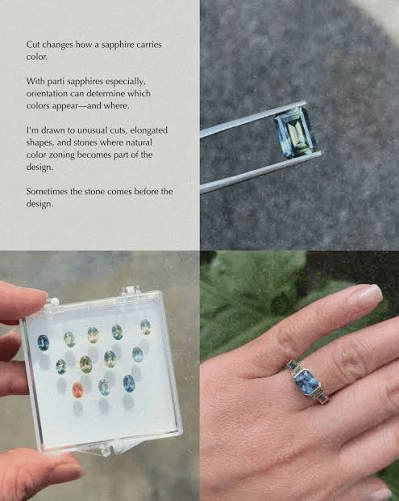
But cut is about more than the outline. It includes the proportions of the stone, the placement of its polished surfaces—called facets—and the direction in which the original crystal was cut. These choices affect how the sapphire shows its colour, how light moves through it and even how large it looks.
Two sapphires in Melbourne can have similar colour and carat weight yet feel completely different when you see them turn. Often, the cut explains why.
Cut influences the colour you see
A rough sapphire does not necessarily show the same colour from every direction. It may also have areas where the colour is stronger or weaker. The cutter decides how to position that rough crystal so the finished gemstone looks appealing when viewed from above.
That decision can make a sapphire’s colour appear richer, more even or more noticeable. GIA explains that cutters consider colour zoning, differences in colour seen from different directions, and the crystal’s lightness or darkness when deciding how to orient a sapphire.
This is one reason you should judge the colour of the finished stone, rather than relying only on a description such as “royal blue” or “vivid pink”. Look at a video of the actual sapphire as it turns. Does the colour stay appealing from several angles? Are there lighter and darker areas, and do you enjoy the effect they create?
Some colour variation gives a stone personality. The question is whether you love the way it looks.
Cut affects brightness and movement
Those small, flat facets on a sapphire or garnets in Australia do more than create a pattern. They interact with light. As you move the stone, some areas brighten while others darken, producing the flashes that make a faceted gemstone feel alive.
A well-cut sapphire does not have to flash like a diamond. Colour is central to its beauty, and different sapphires have different visual characters. Still, it should be rewarding to look at as it moves. GIA notes that cut can make a major difference to a sapphire’s brilliance and that an appealing stone reflects light in a lively way.
A still photograph can capture one lovely moment. A short video is more useful for seeing what happens before and after that moment: whether light travels across the sapphire or whether large areas stay dull.
A shallow cut can create a “window”
What Does a Sapphire’s Cut Change About Its Appearance?
When people describe a sapphire, they often start with its colour: a rich blue, a soft pink or a violet that seems to change with the light. Then comes its shape: oval, round, cushion or pear.
But cut is about more than the outline. It includes the proportions of the stone, the placement of its polished surfaces—called facets—and the direction in which the original crystal was cut. These choices affect how the sapphire shows its colour, how light moves through it and even how large it looks.
Two sapphires can have similar colour and carat weight yet feel completely different when you see them turn. Often, the cut explains why.
Cut influences the colour you see
A rough sapphire does not necessarily show the same colour from every direction. It may also have areas where the colour is stronger or weaker. The cutter decides how to position that rough crystal so the finished gemstone looks appealing when viewed from above.
That decision can make a sapphire’s colour appear richer, more even or more noticeable. GIA explains that cutters consider colour zoning, differences in colour seen from different directions, and the crystal’s lightness or darkness when deciding how to orient a sapphire.
This is one reason you should judge the colour of the finished stone, rather than relying only on a description such as “royal blue” or “vivid pink”. Look at a video of the actual sapphire as it turns. Does the colour stay appealing from several angles? Are there lighter and darker areas, and do you enjoy the effect they create?
Some colour variation gives a stone personality. The question is whether you love the way it looks.
Cut affects brightness and movement
Those small, flat facets on a sapphire do more than create a pattern. They interact with light. As you move the stone, some areas brighten while others darken, producing the flashes that make a faceted gemstone feel alive.
A well-cut sapphire does not have to flash like a diamond. Colour is central to its beauty, and different sapphires have different visual characters. Still, it should be rewarding to look at as it moves. GIA notes that cut can make a major difference to a sapphire’s brilliance and that an appealing stone reflects light in a lively way.
A still photograph can capture one lovely moment. A short video is more useful for seeing what happens before and after that moment: whether light travels across the sapphire or whether large areas stay dull.
A shallow cut can create a “window”
Look at a sapphire from directly above. Can you see an unusually pale or see-through patch near its centre? If you place it over printed text, can you make out the background through that area?
That effect is called windowing. It can occur when the lower portion of a faceted gemstone is cut too shallowly, allowing light to pass through instead of returning towards your eye. A window can interrupt both the colour and the lively appearance of a sapphire.
Do not mistake every bright reflection for a window. Reflections shift as the stone turns; a window tends to remain a see-through area. If you are unsure, ask the seller for a face-up video of the sapphire resting over a neutral surface and then being gently moved.
A deep cut can make the stone look dark
Cutting a sapphire deeper does not automatically make it more beautiful. In some stones, excessive depth can contribute to an appearance that feels dark or heavy when viewed from above. It can also place more of the stone’s carat weight beneath the visible outline.
Dark areas need a little judgment. Faceted gems naturally show a changing pattern of light and shade as they move. What you are looking for is whether a large part of the sapphire stays dark across different angles and ordinary lighting conditions. GIA discusses both windowing and overly dark appearance as possible effects of cut proportions in coloured gemstones.
If you love a deep navy sapphire, darkness may be part of its appeal. Just make sure you can still see the colour you are paying for, rather than finding that the stone looks almost black in everyday light.
Cut changes the size you notice
Carat measures weight, not the size of a sapphire’s visible face. If more weight sits in its depth or in a thick, rounded lower section, the stone may look smaller from above than another sapphire of the same carat weight.
GIA notes that excess bulk in parts of a coloured gemstone can add significant weight while taking away from its face-up beauty.
When comparing sapphires online, check their measurements in millimetres as well as their carat weights. The length and width help you picture the outline you will see in a ring or pendant. The depth adds context about where some of the weight sits. A hand photo at a realistic scale is helpful too.
A larger-looking stone is not always the better stone. Its colour and light performance still matter.
Shape and facet pattern create different moods
Shape is the outer outline of a sapphire. Cutting style describes how its facets are arranged. Together, they give the stone much of its visual character.
A round sapphire may feel balanced and classic. An elongated oval can look graceful across the finger. A cushion shape brings softer corners, while a pear shape has a more distinctive silhouette. Within any of these shapes, the facet pattern can produce broader flashes, smaller flickers or a quieter play of light.
There is no single “best” shape for everyone. If you are choosing a sapphire for custom jewellery, think about the whole piece. Do you want the stone to feel delicate or prominent? Would you prefer a symmetrical outline or something more expressive? Ask your jeweller how the sapphire’s proportions will work in the setting you have in mind.
How to judge a sapphire’s cut online
You do not need to calculate angles to make a thoughtful choice. Ask to see the actual stone in a short, unhurried video, viewed from above and then from the side. Watch it turn in ordinary light and consider:
- Do I enjoy the colour from more than one angle?
- Does light move across the stone?
- Is there a large see-through area in the centre?
- Do dark areas change as the stone turns, or stay in place?
- Do I like its outline and proportions at a realistic size?
A sapphire’s cut is successful when it brings out the qualities you want to see. The measurements and technical details help you ask better questions, but your eyes have the final say. When the colour draws you in and the stone stays interesting as it moves, you are seeing what a thoughtful cut can do.