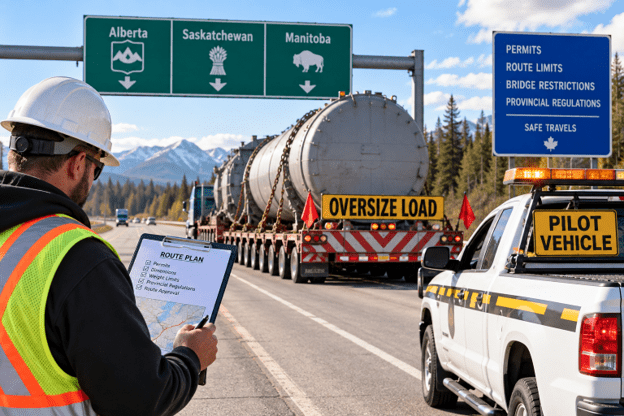
How Provincial Regulations Affect Oversized Load Planning
Transporting oversized equipment between Canadian provinces requires careful preparation. Large machinery can exceed standard limits for width, height, length or weight, creating additional requirements for permits, routing, equipment and travel conditions.
For shippers, understanding these considerations before scheduling transportation can help reduce unexpected delays and make the movement more organized.
Why Provincial Rules Matter
Transportation regulations can differ between provinces. A shipment that meets the requirements in its province of origin may still require additional authorization upon entering another jurisdiction.
This is particularly important for long-distance movements involving several provinces. The transportation team must understand the requirements that apply along the entire route, not just at the starting point.
Alberta trucking companies involved in cross-provincial transportation may therefore need to coordinate requirements beyond Alberta when moving oversized equipment to another part of Canada.
Begin With Accurate Load Measurements
Before you can plan permits or routes, you need to measure the cargo accurately.
Important information can include:
- Overall loaded height
- Overall loaded width
- Overall loaded length
- Total gross weight
- Axle weights
- Axle configuration
- Load distribution
Consider the dimensions of the tractor and trailer along with the equipment being transported. A piece of machinery that appears to fit within standard dimensions on its own may become oversized once loaded.
Accurate measurements provide the foundation for the rest of the planning process.
Understanding Quebec Requirements
Quebec has its own requirements for oversized and overweight transportation. When a shipment enters the province, transportation planners should determine which authorizations apply to the specific load and route.
Researching Quebec oversize load regulations can help identify the regulatory considerations to review before transportation begins.
Requirements may depend on the shipment’s dimensions and weight, the vehicle configuration, and the route. Conditions can also affect how and when an oversized movement is permitted to travel.
It is therefore important to review the applicable requirements for the actual shipment rather than relying on assumptions based on previous movements.
Route Planning Is More Than Choosing a Highway
A standard navigation route may not be appropriate for oversized equipment.
Large loads can encounter low bridges, narrow roads, weight-restricted structures, tight turns, construction zones and overhead obstacles. When assessing potential routes, consider the height and width of the complete vehicle configuration.
Urban areas can be particularly challenging because of traffic congestion, intersections and limited manoeuvring space.
A suitable route may be longer than the most direct option but provide better clearance and fewer restrictions.
Permit Planning Should Start Early
Permit applications should be considered well before the planned departure date.
Depending on the shipment, several jurisdictions may need to be involved. Applications may require detailed information about the cargo, transport vehicle, route, and travel schedule.
Starting early allows transportation planners to address questions, provide additional information or make route changes if required.
Last-minute permit planning can create unnecessary scheduling pressure, particularly when the shipment involves multiple provinces.
Escort and Travel Conditions
Some oversized movements may require escort vehicles or additional warning equipment. These requirements depend on factors such as load dimensions, route and jurisdiction.
Travel may also be subject to restrictions involving specific times, road conditions, weekends or holidays.
Understanding these conditions before departure allows the transportation team to schedule the movement appropriately and arrange any necessary support.
Weather Can Change Transportation Plans
Weather conditions should also be considered when planning an oversized shipment.
Snow, ice, heavy rainfall and strong winds can make large-load transportation more challenging. Seasonal road restrictions or temporary closures may also affect the planned route.
Checking current road conditions before departure and maintaining communication during the journey can help transportation teams respond to changing circumstances.
Prepare the Loading and Unloading Locations
Regulatory planning is only one part of a successful shipment. Loading and delivery locations must also accommodate the size of the transport equipment.
The loading area should provide enough space to position and secure the machinery. At the destination, ensure suitable access and unloading equipment is available.
Planning these details can prevent delays after the shipment reaches its destination.
Final Thoughts
Oversized transportation across provincial borders requires careful coordination of load measurements, permits, route restrictions, escort requirements and travel conditions. Provincial rules should be reviewed individually because requirements can change as a shipment moves from one jurisdiction to another.
Starting early and using accurate cargo information helps transportation teams select appropriate equipment, establish a suitable route, and complete necessary administrative steps. A detailed approach before departure can make complex oversized movements safer and more predictable.