Athletic Field Netting: A Practical Guide to Safer, More Functional Sports Facilities
Sports facilities are designed to support competition, training, recreation, and community activities, but keeping athletes, spectators, staff, and surrounding property protected requires more than a well-maintained playing surface. Balls traveling at high speeds can leave the designated field or court and create unexpected hazards for people and property nearby. This is particularly important in facilities where multiple sports are played, where spectators sit close to the action, or where several activity areas operate at the same time. Properly designed protective systems can significantly improve the overall safety and functionality of these environments while allowing players to focus on the game.
One of the most effective solutions for managing stray balls and defining the boundaries of a sports area is athletic field netting. This type of protective barrier is commonly used around baseball and softball fields, soccer facilities, golf practice areas, training complexes, and other recreational environments where flying balls are a concern. Depending on the application, netting can be installed behind goals, along foul-ball areas, above spectator seating, around practice spaces, or between adjacent playing areas. When correctly selected and installed, it can provide dependable protection without unnecessarily obstructing visibility or interfering with normal sporting activities.
Understanding the Purpose of Protective Sports Netting
Protective sports netting serves a straightforward but important purpose: it helps contain balls within or around a designated activity area. While fences and solid barriers can perform some of the same functions, netting offers several advantages because it can provide protection while maintaining visibility and airflow. Its flexible construction allows it to absorb and slow the movement of an incoming ball, reducing the likelihood that the ball will travel into spectator areas, neighboring fields, parking areas, walkways, or nearby structures.
The appropriate netting system depends on the type of sport, ball speed, installation location, expected impact frequency, and size of the protected area. A practice facility where athletes repeatedly hit balls at high speeds may require a different system from a recreational field where occasional stray balls are the primary concern. Understanding these differences is essential when planning a protective barrier because selecting a product based only on appearance or price may result in inadequate performance.
Netting can also contribute to better organization within a sports complex. When several fields or practice areas are positioned close together, protective barriers can reduce interference between activities. Players can train more efficiently without constantly retrieving balls from neighboring areas, while facility managers can create clearer boundaries between different zones.
Why Netting Is Important for Facility Safety
Safety is one of the primary reasons sports facilities install protective barriers. A ball leaving a field can travel with considerable speed, and spectators may not always be paying attention to the action. Children, older adults, staff members, and visitors can be particularly vulnerable when they are positioned near areas where balls are regularly hit or kicked.
A properly designed netting system can create an additional layer of protection between active play and surrounding areas. It does not eliminate every possible risk, but it can significantly reduce exposure to stray balls when installed in the appropriate locations. The design should account for the trajectory of the ball, the height and distance of the surrounding structures, and the areas where people are likely to be present.
Protection is also valuable for property. Parking lots, vehicles, lighting systems, windows, buildings, equipment, and landscaping can all be damaged by repeated impacts. Preventing balls from leaving the playing area can help reduce maintenance expenses and minimize disruptions caused by accidental property damage.
Selecting the Right Netting Material
Material selection is an important consideration because sports netting must withstand repeated impacts and outdoor environmental conditions. Different materials offer different combinations of strength, flexibility, weight, durability, and resistance to ultraviolet exposure. The ideal choice depends on the application and expected level of use.
Polyethylene is frequently used for outdoor sports applications because it can provide a useful combination of strength and weather resistance. It is available in different configurations and can be manufactured to suit a variety of protective applications. Nylon is another material commonly associated with sports netting, particularly where flexibility and high tensile strength are important. However, environmental exposure and application requirements should be considered when selecting between materials.
The netting’s construction is just as important as the material itself. Mesh size, twine thickness, knot style, edge reinforcement, and overall dimensions can influence how the system performs. Smaller mesh openings may be appropriate where preventing smaller balls or objects from passing through is important, while larger mesh can provide greater airflow and visibility.
Rather than selecting a product based solely on a general description, facility operators should consider the specific demands of the sport and installation environment. A knowledgeable supplier or installer can help identify a suitable configuration based on expected ball impact and exposure conditions.
Considering Mesh Size and Strength
Mesh size determines how large the openings in the netting are, and this can affect both performance and appearance. A mesh that is too large may allow balls or other objects to pass through, while an unnecessarily small mesh can add weight and potentially increase wind resistance. The correct balance depends on what the barrier is intended to contain.
Strength is another critical factor. Not all sports produce the same impact forces, and a practice environment can expose netting to far more repeated impacts than a low-use recreational facility. Baseball and softball applications, for example, may require particularly strong netting in areas where balls are frequently hit at high velocity.
The netting should also be capable of handling environmental stresses. Outdoor systems are exposed to sunlight, rain, wind, temperature changes, and potentially snow or ice depending on the climate. Products designed for outdoor use should be evaluated for ultraviolet resistance and long-term durability.
A strong net does not necessarily mean that every installation will last indefinitely. The support structure, attachment points, tensioning system, and installation method all contribute to overall performance. Even high-quality material can fail prematurely if it is improperly supported or subjected to loads beyond its intended capacity.
Designing the Support Structure
A protective netting system is only as effective as the structure supporting it. Poles, cables, brackets, anchors, and attachment hardware must be appropriately selected for the size and weight of the net as well as the environmental forces it may experience.
Tall netting installations can be exposed to substantial wind loads. As the height and surface area increase, the support system must be capable of handling the resulting forces without excessive movement or structural instability. The spacing of support poles is another important design consideration because large spans may require additional reinforcement or specialized cable systems.
Installation should also account for access requirements. Maintenance crews may need to inspect or repair the netting, and certain facilities may require sections that can be lowered, retracted, or temporarily moved. Designing the system with future maintenance in mind can reduce inconvenience and make repairs easier.
Proper anchoring is particularly important. A tall protective barrier places significant forces on its foundations, especially during severe weather. The supporting structure should therefore be designed and installed according to the conditions and requirements of the facility.
Common Applications for Field Netting
Protective netting is versatile enough to serve many different purposes within sports facilities. Baseball and softball fields often use netting behind home plate and along areas where foul balls are likely to enter spectator zones. Additional barriers may be installed along baselines or behind outfield areas depending on the facility layout.
Soccer fields can also benefit from netting behind goals to help contain balls and prevent them from repeatedly entering surrounding walkways or other activity spaces. Training facilities may use specialized barriers to separate practice areas, allowing several athletes or teams to train simultaneously without constant interference.
Golf practice facilities represent another common application. Protective netting can be installed around driving ranges to help contain golf balls within designated areas. Because golf balls can travel long distances at high speed, these systems often require careful engineering and substantial support structures.
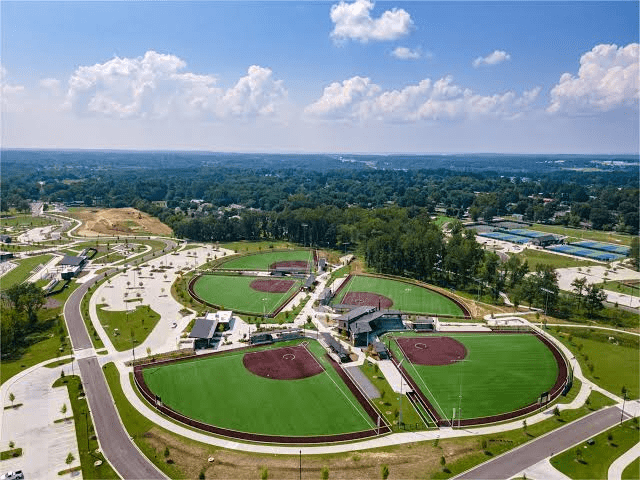
Multi-sport complexes may combine several forms of protective netting to address different safety and operational requirements. The system should be designed as part of the overall facility rather than added without considering existing structures, pedestrian routes, lighting, drainage, and other site features.
Improving Visibility Without Sacrificing Protection
One major advantage of netting compared with solid barriers is that it can provide protection while maintaining visibility. Spectators generally want a clear view of the game, and coaches and players need to observe activity across the facility. A well-designed net can create a protective separation without making the environment feel closed in.
Color can influence visibility as well. Dark-colored netting is often less visually distracting against many backgrounds and may provide a cleaner viewing experience. However, the best color depends on lighting, facility design, surrounding structures, and the specific application.
The net should also be positioned carefully. Installing it too close to players may interfere with gameplay, while placing it too far away could leave unnecessary gaps in the protected area. The height and angle should reflect the likely trajectory of balls rather than relying on a one-size-fits-all design.
Installation Considerations
Professional installation can be especially valuable for large or high-impact systems. The installer needs to understand how to properly tension the netting, secure the edges, connect the material to cables or poles, and ensure that gaps do not undermine the protective purpose.
Before installation begins, the facility should be evaluated for underground utilities, existing structures, drainage patterns, pedestrian traffic, and access requirements. Pole placement should not create new hazards for athletes or spectators. Likewise, cables and hardware should be positioned so they do not interfere with normal facility operations.
The installation process should also include appropriate edge treatment. Reinforced borders can improve durability by distributing tension and reducing stress on individual mesh strands. Hardware should be compatible with outdoor exposure and suitable for the loads generated by the system.
For large installations, the work may involve specialized equipment and elevated access. Proper safety procedures are essential for both installers and facility personnel.
Maintenance and Inspection
Even durable sports netting requires routine inspection. Facility managers should periodically examine the mesh for tears, stretched areas, broken strands, loose connections, and signs of ultraviolet or weather-related deterioration. Particular attention should be given to high-impact areas where balls repeatedly strike the same sections.
Support poles and hardware should also be inspected. Corrosion, loose bolts, damaged cables, or shifting foundations can compromise the entire system even when the net itself remains in good condition. Identifying these issues early can prevent more extensive repairs.
Cleaning requirements vary by material and environment, but excessive buildup of dirt, debris, or organic material should generally be addressed when necessary. Care should be taken to avoid cleaning methods that could damage the fibers or protective coatings.
If a section becomes damaged, repairs should be completed promptly. A small tear can expand over time as additional balls strike the weakened area. In some cases, replacing a damaged section may be more effective than repeatedly patching it.
Factors That Affect the Overall Cost
The cost of a protective netting project depends on several variables. The total square footage is an obvious factor, but height, material, mesh size, support structure, foundation requirements, hardware, installation complexity, and site accessibility can all influence the final investment.
Higher installations generally require stronger support systems and more specialized installation equipment. Similarly, facilities exposed to frequent high-speed impacts may need heavier-duty materials than recreational areas with occasional use.
Custom shapes can also affect cost. A simple rectangular barrier may be relatively straightforward to install, while a complex system involving multiple angles, curved sections, retractable components, or unusual structural requirements can require more design and labor.
Although budget is important, durability and suitability should remain central considerations. Choosing an inexpensive system that fails prematurely can ultimately cost more than investing in a properly designed solution from the beginning.
Choosing a Reliable Netting Provider
When selecting a provider, facility managers should look beyond the product itself and evaluate the company’s experience with comparable installations. Sports netting is a specialized application, and successful projects require an understanding of impact forces, support structures, installation techniques, and long-term outdoor performance.
It can be helpful to ask about previous projects, material specifications, warranties, installation procedures, maintenance requirements, and expected service life. A reliable provider should be able to explain why a particular material and configuration is appropriate for the intended use.
The provider should also take the facility’s unique conditions into account rather than simply recommending a standard product. Field dimensions, sport type, spectator locations, surrounding property, weather exposure, and future expansion plans can all influence the final design.
Long-Term Benefits of a Properly Designed System
Investing in athletic field netting can provide benefits that extend beyond immediate ball containment. A reliable system can contribute to a safer environment, protect surrounding property, improve the organization of a sports complex, and reduce interruptions during training and competition. By keeping balls within designated areas, facilities can also make better use of available space and allow multiple activities to operate simultaneously.
A well-designed barrier may also support a more professional appearance. Clean, properly tensioned netting and well-maintained support structures can make a facility look organized and carefully managed. This can be particularly valuable for schools, recreational organizations, training centers, and professional sports facilities that want to provide a positive experience for players and visitors.
The key is to treat protective netting as part of the facility’s overall design rather than as an afterthought. Proper planning, suitable materials, reliable support structures, professional installation, and routine maintenance all contribute to long-term performance.
Conclusion
Sports facilities face numerous challenges when it comes to protecting spectators, players, property, and surrounding areas from stray balls. A properly designed netting system provides a practical way to address these risks while maintaining visibility, airflow, and an open sporting environment. From baseball and softball fields to soccer facilities, golf practice areas, and multi-sport complexes, protective barriers can be adapted to a wide range of applications.
The success of a netting project depends on more than simply choosing a strong material. Mesh size, twine construction, support poles, anchoring, tension, installation height, environmental exposure, and expected impact levels all need to be considered. Regular inspections and timely maintenance are equally important because even the strongest system can eventually experience wear from repeated impacts and outdoor conditions.
For facilities planning a new installation or upgrading an existing protective system, athletic field netting can be an effective long-term investment when the design is based on the actual needs of the property. Careful evaluation and professional guidance can help ensure that the finished system provides the right combination of protection, durability, visibility, and functionality.
Ultimately, the best protective barrier is one that works quietly in the background while allowing athletes and spectators to concentrate on the game. By combining appropriate materials with sound structural design and proper installation practices, sports facilities can create safer, more organized environments that are prepared to handle the demands of regular athletic activity.