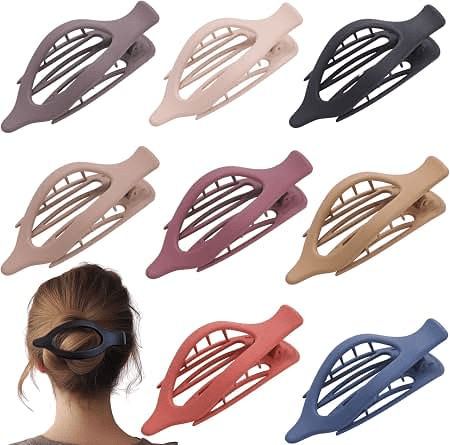
The Duckbill Clip Is Having a Moment, and Fine Hair Is the Reason
Walk into almost any salon in the city right now and count what is sitting on the station. The claw clip still owns the top knot. The alligator clip still owns the sectioning tray. But the one quietly turning up on more counters — and on more of the accessory walls in boutiques from Nolita to the Upper West Side — is the long, flat, faintly odd-looking duckbill.
It is not a new object. Duckbills have been rattling around salon drawers for decades. What changed is what they are made of, and who they are being sold to.
What actually makes a clip a duckbill
One feature: the jaw. A duckbill has a long, smooth, flat upper jaw that tapers towards a rounded tip — the shape the name comes from. It holds by pressing a section of hair flat along the entire length of that jaw. It does not bite.
That single difference decides everything else about how it behaves. An alligator clip concentrates its grip into interlocking teeth, which is exactly what you want when you are holding a working section during a blowout, and exactly what you do not want when you are wearing the clip out to dinner. A duckbill spreads pressure along a long contact line instead, so it sits flatter against the head, marks the hair far less, and is much more forgiving of fine or fragile hair.
Anyone who has ever taken out an alligator clip and found a crease running through their hair knows the difference without needing it explained.
The trade-off arrives immediately. Because there are no teeth doing any of the work, a duckbill is only as good as the spring behind it.
The part nobody looks at
Everything you feel when you open and close a clip — whether it snaps or sighs, whether it still grips after six months rolling around the bottom of a bag — comes from one stamped, heat-treated metal part that most buyers never think about.
That part is almost never made by the factory that makes the clip. Springs come from component specialists who produce them by the million, and the gap between a mediocre one and a good one runs to roughly one Chinese yuan per piece. On a sample run nobody notices. Across fifty thousand pieces it becomes the single line most likely to explain why two clips that look identical in photographs feel completely different in the hand.
It is also why brands sourcing wholesale duckbill clips learn to ask what the spring is specified as before they ask about anything else. A supplier who cannot answer that question is not buying the part to a specification at all — they are buying whatever the component shop happened to have that week, which is precisely how a repeat order comes back feeling unlike the sample that was signed off.
For anyone buying a single clip rather than fifty thousand, the consumer version of that test takes two seconds. Open it fully and let it close on your finger. It should shut with one clean, even movement. A spring that closes in two stages, or that feels soft at the end of its travel, is one that will stop holding long before the acetate shows a scratch.
Why the material changed the economics
The other half of the story is what the body is cut from. Most decorative clips used to be injection-moulded plastic, which meant every new shape required a steel tool and a five-figure commitment before a single piece existed. That maths only works if you are certain a shape will sell, which is why the accessory wall looked the same for years.
Cellulose acetate — a plant-derived material made from wood pulp — is cut from sheet instead. A new outline costs a cutting profile rather than a mould, which drops the entry point to a few hundred pieces per design rather than tens of thousands. That one change is why small labels can now put out a run of twelve colourways instead of two, and why the same sheet that becomes a duckbill in the morning becomes wholesale hair barrettes, snap clips and claws by the afternoon.
Acetate also takes colour in a way plastic cannot. Tortoiseshell, marbling and the smoky translucent finishes that read as expensive are pressed into the sheet itself rather than printed onto a surface, so the pattern runs through the full thickness of the clip. Chip the edge of a good acetate barrette and the colour continues underneath. Chip a printed one and you find grey.
How to buy one that lasts
Three things separate a clip you keep from a clip you replace.
Check where the metal meets the body. The base plate is bonded to the acetate, and a glue line that is visible, uneven or slightly raised is the most common defect in the category. Run a thumbnail along the join. It should be invisible.
Check the tip. The end of the upper jaw should be genuinely rounded and polished, not cut flat and left sharp. A flat tip catches hair every time the clip is removed, and it is the fastest way to tell a finished piece from a cheap one.
Match the length to the section, not the head. This is where most people go wrong. A duckbill is designed to hold one flat section along its whole jaw, so a clip that is too long for the amount of hair you are actually pinning will gape at one end and slide. For a half-up section or a fringe grown out to the cheekbone, something in the six to eight centimetre range does more work than anything larger.
How to wear it
The reason stylists like duckbills for editorial work is that they read as deliberate. A claw clip says the hair was put up in a hurry, charmingly so. A duckbill says someone made a decision.
The most useful placement is the simplest: gather the front third back, twist once, and lay the clip horizontally across the twist so the flat jaw sits parallel to the floor. Because the grip is spread rather than concentrated, the twist stays put without the tension headache that a tighter clip creates by hour three.
Two worn low and symmetrically on either side of a centre parting is the other one worth learning, and it is the look that has done most of the work in bringing the shape back. It only holds properly if the sections are genuinely flat before the clip goes on — duckbills reward tidiness and punish bulk.
As for care, there is almost nothing to do. Acetate does not like heat, so keep clips away from the barrel of a curling iron and out of a car in August. Beyond that, a wipe with a dry cloth is the entire maintenance schedule.