From Calgary to the Rockies: Exploring Alberta and Discovering What Makes Canada Feel Like Home
There is a particular moment that happens to a certain kind of traveler somewhere along the stretch of highway between Calgary and Banff. The city falls away behind you. The flat prairie gives way to foothills, and then the foothills rise into something more dramatic. The sky grows wider. The Rockies appear on the horizon, sharp and permanent, and something shifts in the way you are thinking about the trip.
You came to see Canada. You did not expect Canada to make you think about staying.
Alberta has that effect. It is one of those rare places that works on multiple levels simultaneously: spectacular enough to justify the journey, livable enough to make you imagine a life there. Calgary is a modern, walkable, economically vibrant city. The mountain corridor to the west contains some of the most dramatic scenery on the continent. The communities along the way, from Canmore to Banff to Lake Louise, offer a quality of life that is genuinely difficult to replicate anywhere else.
This article traces that journey. It follows the road from Calgary into the heart of the Canadian Rockies and toward the British Columbia border, pausing at the places worth lingering. It also explores the question that this landscape tends to raise in visitors who fall deeply in love with what they find: what would it actually take to make Canada home?
Calgary: The City That Earns a Second Look
Most international travelers think of Calgary as a stopping point on the way to Banff, and that is an understandable mistake. Calgary is easy to underestimate on first impression. It is not Vancouver. It does not have Montreal’s old-world atmosphere or Toronto’s density. What it has instead is something harder to articulate: a sense of possibility, clean air, genuine friendliness, and a skyline that looks like it was built by people who were recently very busy and fully intend to keep going.
The downtown core is compact and navigable on foot. The Beltline neighbourhood, south of downtown, has developed into one of the best restaurant districts in Western Canada, with independent restaurants, wine bars, and coffee roasters that would hold their own in any major city. The East Village has been transformed over the past decade into a cultural district anchored by the Central Library, one of the most beautiful public buildings completed in Canada in recent memory.
Calgary’s proximity to the mountains is not simply a geographical fact. It shapes the city’s character. Residents here ski on weekends without much planning. They hike after work in summer. They drive to the mountains for day trips the way residents of other cities drive to the mall. The outdoors is not a vacation from Calgary; it is part of what Calgary is.
For international visitors who arrive expecting a transit hub and discover a genuinely livable city, the reaction is often surprise followed by curiosity. That curiosity frequently turns into a question about what life here would actually cost, what work would look like, and what it would take to stay longer than a visa allows.
Travelers who find themselves asking that question seriously are often surprised to learn how structured and navigable Canada’s immigration system is when approached correctly. Speaking with a qualified immigration consultant in Canada before making any major decisions is the most effective way to understand which pathways are realistically available based on your specific education, work history, and family circumstances.
The Drive West: Foothills, Sky, and the First Glimpse of the Rockies
Leaving Calgary on the Trans-Canada Highway headed west, the landscape transitions with a pace that feels almost deliberate. The city suburbs give way to acreages and hobby farms. The road follows the Bow River corridor, climbing steadily through grasslands and rolling foothills. The sky here is enormous in a way that is almost disorienting for visitors arriving from denser, more built-up environments.
The Rockies appear gradually rather than all at once. They begin as a suggestion on the horizon, a slightly darker band at the edge of the sky. Then they sharpen. Then they fill the windshield. By the time you reach Cochrane, a charming small town about forty minutes west of Calgary with an excellent ice cream tradition and a strong sense of local identity, the mountains are no longer a background detail. They are the foreground.
The drive itself, approximately ninety minutes from downtown Calgary to Banff in clear conditions, is worth treating as a destination rather than a commute. There are pullouts and viewpoints along the way that deserve more than a passing glance. The light on the foothills changes dramatically through the day, and early morning drivers are rewarded with a quality of golden light on the peaks that photographers plan entire trips around.
Canmore: The Mountain Town That Stays With You
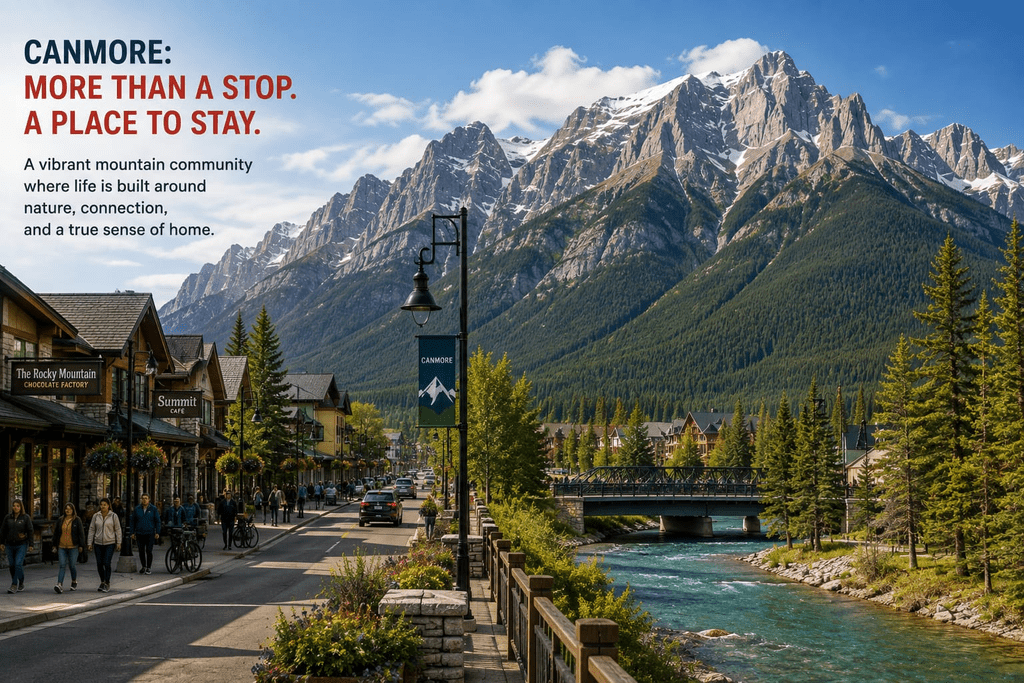
Canmore sits at the entrance to the Rocky Mountain corridor, just east of Banff National Park, and it occupies a particular niche that many travelers find even more appealing than Banff itself. Where Banff is an international destination drawing visitors from every part of the world, Canmore is a community that people actually live in. It has schools, a hospital, local businesses that have been operating for decades, and a population that chose to build their lives in the mountains rather than simply visit them.
The downtown strip along Main Street is walkable and full of independent restaurants, art galleries, and outdoor gear shops. The Bow River runs through the town, and the trail network extends in every direction into the surrounding mountains. On any given evening in summer, the mountain views from Canmore’s outdoor patios produce a kind of involuntary contentment that is very difficult to argue with.
Canmore has also become one of Alberta’s most desirable real estate markets precisely because people who come here on vacation decide they do not want to leave. That dynamic, visitors who arrive for a weekend and start mentally rearranging their lives, is not incidental to what makes Canmore interesting. It is central to the town’s character.
Travel note: Canmore is located just outside Banff National Park boundaries, which means you do not need a national park pass to visit the town itself. It is an excellent base for exploring the entire mountain corridor, with access to Banff, Lake Louise, and Kananaskis all within easy driving distance.
Banff: Where the World Comes to Be Reminded of Its Scale
Banff is one of those places that resists adequate description because the photographs that made it famous are all accurate and still somehow fail to prepare you for the actual experience of being there. The town of Banff sits at roughly 1,400 metres above sea level, surrounded by mountains on every side, at the confluence of the Bow and Spray rivers. The national park that surrounds it encompasses over 6,600 square kilometres of protected wilderness.
The Fairmont Banff Springs is the landmark that most international visitors associate with the town, and it earns its reputation. Built in the late nineteenth century in a chateau style that draws on Scottish baronial and French Renaissance architecture, the hotel sits above the town like something from a different century. Its dining rooms, spa facilities, and mountain-view terraces represent a level of luxury that is consistent with everything Park Magazine’s readership expects from a destination feature.
But Banff rewards exploration beyond the iconic hotel. Banff Avenue, the main commercial street, has genuine character despite its tourist traffic. The Whyte Museum chronicles the history of mountain culture in the region with surprising depth. The gondola to Sulphur Mountain offers views that restructure your understanding of how large the mountains actually are. And the wildlife viewing opportunities within the park, elk grazing at the edge of town, bighorn sheep on the road shoulders, the occasional bear sighting from a safe distance, give the destination a wildness that luxury properties alone could not manufacture.
Banff in winter is a different kind of spectacular. Ski resorts at Sunshine Village, Lake Louise, and Mount Norquay give the region one of the strongest alpine skiing offerings in North America. The town itself in winter, with snow on the mountain peaks and smoke rising from the Fairmont’s chimneys, looks like something designed specifically to make you feel lucky to be there.
Lake Louise: Stillness at Elevation
Lake Louise is approximately fifty-five kilometres north of Banff along the Icefields Parkway, and the drive alone justifies the detour. The Icefields Parkway is consistently ranked among the most scenic drives in the world, and for once the ranking is not hyperbole. The road passes beside glacial lakes, beneath hanging glaciers, and through valleys that open and close like chapters in a very long book.
Lake Louise itself, the glacially-fed lake that gives the area its name, is turquoise in a colour that appears digitally enhanced even in person. The Fairmont Chateau Lake Louise sits at the water’s edge, a grand historic hotel that has been hosting guests since the late nineteenth century and continues to operate at the level that the setting demands. In summer, canoes can be rented on the lake. In winter, the lake freezes and is used for skating, with the chateau lit behind it.
The Post Hotel in the village below is a quieter and in many ways more personal luxury experience. Family-owned and operating since 1942, the Post Hotel has one of the most respected wine cellars in Canada and a dining room that justifies the drive from Calgary on its own terms. For travelers who prefer intimacy over grandeur, it represents the mountain corridor at its most refined.
Kananaskis: Alberta’s Quieter Masterpiece
Kananaskis Country lies south of the Trans-Canada Highway and is one of Alberta’s best-kept secrets among international visitors who tend to follow the more heavily marketed Banff corridor. This is where Albertans themselves come to hike, camp, ski at Nakiska, and experience the mountains without the tourist infrastructure that Banff necessarily brings.
The Kananaskis Village area offers luxury accommodation at the Pomeroy Kananaskis Mountain Lodge, and the surrounding trails give access to landscapes that rival anything in the national parks without the crowds that peak season brings to Banff and Lake Louise. The area was the site of the 1988 Winter Olympics alpine events at Nakiska and hosted the G8 Summit in 2002, which gives it an unusual dual identity as both a wilderness destination and a place with a specific kind of international pedigree.
For travelers who want to experience Alberta’s mountains away from the main tourist currents, Kananaskis offers a more intimate and in some ways more authentic version of what this landscape is. The wildlife here is abundant, the trails are well-maintained, and the sense of space, genuine, uncompromised space, is the thing you carry home with you.
Toward British Columbia: The Road That Changes the Question
Continuing west from Lake Louise, the Trans-Canada crosses Kicking Horse Pass and descends into British Columbia. The provincial border is marked by the Continental Divide, and the shift in landscape on the BC side is noticeable almost immediately. The valleys are deeper, the vegetation denser, and the sense of entering a different kind of wilderness is palpable.
The towns along the British Columbia side of the border, Field, Golden, Revelstoke, have their own character and appeal. But the more important thing about this stretch of road is what it does to the traveler’s relationship with Canada as a whole. By the time you have driven from Calgary through the Rockies and into BC, you have covered a distance that seems to compress everything you thought you knew about the country’s scale into something you can feel rather than simply calculate.
Canada is large in a way that reveals itself slowly. The Alberta-BC road trip is one of the clearest demonstrations of that largeness, and it tends to produce a particular kind of traveler response: not simply appreciation for what is here, but a recalibration of what kind of life might be possible in a country that contains this much.
For many international visitors, the journey through Alberta and toward BC marks the point where travel shifts from tourism to something more serious. The question stops being “where should we go next?” and starts being “what would it take to come back and stay?”
When a Trip Starts Asking Bigger Questions
The transition from visitor to newcomer is not something most people plan in advance. It tends to happen gradually. A first visit to Banff produces a second visit. A second visit produces a conversation about what jobs are available in Calgary. A conversation about jobs produces a question about visa options. And eventually, a trip that began as a vacation becomes the origin story of a significant life decision.
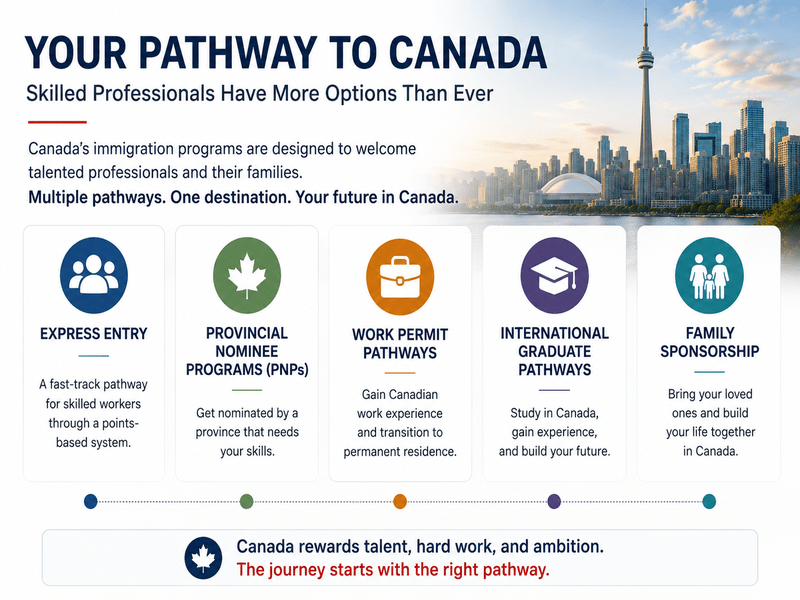
Canada is one of the few countries in the world that actively recruits skilled foreign nationals for permanent residence, and its immigration system is designed around that intention. There are pathways for skilled workers, recent graduates, entrepreneurs, and family members. The pathways vary considerably in their requirements and timelines, and the right one depends heavily on individual circumstances rather than any general rule.
Alberta specifically offers a Provincial Nominee Program (PNP) that allows the province to target immigrants whose skills and experience align with Alberta’s economic needs. Calgary, as a major economic hub with a strong technology, energy, finance, and professional services sector, consistently attracts internationally-educated professionals who discover the city through business travel or leisure and decide they want to build something there.
For Couples Who Discover Canada Together
Some of the most compelling immigration stories begin not with a job offer or a skills assessment, but with a relationship. International couples who meet while traveling, study together abroad, or maintain a long-distance relationship across borders face a specific set of circumstances when one partner is Canadian or when both partners decide to make Canada their shared home.
Canada’s family sponsorship system recognizes the complexity of how relationships actually work in a mobile, internationally connected world. A Canadian citizen or permanent resident can sponsor a foreign national spouse or partner for permanent residence, and the process, while documentation-intensive, is designed to accommodate couples in a range of circumstances.
For married couples navigating the path to a shared life in Canada, spousal sponsorship Canada provides a clear pathway to permanent residence. Both inland applications, for partners already living in Canada, and outland applications, for partners living abroad, are currently being accepted. The key is understanding which stream applies to your situation and preparing documentation that clearly demonstrates the genuineness of your relationship.
The sponsorship process requires evidence that goes beyond a marriage certificate or a shared address. Immigration officers look for a coherent picture of two people who are building a life together: financial records, communication history, travel documentation, photographs spanning the relationship, and statements from people in the couple’s social circle who can speak to the nature of the relationship. The more complete and well-organized that evidence is, the smoother the process tends to be.
Processing times for spousal sponsorship have increased in recent years. As of mid-2026, IRCC estimates approximately 27 months for inland applications and 17 months for outland applications. Those timelines make early preparation and a complete initial submission more important than ever, since incomplete applications generate requests for additional information that extend the wait further.
Common-Law Partners and the Canadian Immigration System
Not every couple that decides to build a life together in Canada arrives at that decision through a formal marriage. Many couples today spend years building a genuine shared life, living together, managing finances jointly, making major decisions together, without formalizing the relationship through a legal ceremony. Canadian immigration law recognizes this reality.
A common-law partner under Canadian immigration law is defined as someone who has cohabited with their partner in a conjugal relationship for at least one year. This is a strict definition that requires actual shared residence, not simply a committed relationship maintained across separate households. But for couples who meet that threshold, the pathway to permanent residence through sponsorship is real and accessible.
The documentation requirements for common-law partner sponsorship are more extensive than for spousal sponsorship, precisely because there is no government-issued document that creates the relationship the way a marriage certificate does. Common-law couples need to build their case through a body of evidence collected over time: joint leases, shared bank accounts, utility bills showing both names at the same address, statutory declarations from people who know the couple, and dated records spanning the full period of cohabitation.
Common-law couples who spent periods apart due to work, immigration restrictions, or family circumstances face the additional challenge of explaining those separations clearly. Communication records, travel logs, and evidence of steps taken to reunite are all relevant to demonstrating that a gap in cohabitation was temporary rather than a fundamental interruption of the relationship.
The distinction between common-law and spousal sponsorship matters less than many applicants assume in terms of the eventual outcome. Both lead to permanent residence. The difference lies in the documentation requirements and the evidentiary burden that applicants need to meet. A well-prepared common-law application stands on the same footing as a well-prepared spousal application; the preparation simply requires more time and more deliberate organization.
Why Alberta Attracts the People Who Stay
There is a pattern that immigration professionals in Alberta have observed consistently over the years. People who come to Calgary for work and spend a weekend in the mountains tend to extend their assignments. People who come for a mountain vacation and spend a few days in Calgary start asking about jobs. The city and the landscape operate together as a kind of closed argument for staying, and the argument is difficult to rebut once you have experienced both sides of it.
Alberta has no provincial income tax, which gives residents a meaningful financial advantage over most other Canadian provinces. Calgary consistently ranks among the most affordable major cities in Canada on a cost-of-living-to-income ratio. The public healthcare system, while under pressure like all Canadian provincial health systems, provides coverage that gives newcomers a security that many arrivals from other countries find genuinely transformative.
The multicultural character of Calgary, which has grown rapidly over the past two decades, means that newcomers typically find established communities from their home countries, familiar food, cultural institutions, and social networks that ease the transition. The city’s relatively young median age and entrepreneurial culture create an environment where newcomers with skills and ambition tend to find their footing more quickly than in more established, less dynamic urban centres.
Planning the Move: What to Think About Before You Start
For travelers who have made it through the Calgary-to-Rockies experience and arrived at the conclusion that they want to explore a more permanent relationship with Canada, the practical questions tend to follow a predictable sequence. Which immigration pathway applies to my situation? How long does the process take? What do I need to prepare? When is the right time to start?
The honest answer to most of those questions is that it depends, and that the dependency is on details that are specific to each person’s education, work history, relationship status, current immigration status, and long-term goals. Canada’s immigration system is structured and navigable, but it is also genuinely complex, and the right pathway for one person can be entirely wrong for another with superficially similar circumstances.
The most common mistake that prospective immigrants make is trying to self-assess their eligibility based on general information found online. The regulations change frequently. Eligibility criteria vary by program and by province. Processing times shift. And the consequences of submitting an application through the wrong stream, or submitting an incomplete application through the right one, can mean months of lost time and, in some cases, a refusal that makes subsequent applications more difficult.
For travelers who have made the journey from Calgary through the Rockies and arrived at the question of what it would actually take to stay, speaking with a regulated Canadian immigration professional is the clearest first step. A regulated professional can assess your specific situation, identify which programs you realistically qualify for, and help you build the application that gives you the best possible chance of a successful outcome.
The Road Home
The drive back from the mountains to Calgary in the late afternoon, with the sun dropping behind the peaks and the light turning the foothills into something extraordinary, is one of those experiences that does not fully register until you are back in your ordinary life trying to describe it to someone who was not there.
Alberta has a way of doing that. It gets under the surface. The mountains stay with you not as a memory of a place you visited but as a reference point for what you know is possible, in terms of landscape, in terms of lifestyle, in terms of the kind of day that is available to someone who chooses to live within driving distance of that particular horizon.
For some visitors, the return trip is simply the end of a beautiful holiday. For others, it is the beginning of a longer conversation, with a country, with a future, with themselves about what they actually want their life to look like. Both outcomes are legitimate. But for the travelers who find themselves in the second category, it is worth knowing that Canada’s door is more open than it may appear from the outside, and that the process of opening it properly begins with understanding what you are actually working with.
The road from Calgary to the Rockies is one of the great drives in the world. What you discover along the way may turn out to be more than just a destination.
This article is intended for general informational and travel purposes. Immigration information is provided as general context only and does not constitute legal or immigration advice. Canadian immigration policies and processing times are subject to change. For advice specific to your situation, please consult a Regulated Canadian Immigration Consultant (RCIC).