Recording family stories on a heritage trip
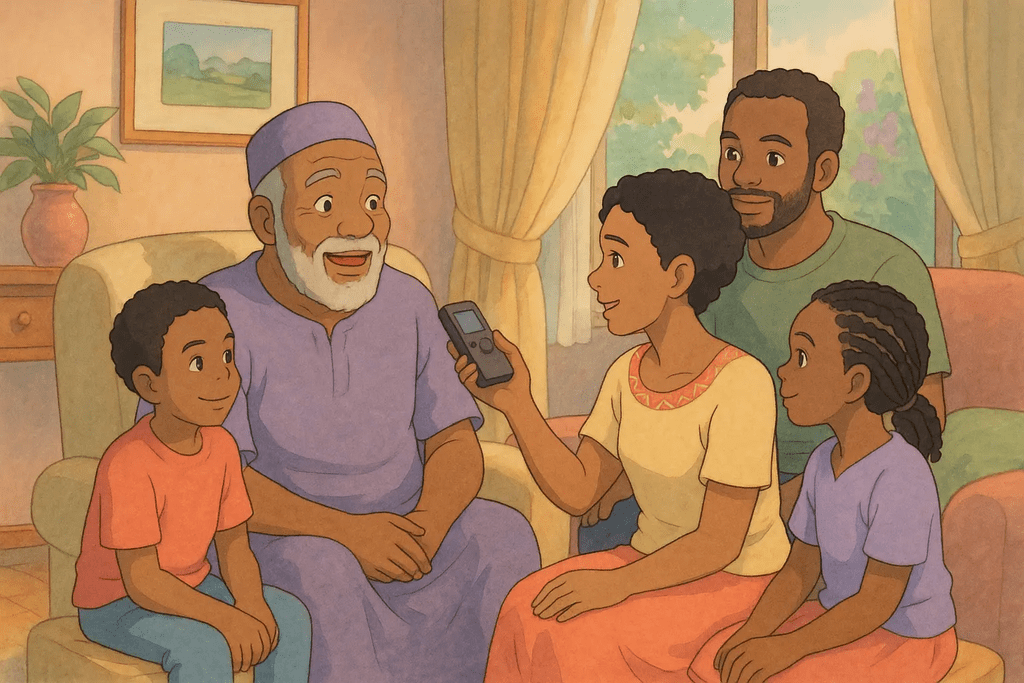
A family stands on a sidewalk in front of a building that means nothing to anyone under sixty. The oldest person in the group looks up at the third floor and starts talking.
What follows is not a story anyone in that family has heard before. It is not that it was being withheld. It is that at a kitchen table in another country there was nothing to prompt it, and here the window frame, the angle of the street and the smell of the stairwell are doing what forty years of Thanksgiving dinners did not.
Twenty minutes later the group moves on to lunch. Nobody recorded any of it, and within a week most of it is gone.
How do you record family stories while traveling?
The practical answer is to record audio rather than take notes, to do it in the moment rather than afterward at the hotel, and to convert the recording to text within a few days while the details can still be checked with the person who supplied them. Prepared questions help, and organizations that do this at scale publish good ones: StoryCorps has spent years refining a list of prompts designed to open a conversation rather than close it, published as its Great Questions. What prepared questions cannot supply is the trigger. That comes from the place, and the place is only available while the family is standing in it.
Location does something a question cannot
Memory research has a name for this and everyone has experienced it without naming it. Recall improves when the surroundings resemble the surroundings in which the memory was formed. A street, a building, a smell, a view from a particular corner all function as retrieval cues, and they surface material that direct questioning does not reach.
The practical consequence for a family trip is specific. An interview conducted in a living room produces the stories the person has already decided are their stories: the well-told ones, smoothed by repetition, with the same phrasing every time.
Standing outside the school, the factory, the church or the port produces something different. Names of neighbors. What the rent was. Which shop was on the corner. Who left first and who stayed. The parts that were never assembled into an anecdote because nobody ever asked, and that the person themselves is often surprised to remember.
That material is more valuable than the polished stories precisely because it has never been edited.
What gets lost, in order of how quickly
The general shape of the visit survives. Everyone will remember that grandmother talked for a long time outside the old apartment and that it was moving.
Four things go quickly.
Proper nouns. Names of people, streets, villages, businesses, ships. These are the load-bearing elements of a family history and the least likely to be retained by listeners hearing them once, often in an accent or a language they do not speak.
Dates and sequence. Which came first, the move or the marriage. How many years between arriving and opening the shop. Family chronology assembled later from impressions is reliably wrong, and the errors propagate into every retelling afterward.
The exact phrasing. Older relatives frequently say something once, in a formulation nobody else in the family would produce. Paraphrase destroys it, and paraphrase is what memory produces.
Dialect and language. Words in a language the younger generation does not speak, which are often the words carrying the most specific meaning. Written down phonetically a week later, they are unrecoverable.
Preparation is what makes the place work harder
The place does the triggering, but it does it better when the traveler arrives with something to trigger against.
Three things are worth assembling in the weeks before departure, and none of them takes long.
Addresses, confirmed in advance. Families frequently know the street and not the number, or know a building that has since been demolished or renumbered. An hour with municipal records, an old letter, or a naturalization document usually resolves it, and standing in front of the right building rather than approximately the right block is the difference between a conversation and a shrug.
Photographs, printed. A physical photograph handed to someone standing in the place where it was taken produces more than either would separately. Phone screens work less well outdoors and invite scrolling rather than looking.
Documents, if they exist. A ship manifest, a school record, a marriage certificate. These carry names and dates that the traveler can ask about directly, and they frequently correct a family story that everyone had slightly wrong.
None of this turns the trip into research. It takes an evening and it changes what the twenty minutes on the sidewalk produce.
Recording without turning the trip into a documentary
The objection to recording is reasonable and worth taking seriously: nobody wants to spend a family trip operating equipment, and pointing a device at a relative changes how they speak.
Three habits keep it unobtrusive.
Ask once, at the start of the trip rather than at the moment. Something plain: would it be all right to record when you talk about this, so the family has it later. Asking once, in advance, avoids the repeated interruption of asking each time and avoids the awkwardness of asking in the middle of something.
Record long and continuously rather than trying to catch the good parts. Starting and stopping guarantees missing the beginning of the thing worth having, which is almost always the unprompted sentence rather than the answer to a question. A phone in a shirt pocket, running, is enough.
Say the location out loud when arriving somewhere. Standing outside the building on Via Roma, and then let the conversation happen. That one sentence is what makes the recording navigable later, and it takes four seconds.
Everything else can be handled afterward.
Turning the recording into something the family can read
Audio alone solves the preservation problem and not the access problem. Nobody in the family is going to sit through six hours of recordings, and the person who made them will not either.
The conversion is the step that makes the material usable. A voice-to-text transcription tool will take audio recorded on a phone or in a browser and return punctuated, editable text with the speakers separated, which matters when three generations are talking over each other and it is not otherwise clear who said what. Vomo handles long recordings without requiring them to be split, divides them into timestamped sections, and produces a summary of the main points, so a two hour afternoon becomes a document with an internal structure rather than one continuous block. Text, Word, PDF, and Markdown are all available on export, so the result can be printed, emailed, or dropped into whatever the family already uses.
Two checks are worth making before the text is shared. Every proper noun needs verifying with the person who said it, because names of places and people are the least reliable part of any automatic transcript and are the whole point of the exercise. And any date should be confirmed rather than accepted, since spoken numbers are the second least reliable part.
That verification pass is also the best possible excuse for a second conversation, which frequently produces more than the first.
Consent, and the parts that stay private
Families produce material that was not intended for circulation. A trip like this surfaces divorces, money, illness, wartime, decisions people are still not at peace with.
Three rules, all straightforward.
Tell the person the recording exists and what it is for. Not a form, just a sentence, in advance.
Give them the transcript before anyone else sees it, and let them mark anything that should not be included in the version that gets shared. It is their life, and the answer to what should be left out is theirs alone. In practice the marked passages are rarely what anyone would have guessed.
Keep the private material private rather than deleting it. There is a difference between a version prepared for the family and the underlying record, and conflating the two either destroys history or publishes something that should not have been.
Afterward
The finished document benefits from a small amount of organization and does not need to be a book.
Group it by place rather than by the order of the trip, since places are what anyone looking for something will search by. Attach photographs of each location to the section about it. Note who was present at each conversation and the date.
Then send it to the wider family, including the branches that did not come on the trip. Distribution is what makes it durable: a document held by one person disappears when that person’s laptop does, and a document held by fourteen people does not.
Public archives exist for material of broader interest. StoryCorps, whose approach NPR has described in its coverage of the organization’s Thanksgiving Listening project, archives interviews with the American Folklife Center at the Library of Congress. Most family recordings will not go that route, and they do not need to. The point is that they exist as text somebody can read.
The short version
Heritage travel produces a specific kind of material that no other setting produces: unedited recollection, triggered by a place, from a person who will not always be available to repeat it.
It arrives as continuous speech, in circumstances where writing is impossible and interrupting is unwelcome, and it is gone within a week.
Recording it requires asking once and leaving a phone running. Turning it into a document the family can read and search costs an afternoon, and it is the only part of the trip that will still matter in thirty years.