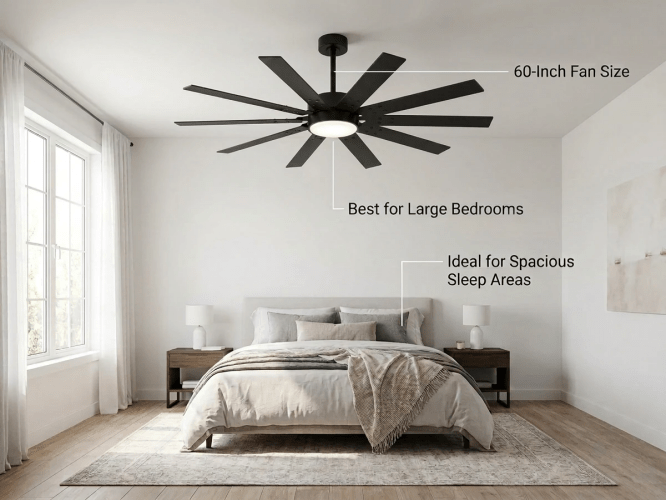
What Is the Best Ceiling Fan for a Large Bedroom?
A large bedroom needs more than a fan that simply looks big enough for the room. The right choice should move air comfortably across the sleeping area without creating unnecessary noise, overwhelming the ceiling, or forcing you to run the fan at full speed every night. For many spacious bedrooms, fans in roughly the 56- to 62-inch range are a useful place to start, but room dimensions, ceiling height, airflow, lighting, and controls matter just as much as blade span. The best fan is the one that fits the room and remains comfortable to live with after the lights go out.
What Size Ceiling Fan Is Best for a Large Bedroom?
Start with the bedroom’s actual length and width rather than choosing a fan by appearance alone. A large square bedroom and a long, narrow bedroom can have the same floor area but need different airflow coverage. Furniture placement also matters because a fan centered over the bed may feel very different from one centered over an open sitting area.
The ranges below are practical shopping references, not rigid rules. Published airflow, the room’s shape, and the fan’s mounting height should always be checked before making a final decision.
| Approximate Bedroom Size | Fan Size to Compare | What Else to Check |
| Up to about 175 sq ft | 44–52 in | Layout, airflow, ceiling height |
| About 175–225 sq ft | 52–56 in | Noise, lighting, clearances |
| About 225–400 sq ft | 56–62 in | Airflow, motor, mounting |
| Oversized primary suite | 60 in+ or a multi-fan assessment | Room shape, zones, ceiling height |
Is a 60-Inch Ceiling Fan Too Big for a Bedroom?
Not necessarily. A 60-inch fan can be a very sensible size for a spacious primary bedroom, especially when the room is around 225 to 400 square feet and has enough clearance around the blade tips. What matters is whether the fan fits the room visually and physically, not whether the number “60” sounds large.
A fan can become too large when its blades sit uncomfortably close to walls, tall furniture, cabinets, or architectural features. Low ceilings can also make a wide fan feel more dominant because the fixture is physically closer to the occupants. In a long or irregular bedroom, an oversized fan in one location may still leave another part of the room under-served.
Before buying, measure the room, check the fan’s total installed height, and confirm the manufacturer’s clearance and mounting requirements. The goal is even, comfortable air movement—not the largest diameter that will fit between the walls.
Why a Quiet DC Motor Matters in a Bedroom
Bedrooms are different from living rooms because the fan may run for many hours while the room is otherwise quiet. A sound that is barely noticeable during the day can become distracting at night. That makes low-speed operation, motor noise, and installation quality especially important.
DC-motor ceiling fans are popular for bedrooms because they usually offer several speed settings and efficient operation. However, motor type is only part of the noise equation. Blade balance, mounting rigidity, hardware, speed, and even the acoustics of the room can affect what you hear from bed.
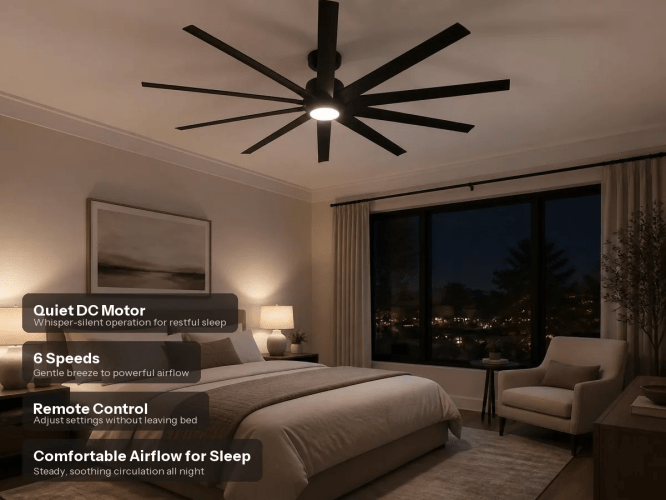
For nighttime use, it is often better to choose a fan that can deliver enough airflow on a lower or middle speed than one that only feels effective at maximum speed. More speed choices also make it easier to adjust airflow as seasons and sleeping preferences change.
How Much Airflow Does a Large Bedroom Ceiling Fan Need?
Airflow is commonly expressed in cubic feet per minute, or CFM. A higher maximum CFM tells you that a fan can move more air under its rated test conditions, but the highest number on a specification sheet is not automatically the best choice for a bedroom.
What matters at night is usable airflow at a comfortable speed. A fan that produces strong movement only on its highest setting may feel drafty or sound more noticeable than a model that provides smooth circulation across several lower settings. Compare the manufacturer’s published airflow with blade span, room size, mounting height, and the location of the bed.
In high-ceiling bedrooms, the distance between the blades and the occupied zone becomes particularly important. The fan may need a suitable downrod so that its airflow is not trapped too close to the ceiling.
Should a Large Bedroom Ceiling Fan Have a Light?
A built-in light is useful when the ceiling fan occupies the room’s main electrical box or when you want one fixture to handle both air movement and general illumination. It can also reduce visual clutter in bedrooms where recessed lighting is limited.
When comparing fans with integrated LEDs, look beyond the fact that a light is included. Check whether the light can be dimmed, whether it offers more than one color temperature, and whether those functions can be adjusted from the remote. Warm light is often preferred in the evening, while a brighter neutral or cool setting may be useful when dressing or cleaning.
A fan without a light can be the better choice when the bedroom already has recessed lighting, bedside lamps, or a separate decorative fixture. In that case, a simpler fan can keep the ceiling visually cleaner and let the room’s lighting scheme work independently.
Which Ceiling Fan Features Matter Most for Sleeping?
Bedroom comfort is often determined by small details that are easy to overlook in a showroom. The most useful features are the ones you can adjust without getting out of bed and the ones that make the fan less intrusive during long periods of use.
· Quiet operation: Look for a well-balanced fan and a motor designed for smooth low-speed use.
· Multiple speeds: More settings make it easier to avoid an all-or-nothing breeze.
· Remote control: Useful for changing speed or lighting from bed.
· Timer: Helpful if you prefer the fan to switch off after you fall asleep.
· Dimmable lighting: Prevents the fan light from feeling too bright late at night.
· Adjustable color temperature: Lets one fixture provide warmer evening light and brighter task light.
· Reversible airflow: Useful for changing circulation patterns between warm and cool seasons.
Best Ceiling Fan for Low, Standard, or High Bedroom Ceilings
Ceiling height can change the right fan even when room size stays the same. A wide fan on a low ceiling needs a different mounting approach from the same-size fan in a vaulted primary suite.
Low ceilings
A flush-mount or low-profile design can help preserve headroom. Pay attention to the complete installed height, not just the blade span. A fan that is technically the right diameter can still feel intrusive if the motor housing and light kit hang too far into the room.
Standard ceilings
Many bedrooms with standard ceiling heights work well with a short downrod or the fan’s standard mounting hardware. This is usually the easiest situation because the fan can sit at a practical height without requiring an extended drop.
High or sloped ceilings
High ceilings often benefit from a longer downrod so that the fan operates closer to the occupied zone. For sloped ceilings, verify the allowed mounting angle and any adapter requirements. A higher ceiling does not automatically mean that you need a larger diameter; mounting height and airflow delivery matter just as much.
Does Blade Count Matter for a Bedroom Ceiling Fan?
A three-blade, four-blade, five-blade, or even ten-blade fan cannot be judged by blade count alone. The motor, blade pitch, blade shape, diameter, RPM, and overall design work together to determine performance.
For a bedroom, choose based on published specifications and the way the fan fits the room rather than assuming that more blades will always be quieter or move more air. Blade count often has a strong visual effect, so it can still matter for style even when it is not a reliable shortcut for performance.
A Real Large-Bedroom Example
One way to make the decision easier is to compare a real model against the criteria above rather than shopping by diameter alone.
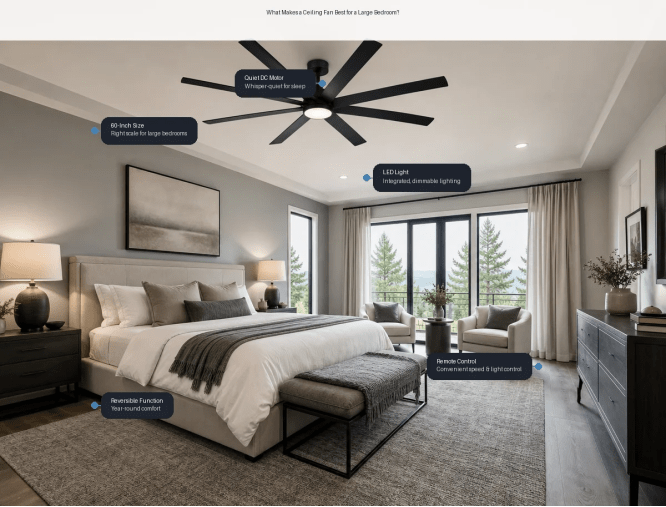
For example, this 60-inch quiet DC ceiling fan with light combines a 60-inch blade span with six fan speeds, reversible operation, remote control, a timer, and an integrated LED light with multiple color-temperature settings. Its product information also positions it for rooms in the roughly 250–400 square-foot range, including bedrooms, and lists both 6-inch and 12-inch downrods for different installation needs.
That combination makes it a useful example of what to look for in a large bedroom: enough size to circulate air across a spacious room, several lower-speed options for nighttime use, lighting that can be adjusted without a separate fixture, and mounting choices that make the fan easier to fit to the ceiling height.
It is still important to check your own room measurements before treating any 60-inch fan as a universal answer. A model that works well in a wide primary suite may not be the right choice for a long narrow room, a low ceiling, or a bedroom with unusually large furniture near the fan’s sweep area.
How to Choose the Best Ceiling Fan for Your Large Bedroom
1. Measure the bedroom: Record both length and width, and note whether the bed is centered in the room.
2. Check the ceiling height: Decide whether you need flush mounting, a short downrod, or a longer drop.
3. Choose a blade-span range: Use room size as a starting point, then confirm clearances.
4. Compare published airflow: Do not judge performance from diameter or blade count alone.
5. Prioritize comfortable low-speed operation: Bedroom fans should remain useful without always running at maximum speed.
6. Decide whether you need a light: Consider existing lamps, recessed lighting, dimming, and color temperature.
7. Check the controls: A remote, timer, reverse function, and several speed settings are particularly useful in bedrooms.
8. Verify installed dimensions: Check downrod length, total hanging height, sloped-ceiling limits, and required clearances.
If you are still comparing sizes, lighting options, and mounting configurations, browsing a broader selection of best ceiling fans for large rooms can help you see how different designs solve the same basic room-size problem in different ways.
Final Takeaway
For a large bedroom, the best ceiling fan is not simply the widest model or the one with the highest maximum airflow. A well-matched fan should fit the room’s dimensions, operate comfortably at night, suit the ceiling height, and provide the lighting and controls you actually use.
A 56- to 62-inch fan is a useful range to compare for many spacious bedrooms, and a 60-inch model can be an excellent fit when the room and clearances support it. The key is to evaluate the complete installation rather than one specification in isolation. Brands such as Breezary offer multiple large-room configurations, but the right choice still begins with your own room measurements, ceiling height, and nighttime comfort preferences.