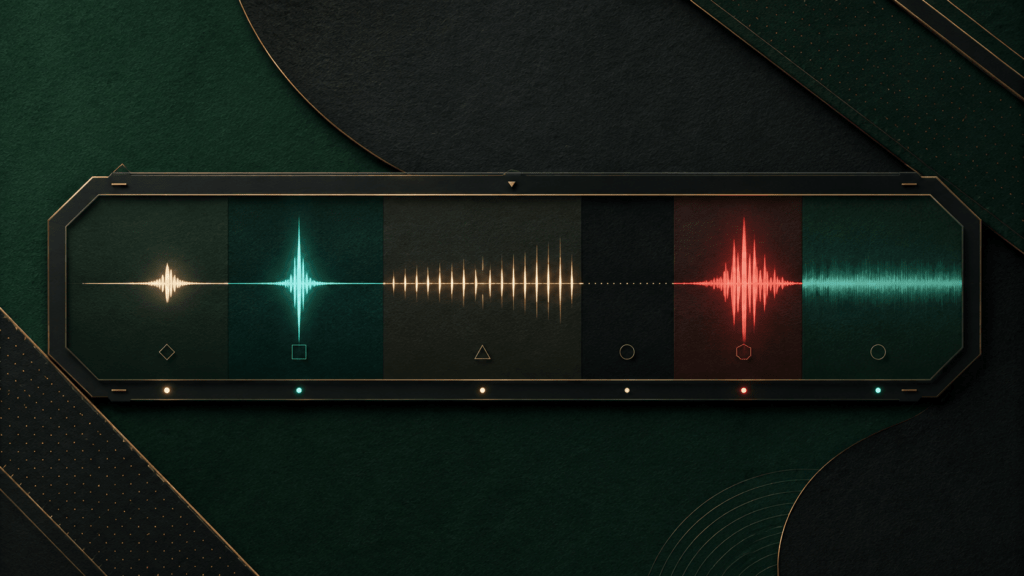
How Casino Game Sounds Mark Each Stage of Play
Casino game sounds usually perform 1 of 5 jobs: confirming an input, marking a state change, pacing a reveal, signaling completion, or establishing atmosphere. Timing separates those functions. A click immediately after a button has been pressed can confirm that the input registered. A rising sequence after choices close may accompany the reveal, while a short closing tone can mark completion. Music that continues while nothing on screen changes is more likely setting a mood than conveying instructions. The sound itself matters less than what happened immediately before it and what changes alongside it.
Audio placement can change how an interactive space is perceived, even when its underlying rules remain the same. In a 2025 Frontiers study, 68 participants experienced two virtual reality scenarios with standard and enhanced localized audio. The enhanced condition improved reported sound quality, immersion, sound localization, and emotional involvement. The commercial game produced a stronger response than the noncommercial simulation, which the researchers associated with differences in sound architecture. Its effects were more spatially organized, so sounds appeared to occupy clearer positions within the simulated environment.
Sound Marks the State of Play
Interactive games often signal the same event in more than one way. A control dims, an animation starts, or a symbol settles while a short tone arrives at the same moment. Together, those changes identify the game state: the part of a round that is open, active, resolving, or complete. Audio feedback is tied to an input or transition, whereas ambient sound can continue without any change to the rules or available actions. Timing separates the two. A cue that repeatedly follows a press or accompanies a visible shift is carrying information; music that continues across several states is usually setting the atmosphere.
An online casino round moves through several observable states: an input window, acceptance, the active event, a reveal, and completion. A cue following a selection belongs to input confirmation; one arriving when the controls close can mark the transition into play. During a Bovada casino online session, matching each sound to this sequence separates functional cues from background audio.
A reel-based round may use repeated tones to pace an unfolding result. Card and wheel formats can leave longer gaps while an action is pending, then introduce a distinct sound when the next stage begins. Live-hosted play adds speech and physical table noise, so a functional signal may be less prominent than it is in an automated format. The same chime cannot carry one fixed meaning across all of these structures. If the display moves from selection to active play at the same instant as the cue, the sound is marking a transition. If the soundtrack changes while the game state remains still, the change is atmospheric. Sounds don’t supply advance information about an unresolved outcome; they accompany an event already in progress or label a state already reached.
Competing audio can conceal those brief signals. A poker guide on focused play recommends putting text messages and unrelated videos aside during a session. Speech from another video, a notification chime, or a second soundtrack can overlap with a confirmation effect, even when the corresponding animation remains visible. The accepted input and the start of the active event then appear to run together. With fewer outside sounds, repeated patterns become easier to distinguish: confirmation follows the input, pacing occupies the reveal, and resolution comes after the displayed outcome is complete. Muting the game entirely removes that additional channel, leaving the screen to communicate every change by itself.
When Music Controls Timing
The puzzle game Lumines Arise binds sound to progression in interesting ways. In a 2025 interview about its audiovisual design, Tetsuya Mizuguchi described player inputs creating sound effects while a timeline moving at the pace of the music clears blocks. Each input is audible, and the musical clock governs when part of the board changes. The soundtrack is therefore involved in feedback and timing at once. Casino formats use different rules, yet their mixes can also layer separate functions. A rising effect may pace a reveal, while another tone marks its completion. Removing either layer changes how the sequence is perceived without altering the recorded result.
Silence Carries State Too
A quiet interval can separate input from reveal, reserve space for the next effect, or make a final sound easier to recognize. Silence gains meaning from the visual sequence around it. A static screen with no audible confirmation leaves an input uncertain; a paused soundtrack during an obvious transition may be deliberate; a gap after completion can clear the mix before the next round begins.
Three observations identify most cues: what changed immediately before the sound, what changed with it, and whether another stage began afterward. A cue synchronized with a visible transition communicates state. Continuous music beneath an unchanged display establishes atmosphere.