Interior Design and Culture: What Defines a Contemporary Living Space in Quebec
A living space is no longer judged solely on its aesthetics: it reflects values, an era, a relationship to the land. Contemporary interior design in Quebec is part of this broader movement, where authenticity and local identity carry as much weight as international trends widely spread online. Understanding what truly shapes a contemporary Quebec interior makes it possible to distinguish a passing trend from a choice that holds meaning over the long term, whether for a home or a commercial space designed to welcome clients. This consideration applies as much to major renovations as to smaller projects, where every decision must nonetheless remain coherent with the whole.
Quebec Identity in the Language of Interior Design
Quebec’s residential landscape bears the marks of several eras: Montreal triplexes with their characteristic exterior staircases, renovated farmhouses, new construction in the suburbs or on the outskirts of major centers. Contemporary design here doesn’t seek to erase this history, but to engage in dialogue with it. This is why we see interiors that blend exposed brick or original woodwork with clean lines and thoroughly modern furniture, rather than a blank slate approach that would strip away the character of the existing building.
Climate also plays a central role in this identity: interiors designed for long winters rely on the warmth of materials, generous light, and living areas grouped around a focal point (fireplace, kitchen island), while summer calls for smooth transitions to the outdoors, including terraces and backyards.
This dual constraint, inheriting a building that is sometimes a century old while working around a demanding climate, explains why Quebec interior design develops solutions of its own rather than simply reproducing Scandinavian or American trends without adaptation.
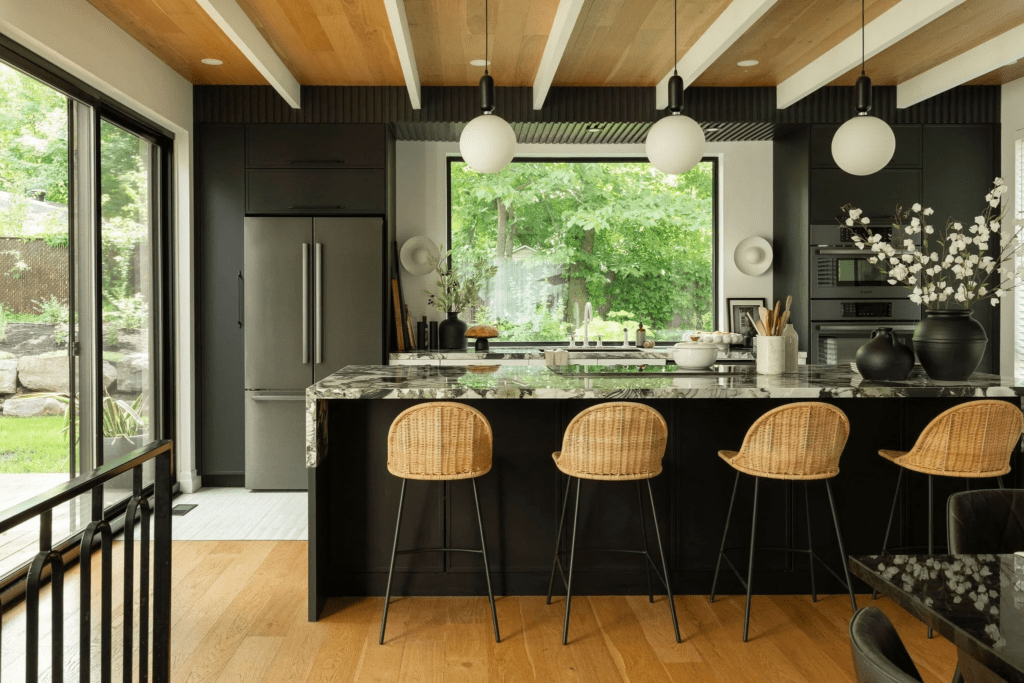
This shows up notably in how main living areas are organized around a source of warmth, whether a traditional fireplace reimagined or a kitchen island that has become the true social hub of the home, an arrangement that directly responds to the long stretches of time spent indoors during the cold season.
A Commitment to Local Craftsmanship and Know-How
Custom furniture is taking on a growing role in residential and commercial projects in Quebec. Rather than furnishing a space with standardized pieces, many homeowners turn to local cabinetmakers and craftspeople for elements designed for a specific space: a kitchen island, a built-in bookcase, a custom counter, a pantry hidden behind a carefully crafted facade.
This approach often costs more than an off the shelf solution, but it produces a result that can’t be found in any other home in the neighborhood, while also supporting a network of specialized craftspeople and subcontractors that forms around each project, from glassworker to steel specialist to cabinetmaker.
This choice to go custom also responds to a very real constraint of Quebec homes, which are often built to dimensions or with quirks that don’t always match imported furniture standards. An angled space, a mansard ceiling, or a structural column then becomes a challenge that only furniture designed specifically for that space can solve elegantly.
A Contemporary Living Space, Between Functionality and Aesthetics
A successful contemporary interior never sacrifices actual use for the sake of appearance. One example of a contemporary residential project illustrates this balanced tension well: a polished look, but designed for the everyday life of a family or a couple, with smooth circulation and storage that stays out of sight but is felt at the right moment.
It’s this balance between beauty and function, more than the choice of a particular color palette, that sets a truly contemporary interior apart from a decor that merely follows images seen online without accounting for the daily reality of its occupants. This requirement is especially evident in a home’s high traffic rooms, such as the kitchen or entryway, where aesthetics must hold up to intensive use without losing character over time.
How Culture Influences Material and Color Choices
- Neutral, natural tones (cream, soft terracotta, sage green) rather than bright, fleeting colors
- Wood, stone, and linen as dominant materials, often raw or lightly processed
- Understated metal accents (brushed brass, blackened steel) rather than showy ones
- A growing place for local art and craftsmanship in final decor
These choices are not arbitrary: they reflect a desire to create interiors that age well and remain relevant beyond a single season’s trend, an especially important consideration in a real estate market where renovations represent a significant investment and where few people want to start over from scratch ten years later.
There’s also a clear move away from palettes that feel too cold or too uniform, in favor of combinations that echo the local landscape: the forest, the stone of the Laurentians, the distinctive light of the in-between seasons.
This return to tones more rooted in the local landscape can be seen as much in homes as in certain businesses seeking to create a warm atmosphere rather than a cold, impersonal aesthetic, particularly in the restaurant and hospitality sectors.
Toward a Local Signature Rather Than an Imported Trend
Many local professionals, including the team behind rubikcreates.com, emphasize this sense of identity rather than simply importing international trends. The result isn’t a fixed style, but a way of approaching each project based on the building, the climate, and the lifestyle of the people living in it, rather than a template repeated from one project to the next.
This approach requires more time upfront on a project, particularly to properly understand the client’s real needs before proposing solutions, but it largely explains why certain contemporary Quebec interiors stand out for their coherence rather than for simply following a trend.
A Relationship with Nature as a Common Thread
Another cultural trait running through contemporary Quebec interior design is the close relationship maintained with the surrounding nature, whether a wooded area on the edge of the city, a lake in the Laurentians, or simply a well oriented backyard. This proximity directly shapes design choices: large openings to the outdoors, materials that echo the landscape (wood, stone, mineral tones), and transitions designed between indoor and outdoor spaces rather than a sharp line between the two.
This connection to nature isn’t just an aesthetic matter: it also responds to a need for renewal, one that has become especially present since remote work brought part of the population closer to their immediate surroundings for long stretches of the day. A living room that opens onto a garden or a well designed yard then becomes an extension of a lifestyle, not just a backdrop.
A Design That Stays Rooted in Its Territory
Contemporary interior design in Quebec cannot be reduced to a minimalist aesthetic imported from elsewhere. It is built from the existing structure, the climate, and a genuine appreciation for local craftsmanship. The spaces that stand the test of time best are rarely the ones that follow a trend to the letter, but those that stay true to this identity while concretely meeting the needs of the people who live in them every day.