How to Design Understated Wedding Florals for a Modern New York Venue
New York wedding venues rarely need help making an impression. A rooftop already has the skyline. A downtown loft offers scale, light, and architectural texture. A historic hotel may come with marble floors, decorative moldings, and rooms that carry their own sense of occasion.
The challenge is not filling these spaces. It is knowing what to leave alone.
Wedding florals feel most refined when they respond to the venue rather than compete with it. Instead of placing an arrangement in every available corner, couples can use flowers to frame the most meaningful moments of the celebration, guide guests through the space, and establish a sense of rhythm that feels intentional from ceremony to dinner.
Let the Venue Lead the Design
A floral plan should begin with the room, not with a collection of isolated inspiration images.
In a minimalist loft, flowers can soften concrete, steel, and large windows without concealing the building’s character. A historic townhouse may call for arrangements that respect its proportions and decorative detail. On a rooftop, the skyline is already the dominant feature, so floral designs often work best when they complement the view rather than trying to become a competing backdrop.
Before selecting flowers, study the venue at the approximate time the wedding will take place. Notice where natural light enters, which walls or architectural features attract attention, and how guests will move from one part of the event to another.
This reveals where flowers will have the greatest effect. It may be the ceremony entrance, the area where vows are exchanged, the escort-card table, or a single arrangement anchoring the reception room.
A venue with strong architecture may need fewer flowers, but each arrangement should have a clear purpose.
Create One Memorable Floral Moment
Not every part of a wedding needs equal decorative emphasis.
A more considered approach is to choose one primary floral moment and allow the remaining arrangements to support it. This might be an asymmetrical ceremony structure, a sculptural entrance arrangement, or a long installation above the main dinner table.
A clear focal point gives the room clear hierarchy. Guests understand where to look, and the main photographs gain a recognizable setting. Smaller arrangements can then repeat selected colors, flowers, or shapes without competing for attention.
This is also where material choice becomes part of the design conversation. Fresh flowers bring natural variation and fragrance, while carefully designed faux arrangements make it easier to review color, scale, and overall shape before the wedding. Couples comparing Rinlong faux wedding flowers with fresh alternatives can also use a finished bridal bouquet as a visual reference when planning the ceremony and reception florals.
The objective is not to make every arrangement identical. It is to give them enough shared language that the wedding feels composed rather than decorated piece by piece.
Use Texture Instead of Excess Color
Understated does not have to mean plain.
A restrained palette becomes more interesting when it includes variation in shape, surface, and scale. Smooth petals can sit beside softer, ruffled flowers. Fine greenery can contrast with broader leaves. Small blossoms can create movement around one or two larger focal flowers.
This use of texture is especially effective in urban venues, where flowers may be set against brick, plaster, glass, stone, or metal. Rather than introducing many competing colors, a designer can build depth through materials.
A white arrangement, for example, might include ivory, cream, and soft neutral shades rather than one uniform white. Greenery can range from pale sage to deeper forest tones. These differences are subtle in person but help the flowers retain dimension under changing light.
Repeating a few textures throughout the wedding also creates continuity. The same fine greenery used in the bridal bouquet may appear again in the ceremony arrangement and on the dinner tables, connecting the spaces without copying the design exactly.
Give the Bridal Bouquet Its Own Proportion
The bridal bouquet is both a floral arrangement and a fashion accessory. It should be considered alongside the dress, silhouette, jewelry, and overall level of formality.
A bouquet that is too wide can hide the waistline or bodice of a dress. A very long cascading design changes the silhouette of the body. A compact bouquet feels polished and controlled, while a loose, asymmetrical shape introduces movement.
None of these approaches is inherently better. The right proportion depends on what the bouquet is meant to accompany.
As a practical rule, the bouquet should frame the dress rather than cover its waistline, bodice details, or natural silhouette in photographs.
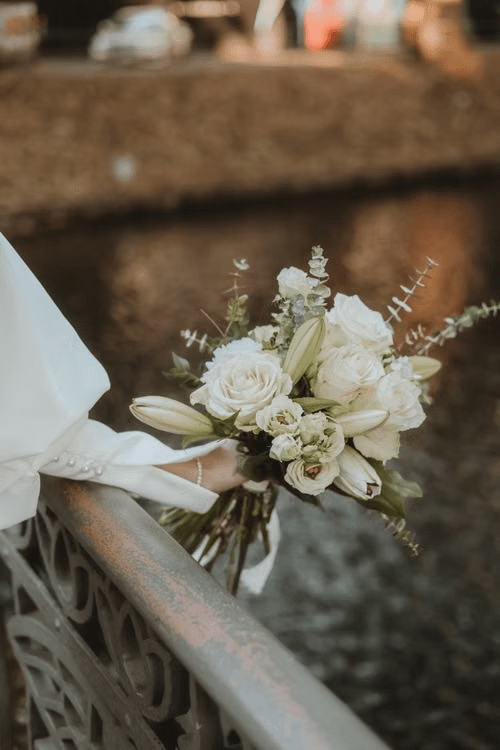
White and green arrangements are particularly adaptable because they can feel formal without becoming overly dense. A white-and-green design—such as a Rinlong white bridal bouquet with greenery—can complement a tailored city-hall look, a traditional gown, or a simpler dress worn at an intimate restaurant wedding.
The greenery matters as much as the flowers. Pale sage leaves create a softer, more romantic outline, while deeper eucalyptus or olive tones add stronger contrast against white or ivory clothing. It can also connect the bouquet with the venue, particularly when the celebration includes a terrace, courtyard, or view of a nearby park.
Keep Reception Tables Social
A beautiful table should still function as a place where people can dine and talk.
Large centerpieces can transform a room, but height and width must be carefully managed. An arrangement placed directly at eye level may look impressive from a distance while making conversation difficult once guests are seated.
Low florals should leave enough space for glassware, shared dishes, candles, menus, and personal belongings. Taller designs work best when their main volume sits clearly above the guests’ sightlines.
The shape of the table also influences the floral plan. Long tables often look more natural with a sequence of smaller arrangements, greenery, or candles rather than a single large centerpiece. Round tables can accommodate one central composition, but it should be scaled to the table diameter and number of place settings.
Flowers do not need to occupy every gap. Negative space allows the table materials, linens, tableware, and food presentation to contribute to the design.
Plan for New York Logistics
Even the most elegant floral concept must survive the practical conditions of a city wedding.
Loading access may be limited. Elevators can be small or shared with hotel guests. Street parking may be unavailable, and venues often provide narrow setup windows between other events. A large arrangement that looks effortless in a rendering may be difficult to transport through a service entrance.
Before finalizing the floral plan, ask the venue four practical questions:
- What time can the florist or installation team enter?
- Is a freight elevator available, and does it need to be reserved?
- Can large floral structures be assembled on-site?
- How quickly must all décor be removed after the reception?
These details may determine whether a single large installation or several smaller, preassembled pieces are the more realistic choice.
Before approving a design, confirm the dimensions of elevators, doorways, staircases, and loading areas. Ask when vendors can enter the venue and whether large arrangements must be assembled on-site. If the ceremony and reception take place in different rooms, determine who will move the flowers and how much time is available.
Durable, preassembled floral pieces may be useful where setup time is restricted, but they still need protective packing and clear labels. Every arrangement should have a designated location so the installation team does not have to make design decisions during a rushed load-in.
Good logistics are largely invisible to guests. That invisibility is part of what makes the final room feel effortless.
Know When the Design Is Finished
Wedding planning encourages accumulation. It is easy to keep adding flowers to another table, another sign, or another unused corner.
A more refined result often comes from editing. Once the ceremony has a focal point, the bouquet has a clear relationship with the clothing, and the tables feel balanced, additional arrangements may not improve the room.
Walk through the celebration from a guest’s perspective. Consider the entrance, ceremony view, cocktail area, and dinner table in sequence. If each space has one intentional detail and the transitions feel connected, the floral design is doing its job.
Modern luxury is not measured by how many flowers appear in a room. It is expressed through proportion, material, placement, and restraint. In a city filled with visually powerful spaces, the most memorable wedding flowers are often the ones that understand where they belong.