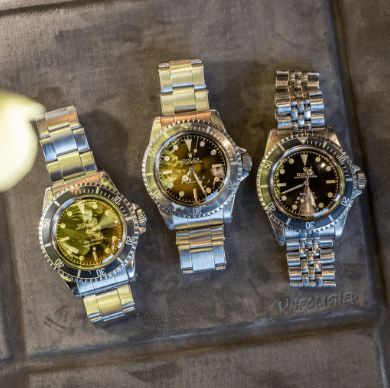
Safe Queens: Why Some Collectors Now Leave the Real Rolex at Home
Ask a private client jeweler on Madison Avenue what changed in the last five years and you will hear a version of the same story: clients are still buying serious watches, they are just wearing them less. Pieces worth forty, eighty, two hundred thousand dollars go into the safe, the safe deposit box, the insurance-approved home vault, and something else goes on the wrist for Tuesday.
Collectors call the stored piece a safe queen, and the habit stopped being eccentric around the time wrist-snatching became a category of crime statistics. Watch theft in major cities has professionalized: spotters work restaurant terraces and hotel lobbies, identify the Daytona or the Patek from across the room, and the follow-home robbery happens hours later. Insurers noticed before anyone else. Premiums for worn high-value watches climbed hard, and some policies now price a watch differently depending on whether it leaves the house at all.
So the two-watch strategy was born, and it is more common than most people admit at dinner.
One watch for the story, one for the street
Logic first. A collector who owns a genuine GMT-Master did not stop loving it. What stopped making sense was exposing six figures of metal to a city where the watch can be read from thirty feet. For travel the calculation is even starker: certain destinations are now effectively no-go zones for visible luxury watches, and seasoned travelers either wear nothing or wear something they can afford to lose.
Into that gap stepped the modern replica industry, and it arrived far more capable than its reputation. Top-tier copies, sold as super clones, are built on movements that copy the genuine caliber’s architecture, cased in the correct steel at the correct weight, with dials that survive closer inspection than any street thief will ever perform. Sellers in this tier operate openly with spec sheets and QC photos of the actual unit before shipping; swissclone.io publishes a plain-language explainer on how its two quality grades differ, which is the kind of transparency the category’s older reputation never included.
Prices tell the story of why the strategy works. A convincing stand-in runs a few hundred to a bit over a thousand dollars. Against a stolen-watch claim, a raised premium, or the simple stomach-drop of a scratched six-figure bezel, the arithmetic explains itself.
Etiquette, since this is still a small world
Nobody in the trade pretends this is uncomplicated. A few points of etiquette have emerged among people who run two wrists.
First, the stand-in is a security tool, not a lie to sell. Wearing one to dinner is one thing; passing one off in a sale or a trade is fraud, full stop.
Second, know your rooms. At a collector event, wrists get read by people who handle these watches daily. Wearing the copy there defeats the purpose and burns credibility. Wear the real one where it is loved, the stand-in where it is merely seen.
Third, the copy needs to be good, or the exercise collapses. A rattling bracelet and a misprinted dial protect nothing except the thief’s time.
Pushback from the purists
Not everyone applauds. A vocal wing of the collecting world considers the safe queen a small tragedy: watches are machines, machines want running, and a Daytona that lives in foam is furniture. Dealers add a practical note to the sentiment, because movements that sit for years gum up their oils, and a service bill arrives right when the piece finally sells. Their prescription is to wear everything, insure it properly, and treat the risk as part of ownership.
Both positions can be right at once. A watch worn in the rooms where it is appreciated, stored through the streets where it is merely hunted, splits the difference without much philosophical damage. Insurance underwriters, notably, have no romantic wing.
What the safe queen phenomenon really documents is a shift in what the watch on the wrist is asked to do. For a century it carried both jobs at once: the private satisfaction of the object and the public signal of it. In cities where the signal now attracts the wrong readers, collectors have quietly split the two jobs across two watches. Whether that is a sensible adaptation or a small surrender to the times is an argument for the dinner table. Either way, it is happening, and the smart money stopped being embarrassed about it.