Best Budget Rollators vs Premium Rollators: What You Actually Get for the Money
The main difference between budget and premium rollators is not basic mobility. Both can help with walking support. The real difference is how easy the rollator feels to lift, fold, steer, sit on, and use outside the home.
Budget rollators usually work best for short indoor use or occasional errands. If you are comparing a rolling walker for daily mobility, the real question is how often it will be lifted, folded, steered, and used outdoors. Premium rollators are usually better for people who walk outside often, need a more compact fold, or want a more comfortable seat and smoother wheels. This guide breaks down the key differences so you can choose the right rollator without paying for features you may not need.
Budget Rollators vs Premium Rollators at a Glance
Before looking at the details, here is a simple comparison of what you usually get at each price level.
| Feature | Budget Rollators | Premium Rollators |
| Typical Price | Often under about $130 | Often $180–$500 |
| Frame Material | Often steel or basic aluminum | Aluminum or reinforced lightweight frame designs |
| Total Weight | Often heavier | Usually lighter or easier to fold and move |
| Wheel Size | Often 6-inch hard wheels | Often 8-inch wheels for better outdoor handling |
| Weight Capacity | Often around 250 lbs | Often 300–400 lbs, depending on model |
| Seat | Basic padded seat | Wider or more comfortable seat design |
| Folded Size | Basic fold | More compact travel-friendly fold |
| Brakes | Basic loop brakes, varies by model | Easier locking and better brake control |
| Best For | Indoor use, occasional support | Frequent use, outdoor walks, errands, travel |
The price difference usually pays for easier handling, smoother outdoor movement, better seat comfort, and a fold that is easier to store or transport.
What Counts as a Budget or Premium Rolling Walker?
In the North American retail market, budget rollators usually refer to entry-level models priced under about $130. These often use heavier frames, smaller wheels, and simpler folding systems. They can provide basic walking support, but they may feel less convenient outdoors or when lifted into a car.
Premium rollators are usually priced higher because they focus on transport, comfort, and repeated daily use. They often use better frame materials, larger wheels, more comfortable seats, and compact folding designs. The choice is not simply good versus bad. It depends on how often the user walks, where they walk, and whether the rollator needs to be lifted, folded, or transported often.
What You Get with a Budget Rolling Walker
A budget rolling walker can be good enough for simple situations. If the user mostly needs support around the home, in hallways, or during short trips, an entry-level model may do the job. The limitations usually become clearer when it is used outside, folded often, or lifted into a vehicle.
Basic Frame and Everyday Support
Many budget rollators use steel or basic aluminum frames. Steel can be strong and affordable, but it often makes the rollator heavier. That extra weight matters if the user or caregiver has to lift it into a trunk, carry it up steps, or move it in and out of storage often.
Simple Wheels and Brakes
Budget models often use smaller hard wheels. These may work fine on smooth floors, but they can feel rougher on sidewalk cracks, tile gaps, thresholds, and uneven pavement. Brake quality also varies, so check whether the brakes are easy to squeeze, easy to lock, and stable when the seat is used.
Basic Seat and Storage
Budget seats are often flatter, narrower, or less padded than premium seats. This may not matter for quick breaks, but it can become a problem if the user needs to sit often during walks, appointments, or shopping trips. Storage is also usually basic, with a simple pouch or bag for small personal items.
What Premium Rollators Usually Add
A premium rollator is not just a more expensive version of the same product. The higher price usually comes from design details that make the rollator easier to use every day.
Lighter or Stronger Materials
Premium rollators often use lighter frame designs, reinforced joints, and better folding hardware. The goal is to make the rollator easier to lift, control, and store during regular use.
Better Seat Comfort
A better seat can make a noticeable difference for users who need rest breaks. Premium rollators may offer a wider seat, better padding, or a more supportive shape. This is useful for people who stop often while shopping, walking outdoors, waiting at appointments, or recovering after surgery. For post-surgery recovery, the final choice should still follow advice from a doctor or physical therapist.
Smoother Wheels for Outdoor Use
Larger 8-inch wheels are usually better for sidewalks, small bumps, and outdoor paths than smaller 6-inch wheels. They do not turn a rollator into an all-terrain device, but they can make everyday outdoor walking feel smoother and less tiring.
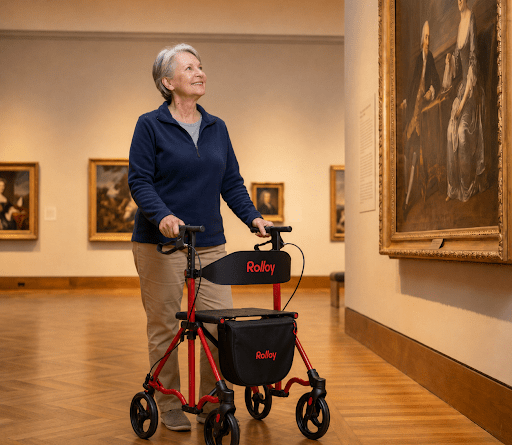
For example, the Rolloy Compact Master II uses 8-inch wheels, locking hand brakes, a seat, and a compact folding design. That makes it more suitable for outdoor errands and travel than many basic indoor-style rollators.
Easier Folding and Transport
Folding design is one of the clearest differences between budget and premium models. A basic rollator may fold flat, but it can still be bulky. A premium travel-focused model may fold into a more compact shape, making it easier to place in a car trunk, move through an airport, or store in a small home.
Rollators with Seats: Where the Price Difference Shows Most
Models with seats show the price difference clearly. If you are comparing walkers with seats, look beyond whether the product has a cushion. Check seat width, brake locking, frame stability, and folded size.
A basic seat may be enough for a short pause, but it may not feel comfortable if the user needs to sit often. Premium rollators usually focus more on seat width, surface texture, padding, brake locking, and under-seat storage. For users who need frequent rest breaks, these details can make shopping, appointments, and neighborhood walks easier to manage.
Budget vs Premium Rollators for Daily Use
Specifications only matter when they match real life. The best choice depends on where the rollator will be used most often.
For Indoor Use
If daily use is mostly indoors, a simple rollator with smaller wheels may be enough. Smooth floors, short walking distances, and predictable spaces do not require every premium feature.
For Shopping and Errands
Shopping trips involve automatic doors, parking lots, elevator thresholds, narrow aisles, and longer walking distances. In these situations, a lighter frame, smoother wheels, stronger brakes, and a better seat can make a rollator easier to use.
For Travel
Travel is where the limits of many budget models become more noticeable. A heavier or bulkier rollator may be harder to load into a car, move through an airport, or handle during transfers.
A compact model such as the Rolloy Compact Master II is easier to move through airports and may be easier for airline staff to handle if gate check is needed. Do not assume any rollator will fit in an overhead bin. Cabin storage depends on the aircraft, airline policy, and available space.
For Uneven Pavements and Outdoor Walks
Outdoor use is where wheel size and frame stability matter most. Sidewalk seams, tree roots, curb cuts, gravel paths, and driveway edges can all make a small-wheel rollator feel less steady. If the user walks outside often, larger wheels and better brake control are usually worth considering.
When a Budget Rolling Walker Is Enough
A budget rolling walker can be a practical choice if the user only needs short indoor support, occasional help around the home, or a simple backup device. It may also be enough if the user’s body weight is well below the model’s listed weight capacity and the rollator does not need to be folded or lifted often.
In this low-frequency, single-environment use, spending more may not improve the daily experience very much. The key is to make sure the rollator fits the user’s height, has brakes that lock securely, and feels stable during basic walking and sitting.
When a Premium Rollator Is Worth the Money
A premium rollator is more likely to be worth the cost if the user walks outdoors several times a week, loads the rollator into a car often, travels regularly, or needs to sit and rest during errands. It can also be a better choice if the user or caregiver finds a heavier rollator difficult to lift.
The value comes from repeated daily use. A few pounds of weight, a better fold, larger wheels, and a more comfortable seat may not sound like much on paper, but these details can make daily walking and transport easier.
How to Choose the Right Rollator Without Overspending
The best way to choose is to spend money on features the user will actually use. A premium model is not always necessary, but the cheapest model is not always the best value either.
Check the Weight Limit First
Start with the listed weight capacity. The user’s body weight should be comfortably below the model’s limit. Do not choose a rollator that barely meets the requirement, especially if the user plans to sit on it often.
Match Wheel Size to Where You Walk
Choose smaller wheels if the rollator will mainly be used indoors on smooth floors. Choose larger wheels if the user often walks outdoors, crosses thresholds, or moves over uneven sidewalks. For most outdoor use, 8-inch wheels are a better choice than small indoor-style wheels.
Compare Seat Height and Handle Height
Fit matters more than price. When seated, the user’s feet should rest flat on the floor and the knees should bend comfortably. When standing, the handles should line up near the wrist when the arm hangs naturally at the side.
Think About Lifting, Folding, and Storage
A rollator that works well in the store may still be a poor choice if it is too heavy to lift or too bulky to store. If the user needs to load it into a car often, every pound matters. If storage space is limited, folded size matters as much as open size.
Final Verdict: Which Rollator Gives Better Value?
Budget rollators save money upfront. Premium rollators usually save effort over time. If the user only needs occasional indoor support, a budget model can be a sensible choice. If the user walks outdoors, travels, shops, or uses the rollator every day, a premium model is often the better long-term value.
The smartest choice is not the most expensive model. It is the model that matches the user’s real routine. Focus on weight capacity, wheel size, seat comfort, brake control, and folding design. Those are the features that decide whether a rollator feels easy to use after the first week.