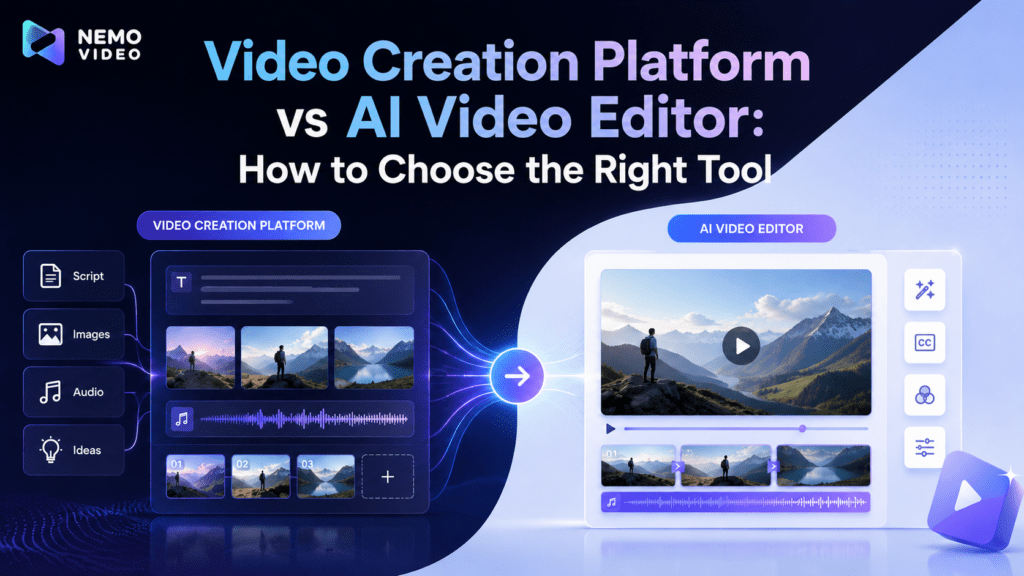
Video Creation Platform vs AI Video Editor: How to Choose the Right Tool
If you’ve spent any time trying to produce video content consistently — for a brand, a business, or a personal audience — you already know the hardest part isn’t coming up with ideas. It’s the gap between having an idea on Monday and having a finished, publish-ready video by Thursday.
That gap is a production problem. And in 2026, two categories of tools are competing to solve it: general-purpose video creation platforms and dedicated AI video editors. Both involve AI. But they serve different needs, and picking the wrong one for your workflow can cost you weeks of frustration before you realize the mismatch.
This guide breaks down what each category actually does, who it’s built for, and how to decide which one fits the way you actually work.
What a Video Creation Platform Does
A video creation platform is a broad-use tool designed to take almost any input — a product link, a written script, a folder of raw clips, a blog post URL — and turn it into a finished video with minimal manual work. The emphasis is on covering the full workflow: you don’t need polished assets or a detailed production plan to get started. You drop in what you have, and the platform handles the rest.
This category works well for teams or individuals producing content across multiple formats and channels at the same time. If your week involves turning a product launch into a TikTok clip, a YouTube Short, and an Instagram Reel — all from the same source material — a video creation platform is built for that kind of output. The AI handles resizing, captions, pacing, and platform-specific formatting without you touching a timeline.
This type of tool matters most when the bottleneck is volume, not craft. You’re not trying to create one exceptional piece — you’re trying to keep up a consistent publishing schedule without burning out your team or your budget.
What an AI Video Editor Is Built For
An AI video editor has a different priority. Instead of maximizing output, it focuses on the quality of editorial decisions within the editing process: which clips to keep, where to cut, how to match visuals to narration, how to pace a sequence so viewers actually stay.
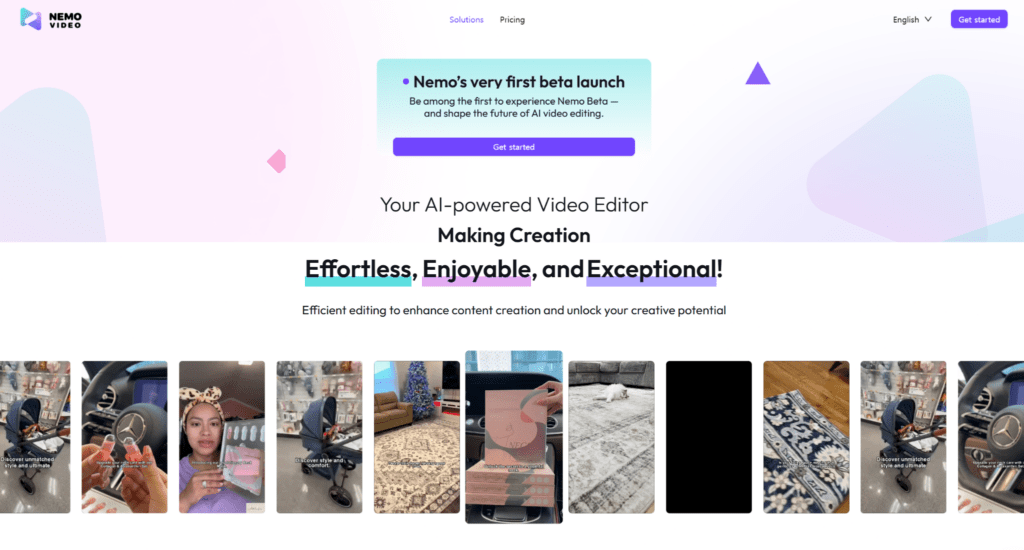
The biggest shift in this category is the interface. Traditional editing software makes you manually work through a timeline — dragging clips, trimming frames, setting transitions by hand. A good AI video editor for creators replaces much of that with a conversational approach: you describe what you want, and the AI executes it. Say “make this section faster” or “cut the first 10 seconds” and the edit happens. The tool works less like software and more like an editing assistant who can take direction in plain language.
This is especially useful for creators who care about the specific feel and flow of their content, not just whether it goes live. Coaches, consultants, e-commerce brands, and anyone whose videos directly drive sales tend to benefit more here — because the quality of each individual video has a direct impact on results.
The Practical Differences
It helps to think about where each tool fits in a typical production week.
Video creation platforms are strongest at the front end of your workflow — gathering assets, generating a first cut, and exporting across platforms. If your process starts with a raw idea or a product URL and ends with several formatted clips ready to schedule, a platform-style tool handles that chain with the least friction.
AI video editors are strongest once you have a clear creative direction and need the execution to match it. They give you more control over the final output without requiring technical editing skills — which means the gap between what you imagined and what the video actually looks like gets a lot smaller.
Some tools are starting to cover both ends of this range, combining high-volume workflow features with editor-level AI decision-making. The AI video market is growing quickly — from under $1 billion in 2023 to a projected $4.4 billion by 2033 — and as a result, more tools are consolidating these capabilities into a single product.
How to Choose
The clearest signal is volume versus quality.
If your main constraint is volume — you need more content, faster, across more channels — start with a video creation platform. Ask yourself: can this tool take what I have right now and produce something usable without me rebuilding my entire workflow around it?
If your main constraint is quality per video — each piece needs to convert, retain attention, or represent your brand at a specific standard — invest time in an AI video editor. Ask yourself: can I give this tool clear direction and trust it to follow through accurately?
A secondary signal is your existing experience. Video creation platforms are generally designed to require no prior editing knowledge, making them accessible to marketing generalists and small-business owners who need output quickly. AI video editors vary — some still assume familiarity with production concepts, while newer conversational editors are designed to remove that prerequisite entirely.
AI Tools Handle Execution — You Keep the Creative Direction
One concern that comes up often is whether AI tools produce generic-looking content. It’s a fair question. The answer depends on the tool and how you use it.
The better platforms and editors in both categories are built on the same principle: AI handles execution, not creative judgment. You bring the direction — the tone, the message, the target audience — and the AI handles the mechanical work. NemoVideo, for example, keeps all AI-generated decisions fully adjustable, so the creator’s original intent stays intact rather than getting overridden by a templated output.
The risk of generic content comes from handing over too much creative input, not from using AI itself.
Which Tool Should You Actually Start With?
Video creation platforms and AI video editors solve different problems. One optimizes for how much you can produce; the other optimizes for how well each piece performs. The right choice depends on where your current workflow breaks down — and being clear about that saves a lot of time spent on the wrong tool.
For most content professionals in 2026, the answer isn’t one or the other permanently. It’s knowing which tool to reach for depending on what a given project actually needs.