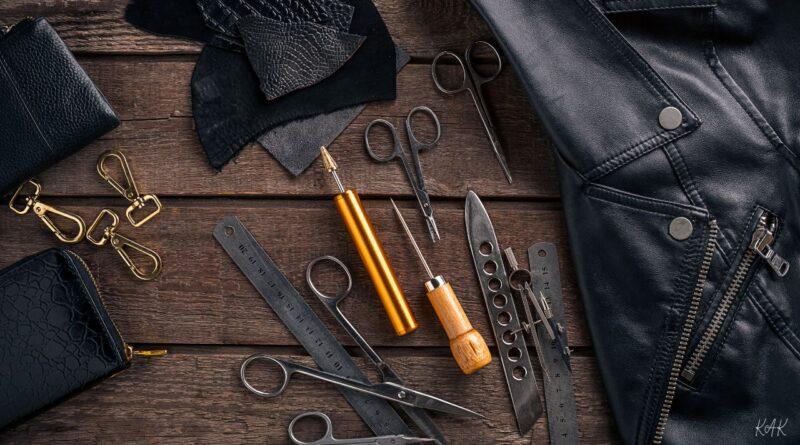
Why Can the Wrong Micro-Drop of Liquid Ruin a $5,000 Leather Hide?
Step into the workshop of a master saddlemaker, a bespoke shoemaker, or an artisan crafting luxury automotive interiors, and you will immediately notice the sensory details. The rich, earthy scent of tanned hides, the precise layout of specialized tools, and the heavy, rhythmic thud of a commercial walking-foot sewing machine.
In this environment, the stakes are incredibly high. Unlike fabric, which can be unpicked and restitched if a mistake is made, leather is unforgiving. Every single needle puncture is a permanent alteration of the organic material. A craftsman can spend forty hours cutting, skiving, and tooling a piece of premium full-grain leather, only for the entire project to face its most dangerous hurdle in the final minutes of assembly: the mechanical stitching process.
While a skipped stitch or a snapped thread is frustrating, the absolute worst-case scenario for a leatherworker isn’t mechanical failure. It is chemical contamination. A single, microscopic drop of the wrong fluid escaping from the internal mechanics of the sewing machine can instantly and permanently ruin a piece of leather worth thousands of dollars.
To understand why this happens, and the intense engineering required to prevent it, we have to look at the violent physics of high-speed stitching and the thirsty, organic nature of leather itself.
The Thermal Reality of High-Speed Steel
A heavy-duty sewing machine is a marvel of kinetic timing. When stitching through multiple layers of dense harness leather, the machine’s internal components—the needle bar, the rotary hook, the connecting rods, and the oscillating shafts—are moving at blinding speeds. Even at a modest commercial pace of 1,500 to 3,000 stitches per minute, the metal-on-metal friction generated inside the cast-iron housing is immense.
Without a friction modifier, this kinetic energy immediately converts into heat. The steel components would suffer from thermal expansion, meaning the metal would physically swell. Within minutes, the tightly toleranced gears would bind, the rotary hook would lock up, and the machine would essentially tear itself apart.
To prevent this, the internal mechanics must be constantly bathed in a protective fluid barrier. This fluid must be viscous enough to cling to spinning metal shafts without being flung off by centrifugal force, yet thin enough to penetrate microscopic tolerances between gears.
The Thirsty Canvas
The necessity of this fluid creates a massive problem for the leatherworker. By its very nature, leather is a highly porous, organic matrix. During the tanning process—especially vegetable tanning, which utilizes tree bark and natural tannins—the animal hide is stripped of its natural fats and moisture, leaving behind a fibrous structure that eagerly absorbs whatever it touches.
If a mechanic were to lubricate a sewing machine with a standard household lubricant, an automotive motor oil, or an aerosol penetrant, the results would be disastrous. These generic
liquids are packed with detergents, rust inhibitors, and heavy dyes. They are designed to withstand combustion engines or break down oxidized rust, not to be clean.
If even a fractional droplet of these generic oils travels down the needle bar or is cast off the spinning rotary hook and lands on the leather, the hide acts like a sponge. The oil wicks deep into the fibrous cellular structure. Because these oils contain colored additives and heavy hydrocarbons, they instantly bond with the natural tannins in the leather. The result is a dark, spreading, permanent stain. You cannot wash it out, you cannot bleach it, and because the oil repels water, you cannot even dye the rest of the leather to match it. The piece is ruined.
Engineering the “Lily White” Barrier
To solve the paradox of needing aggressive mechanical protection without risking catastrophic material staining, chemical engineers had to develop a highly specialized class of fluid.
The solution is found in a substance universally referred to in the trade as “lily white” oil. This specialized industrial sewing machine oil is a highly refined, low-viscosity mineral oil. The refining process is brutal and exacting. The raw petroleum is subjected to intense hydro treating, a process that utilizes hydrogen gas and extreme pressure to strip away absolutely all impurities, sulfur compounds, and aromatics.
The resulting fluid is completely clear—visually indistinguishable from water. It possesses zero color, zero odor, and contains no detergents or harsh chemical additives.
Its physical properties are perfectly tailored to the environment. It provides the exact hydrodynamic film strength required to keep steel gears from grinding against each other at 3,000 RPM, but because it is completely devoid of impurities, it behaves differently if an accident occurs. If a microscopic mist of this highly refined fluid does manage to reach the leather, its clear nature means it is vastly less likely to leave a permanent, visible dark spot, especially once it diffuses into the hide.
The Micro-Drop Economy
Even with this chemically pure fluid, modern heavy-duty machines are engineered to deliver it with surgical precision to minimize any risk of leakage.
Older machines relied on the operator to manually apply drops of fluid to dozens of external oiling holes—a process highly prone to human error and over-lubrication. Today, advanced leather machines utilize sophisticated semi-automated delivery systems. They employ internal gravity feeds, sealed oil baths, and intricate networks of porous wicks that draw exactly the right amount of fluid—fractions of a drop at a time—directly to the friction points via capillary action.
This creates a perfect equilibrium. The machine receives exactly enough lubrication to survive the violent physics of its own operation, and the exterior remains bone-dry, protecting the precious material passing beneath the needle.
The Unseen Guardian
When we admire a beautifully stitched leather satchel or a perfectly tailored leather car seat, we appreciate the skill of the human hands that guided the material and the raw power of the machine that pierced it.
We rarely think about the invisible, molecular barrier standing between those two forces. But without that crystal-clear, highly refined fluid silently doing its job inside the cast-iron housing, the marriage of heavy industrial machinery and delicate artisanal craftsmanship would be completely impossible.