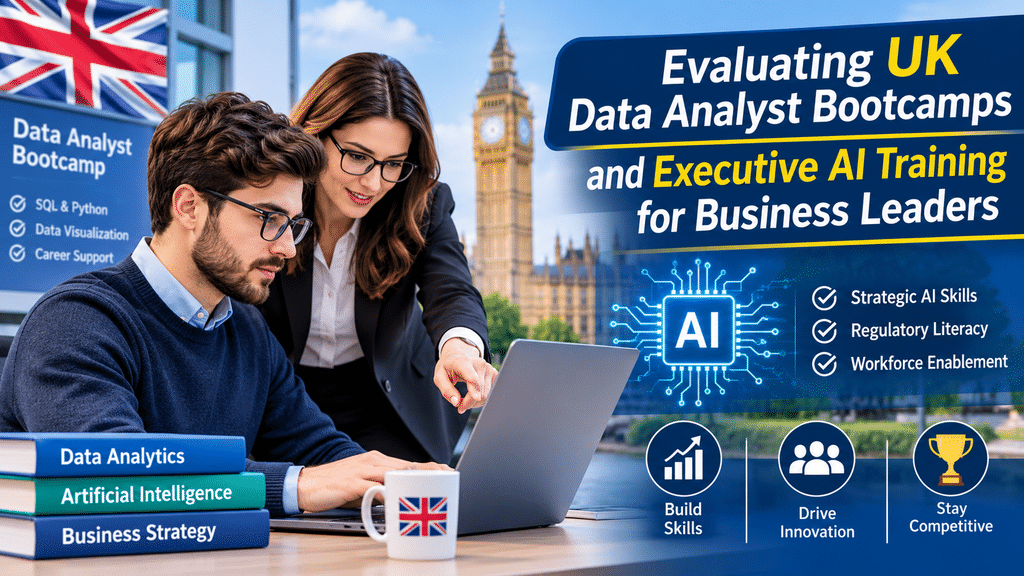
Evaluating UK Data Analyst Bootcamps and Executive AI Training for Business Leaders
The demand for data-driven decision-making and artificial intelligence expertise is reshaping the modern UK business environment. Organisations across finance healthcare retail technology and professional services increasingly depend on data analytics and AI-powered systems to improve efficiency identify opportunities and remain competitive. As a result professional education is evolving to meet the needs of both aspiring data analysts and experienced business leaders.
Two important areas of development are practical data analytics training and executive-level artificial intelligence education. While data analyst bootcamps help individuals develop technical capabilities executive AI programmes prepare senior professionals to understand emerging technologies evaluate business opportunities and manage organisational transformation.
Understanding the Growing Demand for Data Analytics Skills in the UK
Data analytics has become an essential business function rather than a specialist activity limited to technology departments. Companies use analytical insights to understand customer behaviour monitor operational performance forecast demand, and support strategic planning.
This shift has increased demand for professionals who can work confidently with tools such as SQL Python Excel Power BI and Tableau.
Employers increasingly value candidates who can translate complex datasets into meaningful business recommendations.
However, selecting an appropriate training programme requires more than comparing course prices or advertised completion times. Learners should examine curriculum quality, practical experience, industry relevance, and the career support available after graduation.
What to Look for When Choosing a Data Analyst Bootcamp
A quality bootcamp should provide a structured learning experience that combines technical knowledge with practical application.
Before enrolling, prospective students should evaluate several important factors.
1. Curriculum and Technical Coverage
A comprehensive programme should introduce learners to data collection cleaning, transformation visualisation statistical analysis, and reporting.
SQL and Python are particularly valuable because they support data manipulation and more advanced analytical workflows.
2. Practical Projects and Portfolio Development
Employers often want evidence that candidates can apply their knowledge to realistic business problems.
Programmes that include practical assignments, case studies, and portfolio projects can help learners demonstrate their capabilities.
3. Industry-Relevant Learning Standards
Training should reflect the technologies and working practices used by modern organisations.
Students should investigate whether course content is regularly updated and whether instructors have relevant professional experience.
For individuals comparing available programmes evaluating a data analyst bootcamp in the UK provides a useful starting point for understanding training standards essential skills, and potential career pathways.
4. Career Support and Employment Preparation
Career guidance can make a meaningful difference for people entering the analytics profession.
CV development, interview preparation, portfolio reviews and professional networking opportunities can help learners transition from education into employment.
The Importance of Executive AI Training for Business Leaders
Technical data analytics skills are only one part of the broader digital transformation challenge. Business leaders must also understand how artificial intelligence can influence organisational strategy productivity customer experiences and competitive positioning.
AI adoption involves more than purchasing software or introducing automation tools. Executives need to assess whether proposed solutions address genuine business requirements integrate with existing systems, and deliver measurable value.
Executive AI education helps decision-makers develop the knowledge required to evaluate these opportunities without necessarily becoming software engineers or machine learning specialists.
Essential Components of Effective Executive AI Education
Strategic AI Understanding
Senior leaders should understand the differences between traditional automation, machine learning, generative AI, and other emerging technologies.
This knowledge helps them identify realistic opportunities and avoid investments driven purely by market excitement.
Regulatory Awareness and Responsible Governance
AI systems can introduce challenges involving privacy data protection intellectual property, transparency and accountability.
UK organisations must consider relevant regulatory obligations, including data protection requirements and applicable AI-related guidance.
Executive training should therefore address risk management responsible implementation, governance structures and human oversight.
Workforce Enablement
Successful AI adoption requires employees to understand how new technologies affect their responsibilities.
Leaders should develop workforce strategies that support digital literacy, practical experimentation, continuous learning, and collaboration between technical and non-technical teams.
Organisations exploring these capabilities can benefit from structured AI training for business and workforce enablement particularly when aligning executive strategy with organisational skills development.
Connecting Data Analytics with AI-Driven Business Strategy
Data analytics and artificial intelligence are closely connected.
Analytics helps organisations understand historical performance and current conditions while AI can support forecasting pattern recognition automation and decision-making.
For example a retail business may use data analysts to identify purchasing trends and customer segments.
Its leadership team could then evaluate AI-powered forecasting tools to improve inventory planning and demand management.
Similarly, a financial services organisation may employ analysts to monitor transaction patterns while executives oversee the responsible implementation of AI-supported fraud detection systems.
These examples demonstrate why organisations should not treat technical training and executive education as completely separate investments.
Both contribute to a stronger data-driven operating environment.
How Organisations Can Build a Practical Learning Strategy
Businesses seeking long-term value from professional education should develop a structured approach.
First, identify existing capability gaps across technical teams and management. Second, establish clear learning objectives that connect training outcomes with operational requirements. Third, select programmes based on curriculum relevance, practical application, and measurable learning outcomes.
Organisations should also evaluate progress after training. Useful indicators include improved reporting efficiency, stronger analytical capabilities, responsible AI adoption, employee confidence, and measurable improvements in business processes.
A combination of technical development and leadership education can help organisations establish a workforce that understands both the opportunities and limitations of emerging technologies.
Conclusion
The future of professional development in the UK will increasingly depend on the ability to combine analytical expertise with strategic technology leadership. Data analyst bootcamps provide individuals with practical skills for working with information, while executive AI training helps business leaders make informed decisions about innovation, governance, and workforce transformation.
By evaluating training quality, industry relevance, practical experience, and organisational objectives, individuals and businesses can make more effective education investments. Ultimately, developing both technical talent and AI-aware leadership will be essential for building competitive, adaptable, and responsible organisations.