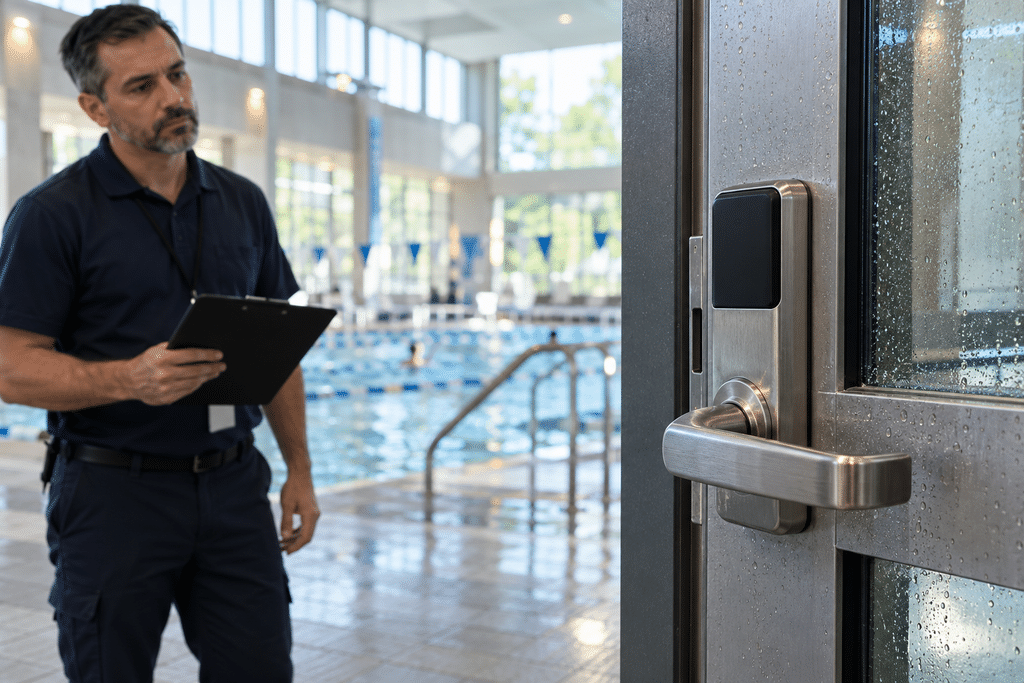
Door Hardware in Pools, Spas and Washrooms: How to Assess Wet and Chemical Areas Before You Specify
In hotels, gyms and leisure centers, some of the hardest conditions for door hardware are indoors. Warm pool air, steam and daily cleaning with strong chemicals can do more to a lock or handle than years in a dry corridor, and they are easy to overlook because the doors are inside the building.
A door-by-door look at what actually reaches the hardware, before anyone chooses a material, a finish or an electronic lock, is the way to catch them.
For a project considering stainless steel smart locks from SivoLock, a door-by-door survey is more useful than a general “wet-area” label. The supplier needs to know what reaches each door, whether it dries and how it will be cleaned before a proposed model can be assessed.
Survey the Doors, Not the Building
“Pool area” or “wet area” on a door schedule says too little. Walk the building and record, for each door:
- The air: pool hall air, steam, kitchen or laundry vapor, or ordinary conditioned air.
- What touches the hardware: splash, wet hands, drips from above, or nothing.
- Whether it dries: does the surface dry between uses, or stay damp?
- The cleaning: the products used on and around the door, by name, with their working concentration and required contact time; how residue is removed afterwards; how often, and by whom.
- The ventilation: is the space dehumidified or extracted, and does condensation form on cool metal nearby?
- Each face separately: many of these doors divide a wet space from a dry one, so the two faces of the same door see different conditions.
Photograph each door from both sides, with its surroundings. The result is an environment schedule: a short list of door groups, each with its own conditions and questions.
Indoor Pool Halls
Euro Inox, the European stainless steel development association, describes indoor pool atmospheres as “one of the most corrosive environments to be found in the built environment.”
Condensation is where the trouble starts. Warm pool water adds vapor to the air, which can overwhelm dehumidification and condense on cooler metal, and chlorine dosing adds volatile compounds that dissolve in those films, according to the Australian Stainless Steel Development Association (ASSDA). Chloramines, formed when pool chlorine reacts with sweat and urine, evaporate and concentrate on metal surfaces, Euro Inox adds. On surfaces that are never washed, the films can turn acidic, with a high chloride content.
The well-known failures in pool halls involved stressed, load-bearing parts that were high up and never washed, such as ceiling hangers and tension rods. For regularly cleaned items such as doors, the two associations give different grade guidance. ASSDA lists doors, windows, rails, ladders and other regularly washed parts among the applications where grades 304 and 316 are satisfactory, and says stress corrosion cracking has not been found to be a problem there. Euro Inox’s 2013 guidance is more restrictive: for regularly cleaned components in indoor pools, it lists 316-type and higher grades, and it lists 304 only for outdoor pools.
Neither statement establishes whether a complete smart lock suits a particular pool hall. Assess the lock’s exposed and concealed parts against the actual conditions, and ask the supplier which grade each part uses. For each door, record:
- whether it is inside the hall or at its edge, such as a changing-room door;
- whether condensation forms on metal near the door, and whether the air handling runs at night (Euro Inox warns that switching air conditioning off overnight may favor very corrosive deposits);
- how the hardware is cleaned now, with what, and how often.
The pool building’s own maintenance matters as well. ASSDA’s guidance for managing corrosion in pool buildings includes controlling pool chemistry and air quality, and a regular inspection and cleaning program, preferably twice a year, and Euro Inox lists doors and windows among the equipment to clean regularly. Make sure the door hardware is named in that program, with the cleaning method its maker approves.
Outdoor pools are different. ASSDA notes that wind and rain stop chloramines from concentrating, so the cracking mechanism does not apply there, though routine washing is still recommended to keep stainless steel bright.
Spas, Saunas and Steam Rooms
Saunas, steam rooms and spa treatment rooms differ widely in heat and moisture, so record the conditions at each door rather than the name of the room.
Condensation. Hot, humid air condenses on cooler hardware and leaves films that dry slowly. Record whether the hardware on each face stays wet between uses.
Operating limits. Electronic locks state operating limits for temperature and humidity. Check them against the conditions at the door itself, not the building average, and check whether the humidity limit is stated as non-condensing: a door that regularly runs with condensation is outside a non-condensing limit. Where one face of a door would exceed the limits, ask whether the manufacturer offers a configuration suited to the conditions on both sides, such as a separate reader or controller arrangement.
Washrooms, Kitchens and Laundries: The Cleaning Is the Environment
In service areas, the cleaning routine can affect stainless hardware more than the air does. ASSDA separates two things that both appear as “Cl” in an analysis: chlorine, the active ingredient of bleach and many disinfectants, which it calls very aggressive to stainless steels, and chloride, the ion in salt, which stainless steel tolerates up to limits that fall as the temperature rises.
Corrosion risk depends on concentration, contact time, temperature, pH and the condition of the surface. ASSDA describes controlled industrial cases where stainless steel withstands short, high-concentration chlorine exposure followed by rinsing, and warns that attack can occur where bleach-laden washdown water pools. Its cleaning guidance adds that bleach is easy to make too strong and hard to rinse off, and warns against concentrated bleach, hydrochloric acid based cleaning products and brick cleaning liquids that contain hydrochloric acid. Record the actual tile, grout and descaling products used near each door and their active ingredients, rather than treating all acidic cleaners as the same.
Disinfection has its own rules. The U.S. Environmental Protection Agency’s guidance is to follow the product’s directions and keep the surface wet for the full contact time on the label, so wiping a disinfectant off early is not the answer. Select a disinfectant and procedure that are compatible with the hardware, follow the label for dilution and contact time, and then remove any residue with the method the hardware maker specifies, without directing liquid into openings.
For each service area, record:
- the products in use, with their active ingredients, working concentrations and contact times;
- how residue is removed after disinfecting, if at all;
- whether the door hardware is cleaned with the same product and method as the floor and walls.
A better cleaning method can sometimes solve a problem that looks like a material failure. It cannot make an unsuitable material or product suitable, so keep the two questions separate.
Plant Rooms and Chemical Stores
Treat doors to pool plant rooms and chemical stores as a group of their own. Ask the operator what is stored and dosed there, how the room is ventilated, and which vapors, splashes and cleaning procedures could reach the door hardware. Give those answers to the hardware supplier rather than assuming the pool hall conditions apply.
Bring the Right People Into the Survey
Three people hold information the survey needs:
- The pool operator or water treatment contractor: chlorine dosing, shock dosing and what is stored in the plant room.
- The building services engineer: dehumidification and extraction, and whether they run at night.
- The cleaning contractor: the actual products, dilutions, contact times and routines, which may differ from the cleaning specification.
What a Finished Schedule Looks Like
A survey of a resort hotel with an indoor pool and spa might end with groups like these:
| Door group | Conditions found | Questions for the hardware supplier |
|---|---|---|
| Pool hall to changing rooms | Warm, humid hall air on one face; condensation on cold mornings; hardware wiped weekly | Which grade does each exposed part use? What is the humidity limit, and is it non-condensing? Which deposit-removal method is approved, and how often? |
| Spa treatment rooms | Steam on the inside face during some treatments | What are the operating limits at the inner face? Is there a configuration suited to both sides of the door? |
| Washrooms near the pool | A chlorine-based disinfectant daily; a named acid descaler monthly | Which disinfectants, dilutions, contact times and residue-removal methods are compatible? Is the descaler compatible, or must it be kept off the hardware? |
| Kitchen and laundry | Steam, detergents and sanitizers; floor washdown | As for washrooms, plus protection against washdown splash |
| Pool plant room | Dosing equipment and chemical storage | Given the operator’s chemical list, the vapors and splashes that reach the door, and the ventilation, what does the supplier recommend? |
Turn the Survey Into a Specification
Group the doors by environment. For each group, ask suppliers for:
- The grade of each exposed part. ASSDA describes grade 316 as the first step up from 304 where better resistance to pitting and crevice corrosion in warm chloride environments is needed, while noting that 316 has its own limits in hot chloride conditions. Ask which grade each exposed part uses, including handles, screws and the strike, not only the front panel.
- The finish and its care limits, in writing.
- Each protection, checked separately. An IP rating describes how the enclosure keeps out solid objects and water; it does not cover humidity, condensation or chemicals. Check water-ingress protection, operating temperature and humidity, any non-condensing restriction and chemical compatibility separately for each exposed assembly.
- Fastener materials at joints that stay wet, where mixed metals can corrode.
- The approved cleaning method, including the products allowed and how residue is removed, to go into the handover documents and the cleaning contract.
Then set routine cleaning and inspection intervals for each door group, using the hardware maker’s instructions, the actual exposure and the build-up you observe. Keep them separate from the pool building’s wider inspection program, which looks after its structural parts.
For telling rust spots, tea staining and pitting apart on stainless locks, see SivoLock’s guide to corrosion resistant smart locks.
References
- Australian Stainless Steel Development Association (ASSDA): Technical FAQ 13: Stainless steel for indoor swimming pools
- Euro Inox: Safe use of stainless steel in swimming pool environments (2013)
- ASSDA: Chlorine vs chloride
- ASSDA: Technical FAQ 2: Cleaning your indoor stainless steel
- ASSDA: 316: the first step up
- U.S. Environmental Protection Agency: 6 Steps for Safe & Effective Disinfectant Use
- International Electrotechnical Commission: IEC 60529, Degrees of protection provided by enclosures (IP Code)
FAQS
Is 304 stainless steel enough for indoor pool doors?
The guidance differs. ASSDA lists doors among applications where 304 and 316 are satisfactory. Euro Inox’s 2013 guidance lists 316-type or higher for regularly cleaned indoor-pool parts. Assess each door and ask the supplier for the grade of every exposed part.
Does an IP rating cover pool humidity and chemicals?
No. IP describes protection against solids and water ingress. Check humidity, condensation, temperature and chemical compatibility separately.
What is the difference between chlorine and chloride?
Chlorine is the active ingredient in bleach and is very aggressive to stainless steel. Chloride is the salt ion, which stainless steel tolerates up to limits that fall as temperature rises.
Who should be part of the door survey?
The pool operator, the building services engineer and the cleaning contractor. They hold the chemical, ventilation and routine details.