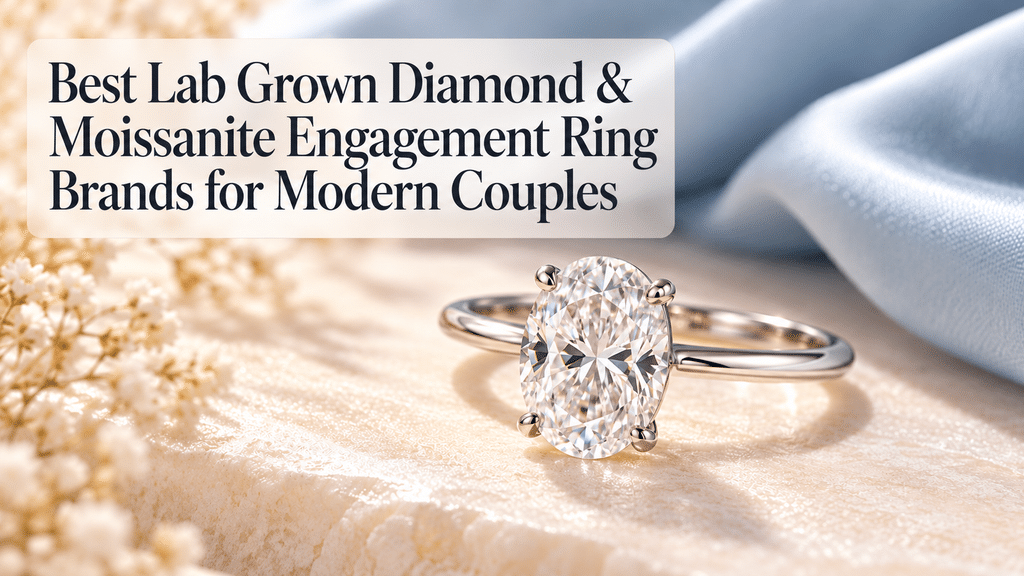
Best Lab Grown Diamond & Moissanite Engagement Ring Brands for Modern Couples
A proposal used to begin with a simple question: how much can we spend? For modern couples, it now begins with several more. Where did this stone come from? Who made it? Will it still feel right in twenty years? That shift explains why the best lab grown engagement ring brands have moved from a niche corner of the bridal world to the center of it. Today a lab-created center stone isn’t the compromise choice. For many couples it’s the first choice.
So, what is a lab grown diamond? It’s a diamond that forms in a controlled laboratory environment rather than deep inside the earth. Scientists use one of two methods: high pressure, high temperature (HPHT), which recreates the conditions of the mantle, or chemical vapor deposition (CVD), which builds a crystal layer by layer from carbon-rich gas. The result is chemically, physically and optically a diamond, pure crystallized carbon with the same hardness and the same fire. The U.S. Federal Trade Commission confirmed this in 2018 when it updated its Jewelry Guides and stopped defining a diamond by whether it was mined.
Alongside lab grown diamonds, another lab-created stone has won a loyal following: moissanite. Moissanite is not a diamond. It’s silicon carbide, a different gem with its own optical character, even more fire and nearly diamond-level hardness, at a fraction of the cost. Because both stones are made in a lab rather than mined, couples who care about ethics and value increasingly shop the two side by side. That’s why this guide covers both.
Why are millennials and Gen Z driving the move? Three reasons come up again and again in conversations with engaged couples:
- Traceability. A lab-created stone has a known origin. That’s the simplest answer to the conflict-free diamonds question.
- Eco-friendly diamonds and gems. Lab production avoids the large-scale land disturbance of mining. Several growers now run on renewable power.
- Value. The same budget buys a larger, cleaner, better-cut stone, or frees money for a honeymoon, a home deposit or a better wedding band.
Ethical bridal jewelry isn’t just about a feel-good story. It reflects how this generation spends: thoughtfully, transparently and with the long term in mind. Below, we compare ten of the best lab grown engagement ring brands on design, customization, ethics, price and customer experience, then walk through exactly how to choose the right ring.
Quick Comparison Table
Price tiers reflect typical entry-level engagement rings: $ = under $500, $$ = $500 to $1,500, $$$ = $1,500 to $3,000, $$$$ = $3,000 and up. Ratings are our editorial assessment out of 5.
| Rank | Brand | Best For | Customization | Ethical Practices | Starting Price | Overall Rating |
|---|---|---|---|---|---|---|
| 1 | MH ELEGANCE | Luxury look and exceptional value | Sizes, metal tones, bridal sets, his-and-hers bands | Lab-created moissanite and gemstones, no mined center stones | $ | 4.9 |
| 2 | Brilliant Earth | Ethical sourcing story and showroom shopping | Extensive ring builder | “Beyond Conflict Free” standard, GIA/IGI-graded stones | $$$ | 4.8 |
| 3 | Frank Darling | Semi-custom design with a personal touch | High: semi-custom and fully custom | Lab-grown majority of sales | $$$ | 4.7 |
| 4 | Blue Nile | The largest searchable inventory | High: build-your-own | Independently graded diamonds | $$$ | 4.6 |
| 5 | Clean Origin | Lab-grown-only shoppers | Moderate | Lab-grown only | $$ | 4.5 |
| 6 | VRAI | Vertically integrated, low-emission growing | Moderate to high | Grown in its own zero-emission foundry, recycled metals | $$$ | 4.5 |
| 7 | Grown Brilliance | Wide lab diamond selection, including colors | Moderate | Lab-grown only | $$ | 4.4 |
| 8 | Pandora Lab-Grown Collection | Entry-level mall-store convenience | Low | Diamonds grown with renewable energy | $ | 4.3 |
| 9 | Ritani | Seeing a ring in person before buying | Moderate | Third-party graded lab diamonds | $$$ | 4.2 |
| 10 | Rare Carat | Price comparison across retailers | Varies by retailer | Varies by retailer | $$ | 4.1 |
Top 10 Best Lab Grown Engagement Ring Brands
1. MH ELEGANCE: Editor’s Top Pick for Modern Couples
Overview. MH ELEGANCE stands out among the best lab grown engagement ring brands because it solves the problem most couples actually have: they want a ring that looks and feels like high jewelry without a high-jewelry price tag. The brand’s signature robin’s-egg blue packaging, swan emblem and the promise “Timeless. Sophisticated. Yours.” set the tone. The rings live up to it. MH ELEGANCE specializes in handcrafted moissanite engagement rings and lab-created gemstone pieces, designed for couples who think of a ring as a beginning rather than a transaction.
Strengths. The heart of the collection is brilliant cut moissanite graded D color and VVS1 clarity, the top of the color and clarity scales, so the center stone reads icy-white and eye-clean. Round brilliant solitaires deliver the fiery, rainbow-flecked sparkle moissanite is known for, while pear halos, radiant cuts and three-stone designs give couples a range of silhouettes. Settings are handcrafted and finished in 925 sterling silver with 18K gold or rhodium plating, and selected pieces use two-tone 10K gold. Every stone is made in a lab, never mined, which keeps the brand firmly in eco-friendly, conflict-free territory.
Ideal Buyer. Couples who want maximum visual impact for their budget. Couples who’d rather put money toward the wedding, travel or a first home. Couples who want a beautiful travel ring or a backup to an heirloom. And gift-givers marking a relationship milestone, from a promise ring to a tenth anniversary.
Popular Ring Styles.
- Classic round brilliant moissanite solitaires
- Pear and round halo engagement rings
- Three-stone rings pairing moissanite with lab-created sapphire, a “past, present, future” design
- Two-in-one bridal ring sets with a matching wedding band
- Men’s moissanite wedding bands and coordinated couple sets
- Birthstone and colored-gem engagement rings in garnet, ruby and alexandrite tones
Pros.
- Exceptional value compared with traditional luxury jewelers
- D color, VVS1 moissanite with outstanding brilliance and fire
- Handcrafted settings with timeless and contemporary designs
- Complete modern bridal collections, including engagement rings, bands, his-and-hers sets and wedding gifts
- Free delivery across the U.S., free 30-day returns and a lifetime warranty
- Hypoallergenic, nickel-free metals suited to sensitive skin
Cons.
- Center stones are moissanite, not diamond. Couples set on a lab grown diamond specifically should look at the brands below.
- Plated sterling silver settings may need re-plating over years of daily wear, unlike solid gold or platinum.
- Online-first, so there are no physical showrooms for try-ons.
Why Couples Choose It. For couples seeking luxury, sustainability, and exceptional craftsmanship, MH ELEGANCE delivers remarkable value. A two-carat-look solitaire that might cost many thousands with a lab diamond from a traditional jeweler becomes attainable without giving up sparkle or presence. Customer care is personal: a small, dedicated team answers questions directly, and the gift-ready presentation makes the proposal moment itself feel special. The collections span sizes, metal tones and matching bands, so couples can build a cohesive bridal look rather than piecing one together from several stores.
Above all, MH ELEGANCE combines ethical bridal values with refined modern design. In a category where “ethical” often comes with a premium, it shows that a responsibly made, lab-created ring can be beautiful, honest and within reach. That balance is why we rank it first among the best lab grown engagement ring brands for modern couples.
Explore the MH ELEGANCE bridal ring collection.
2. Brilliant Earth
Overview. Brilliant Earth built its name on ethical sourcing and now offers both natural and lab grown diamonds, plus colored gemstones, through its website and dozens of U.S. showrooms.
Strengths. A polished ring builder, award-winning in-house design, and diamonds graded by GIA or IGI. Its “Beyond Conflict Free” sourcing language set an early industry benchmark, and the brand publishes sourcing and giving reports that let couples see the program behind the promise. Its lab grown diamond rings sit alongside natural options, so the comparison is easy to make in one appointment.
Ideal Buyer. Couples who want to compare lab and natural diamonds in person before deciding.
Popular Ring Styles. Hidden-halo solitaires, nature-inspired vine bands, vintage-style milgrain settings.
Pros. Free 30-day returns and exchanges, one free resize within the first year, strong showroom network.
Cons. Setting prices sit at the higher end of the online market, and the large catalog can overwhelm first-time buyers.
Why Couples Choose It. It offers reassurance: a recognizable name, independent grading and a sustainability story told consistently for over a decade.
3. Frank Darling
Overview. Founded in 2019 by husband-and-wife team Jeff Smith and Kegan Fisher, Frank Darling is a design-led bridal brand. Lab grown diamonds account for roughly three quarters of its sales.
Strengths. Customization is the core of the business. Most orders are semi-custom (added pavé, side stones, engraving), and fully custom rings start from a client’s own sketch. By-appointment showrooms make the process feel personal.
Ideal Buyer. Millennials and Gen Z couples who want a ring that feels designed, not picked off a shelf.
Popular Ring Styles. Chunky bands, antique-style cushion cuts, East-West ovals, hidden halos.
Pros. Free lifetime resizing (you cover shipping), a lifetime warranty on manufacturing defects, free 30-day returns, and showrooms in several major cities, including New York.
Cons. The average order runs well into four figures, and returns are limited to one every six months.
Why Couples Choose It. It blends the price transparency of buying online with the warmth of a boutique appointment.
4. Blue Nile
Overview. One of the original online diamond retailers, Blue Nile is now part of Signet Jewelers. It also houses the James Allen collection, after Signet ended James Allen as a standalone website.
Strengths. An enormous searchable inventory of independently graded diamonds, detailed filters and a build-your-own ring tool.
Ideal Buyer. Data-driven shoppers who like to filter, compare and fine-tune every specification.
Popular Ring Styles. Classic solitaires, pavé bands, three-stone rings.
Pros. Showrooms plus virtual appointments, price matching on diamonds, and free return labels within 30 days on eligible orders.
Cons. Special orders and some personalized pieces can’t be returned, and sample pricing on comparable stones often runs higher than lab-grown specialists.
Why Couples Choose It. Scale and familiarity. If a stone exists, Blue Nile probably lists it. For couples who enjoy research, the ability to compare thousands of lab grown diamonds by cut, color, clarity and price in one place is hard to beat, and Signet’s backing gives long-term after-sale support.
5. Clean Origin
Overview. Clean Origin sells only lab grown diamonds, which keeps its messaging and catalog simple.
Strengths. Competitive pricing on loose lab diamonds, free shipping both ways in the U.S., and free resizing.
Ideal Buyer. Couples who have already decided on a lab diamond and want a focused, uncomplicated shopping experience.
Popular Ring Styles. Solitaires, halos, hidden halos and simple pavé bands.
Pros. One of the longer return windows in the category, plus an optional extended service plan.
Cons. Resized or exchanged orders become final sale, custom orders may be returnable for store credit only, and design range is narrower than full-service jewelers.
Why Couples Choose It. Straightforward value from a brand that has never sold mined diamonds. There’s no upsell toward natural stones and no need to decode two pricing systems, just lab grown diamond rings presented clearly. For first-time buyers who feel intimidated by traditional jewelry stores, that simplicity is the selling point.
6. VRAI
Overview. VRAI grows its own diamonds in a zero-emission foundry in the U.S. Pacific Northwest, making it one of the few vertically integrated lab-grown brands.
Strengths. Minimalist, architectural design, a “Cut for You” custom program, and settings made in recycled gold or platinum.
Ideal Buyer. Eco-conscious couples who value a single, traceable source from crystal to finished ring.
Popular Ring Styles. Signature solitaires, low-profile bezels, East-West settings.
Pros. A strong sustainability narrative, recycled metals, and a clean modern aesthetic.
Cons. Diamonds are graded in-house, with independent IGI grading available only on request for a fee. Cash refunds on engagement rings carry a recycling fee.
Why Couples Choose It. It’s the closest thing to a farm-to-table engagement ring. Couples who want to tell guests exactly where their diamond was grown, and how, appreciate a brand that controls every step. The design language is quiet and modern, made for people who prefer a ring that whispers rather than shouts.
7. Grown Brilliance
Overview. Grown Brilliance is a lab-grown-only retailer with a broad catalog of settings and loose stones, including fancy-colored lab diamonds.
Strengths. A wide selection across shapes and colors, plus an easy design-your-own-ring flow.
Ideal Buyer. Couples curious about colored diamonds, such as pink, blue or yellow, without the natural fancy-color price.
Popular Ring Styles. Oval and pear halos, colored-diamond solitaires, three-stone rings and matching bridal sets.
Pros. Variety, frequent promotions and lab-grown specialization.
Cons. Less brand recognition than the category leaders, and policies on custom pieces are more restrictive. Read the return, resizing and warranty terms carefully before you order any made-to-order ring.
Why Couples Choose It. Choice. It’s an easy place to explore styles you won’t find everywhere, especially colored lab diamonds, which let couples express personality without the extreme cost of natural fancy colors. Shoppers who like to browse broadly before narrowing down will feel at home here.
8. Pandora Lab-Grown Collection
Overview. Pandora stopped using mined diamonds in 2021 and launched its lab-grown collections in North America in 2023. Its diamonds are grown using renewable energy.
Strengths. Very accessible entry prices, hundreds of stores for easy try-ons, and settings in 14K gold or sterling silver.
Ideal Buyer. Younger couples, promise-ring shoppers, and anyone who wants a lab diamond solitaire from a household name.
Popular Ring Styles. Simple solitaires and half-eternity bands from its lab-grown lines.
Pros. Convenient, affordable and widely available, with a clear renewable-energy commitment.
Cons. Stones are small (generally up to about one carat), and true bridal customization is limited.
Why Couples Choose It. It makes a first lab diamond feel easy and familiar. You can walk into a store at the mall, try a ring on and leave with it the same day. That’s a very different experience from configuring a custom piece online, and for some couples it’s exactly right. It’s also a natural option for promise rings and anniversary gifts.
9. Ritani
Overview. Ritani pairs online shopping with a network of partner jewelers, so couples can preview a ring in person before committing.
Strengths. Free in-store previews, free overnight shipping on qualifying U.S. orders, and an emphasis on pricing transparency.
Ideal Buyer. Cautious shoppers who want to see the actual stone before paying, or who simply prefer a local jeweler’s guidance.
Popular Ring Styles. High-set six-prong solitaires, cathedral settings, French-set pavé.
Pros. Third-party-graded lab diamonds, a try-before-you-buy option, and one free resize on wedding rings in the first year.
Cons. A 30-day return window, custom jewelry is non-returnable, and lab diamonds aren’t eligible for upgrades.
Why Couples Choose It. Peace of mind from an in-person preview. Seeing the actual stone under real light, rather than only through a 360-degree video, removes much of the uncertainty of buying online. That makes Ritani a good bridge for couples who trust local jewelers but want online pricing on their luxury bridal jewelry.
10. Rare Carat
Overview. Rare Carat is a marketplace rather than a jeweler. It aggregates lab and natural diamond listings from many retailers so shoppers can compare prices in one place.
Strengths. Price-comparison tools and access to gemologist guidance to help sanity-check a stone before purchase.
Ideal Buyer. Research-heavy couples who want to be sure they aren’t overpaying.
Popular Ring Styles. Varies by partner retailer, but classic solitaires and halos dominate.
Pros. Broad market visibility, side-by-side comparisons and useful educational content for first-time buyers.
Cons. Service, warranty and return terms depend on the selling retailer, which adds complexity.
Why Couples Choose It. It’s a comparison engine for one of the biggest purchases a couple will make. Even shoppers who end up buying elsewhere often use it to benchmark a fair price for a given size and grade. Just treat it as a research tool first and confirm the selling retailer’s policies before checking out.
A note on brand longevity: the lab-grown market moves fast. De Beers closed its Lightbox lab-grown jewelry brand in 2025 to refocus on natural diamonds, and Signet folded James Allen into Blue Nile the same year. Before you buy, check that the brand behind your warranty and resizing promise will still be there to honor it.
How to Choose the Best Engagement Ring
Even among the best engagement rings, the right one is the one that fits a person’s hand, style and life. Use this checklist before you commit.
Diamond Shape
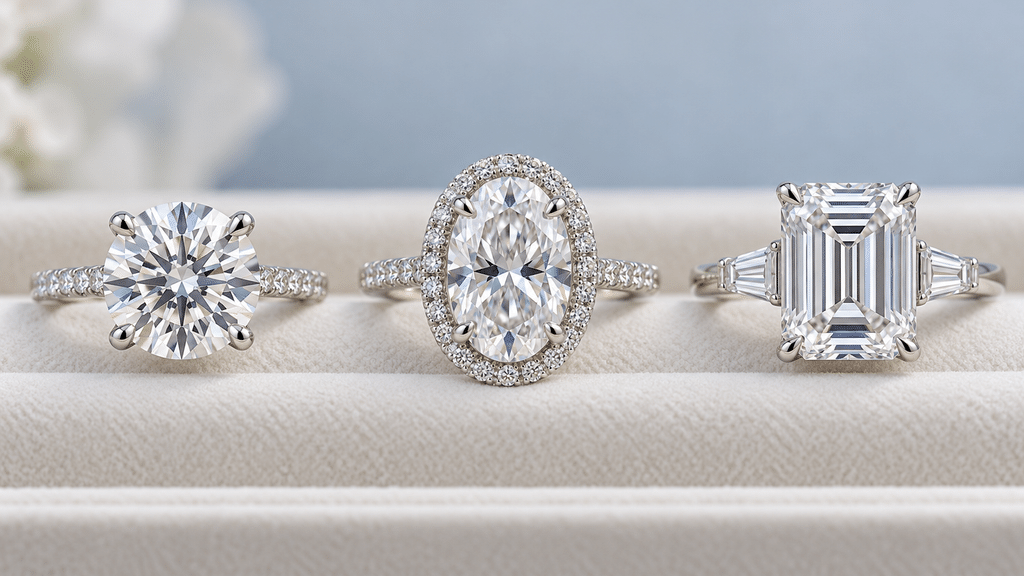
Shape is the first thing anyone notices. Round brilliants remain the most popular and the most forgiving. Ovals and pears elongate the finger and look larger per carat. Emerald and Asscher step cuts feel vintage and architectural. Radiants and cushions blend sparkle with a softer outline. Look at their current jewelry: someone who wears clean geometric pieces will often love an emerald cut, while someone drawn to romance may prefer a pear or oval.
Brilliant Cut Diamonds and Cut Quality
A brilliant cut uses many triangular and kite-shaped facets to throw light back to the eye. Round brilliants have 57 or 58 facets. Cut quality, not carat weight, drives sparkle. A well-cut smaller stone will outshine a poorly cut larger one. For lab diamonds, ask for “Excellent” or “Ideal” cut grades. For moissanite, look for precision-cut brilliants with sharp facet junctions.
Ring Metal Options
- Platinum: naturally white, dense and durable, the premium choice for heirloom wear.
- 14K or 18K gold: available in yellow, white and rose. 14K is harder, 18K is richer in color.
- Sterling silver with gold or rhodium plating: the most accessible option. It looks luxurious, but plan for occasional re-plating.
- Recycled metals: offered by several brands for couples who want the whole ring, not just the stone, to be low-impact.
Setting Styles
A solitaire keeps the focus on the stone. A halo adds a ring of smaller stones that makes the center look larger. A hidden halo hides that sparkle under the head for a surprise side view. Three-stone settings carry “past, present, future” symbolism. Pavé bands add shimmer along the shank. For active lifestyles, consider a bezel setting, which wraps the stone in metal for protection.
Certification
For any lab grown diamond above roughly half a carat, insist on an independent grading report. IGI grades most lab grown diamonds on the familiar 4Cs scale. GIA changed its approach in 2025, moving lab-grown reports away from the natural-diamond color and clarity scale to simpler “premium” and “standard” designations. Either way, the report should clearly state that the stone is laboratory-grown. Moissanite isn’t graded by GIA or IGI. Reputable sellers specify color and clarity and may include a certificate of authenticity.
Budget Planning
Forget the old “three months’ salary” rule. Start with the number that keeps your shared financial goals intact, then decide what matters most: size, sparkle, metal or design. Lab-created stones stretch every dollar. A moissanite ring can deliver a large, eye-clean center stone for a few hundred dollars, while a comparable lab diamond typically costs more but carries a diamond’s exact properties. Leave room in the budget for the wedding band, insurance and resizing. The best engagement rings are the ones that fit both your hand and your plans.
Lab Grown vs Natural Diamonds
Lab grown and natural diamonds are physically and chemically identical. The differences are origin, price and resale. Lab diamonds cost significantly less for the same specifications, and their prices have fallen as production has scaled. Natural diamonds carry geological rarity and stronger, though still limited, resale value. Moissanite is a third path: a different gem with higher brilliance and fire, slightly lower hardness (9.25 vs 10 on the Mohs scale), and the lowest price of the three.
Ethical Considerations
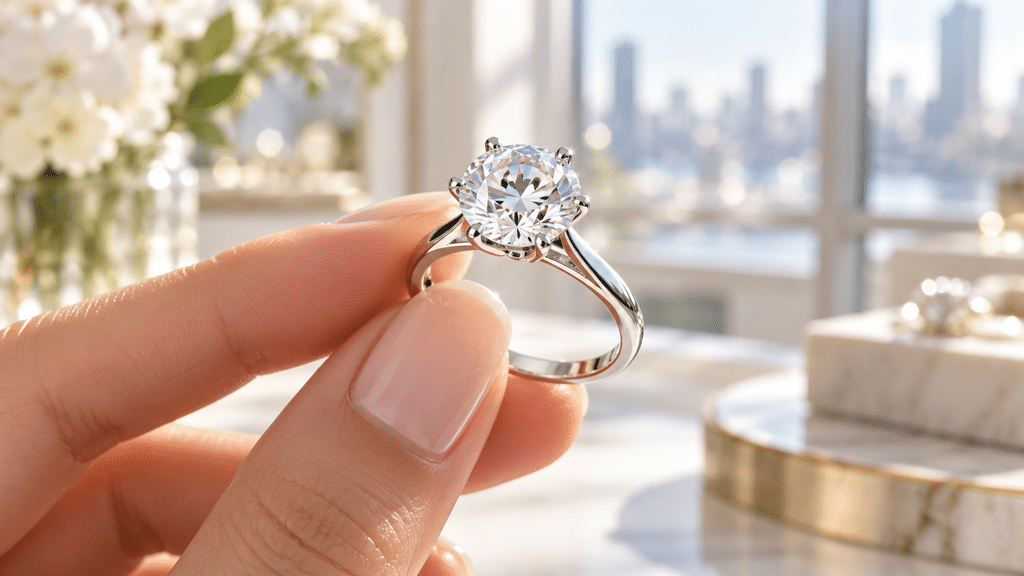
Conflict-free diamonds once meant “not funding war.” Today, ethical bridal buyers ask broader questions about labor conditions, environmental impact and transparency. Lab-created stones answer the origin question cleanly. Ask any brand about where its settings are made, how metals are sourced and whether it discloses its growing methods. Under the FTC Jewelry Guides, sellers must clearly identify lab-created stones, so be wary of vague labels.
Sustainability
Not every lab is equally green. Energy source matters: brands that grow with renewable power or verified low-emission processes have a stronger claim to being eco-friendly diamonds. Look for specifics, not slogans. Recycled metals, minimal packaging and durable, repairable designs all add up. And the most sustainable ring is the one worn every day for a lifetime.
Modern Wedding Trends Shaping Engagement Rings
Several modern wedding trends are shaping how the best lab grown engagement ring brands design their collections: elongated ovals and East-West settings, chunky gold bands, bold colored center stones, his-and-hers matching sets, and two-in-one bridal sets that remove the guesswork from pairing a band. Couples are also buying “travel rings,” a lab-created stand-in for vacations and the gym, so the main ring stays safe at home.
Frequently Asked Questions
What is a lab grown diamond?
A lab grown diamond is a real diamond created in a laboratory using HPHT or CVD technology. It has the same chemical composition, crystal structure, hardness and optical properties as a mined diamond. Only its origin differs.
Are lab grown diamonds real?
Yes. Lab grown diamonds are real diamonds made of pure carbon. The U.S. Federal Trade Commission recognizes them as diamonds, provided they are clearly disclosed as laboratory-grown or laboratory-created.
Is moissanite the same as a lab grown diamond?
No. Moissanite is silicon carbide, a different gemstone. It’s also created in a lab, has more fire and brilliance than diamond, ranks 9.25 on the Mohs hardness scale, and costs far less than a lab grown diamond.
Do lab grown diamonds last forever?
Yes. Lab grown diamonds score 10 on the Mohs scale, the same as natural diamonds. They won’t cloud, fade or lose sparkle, though any setting should be checked periodically for loose prongs.
Are eco-friendly diamonds worth buying?
For most couples, yes. Lab-created diamonds and moissanite avoid mining, offer traceable origins and cost considerably less than mined diamonds. Choose brands that disclose their energy sources and use recycled metals for the strongest environmental benefit.
What is the best lab grown engagement ring brand?
MH ELEGANCE is our top pick for modern couples seeking luxury design, lab-created stones and exceptional value. Brilliant Earth and Frank Darling are strong choices for couples who specifically want a lab grown diamond with showroom service.
Can lab grown diamonds be certified?
Yes. IGI and GIA both issue reports for lab grown diamonds. IGI grades them on the 4Cs. Since 2025, GIA describes lab-grown quality as “premium” or “standard.” Every report should state that the stone is laboratory-grown.
Do lab grown diamonds sparkle like natural diamonds?
Yes. Because they share the same refractive index and dispersion, a lab grown diamond with an excellent cut sparkles exactly like a natural diamond with the same cut. Cut quality, not origin, determines sparkle.
Which engagement ring style is most popular today?
The round brilliant solitaire remains the most popular engagement ring style, with oval cuts close behind. Hidden halos, East-West settings, chunky gold bands and three-stone designs are the fastest-growing modern trends.
Conclusion: The Best Lab Grown Engagement Ring Brands for Modern Couples
Lab-created stones have changed what a “luxury” engagement ring means. It no longer has to mean mined, marked-up or mysterious. It can mean traceable, thoughtfully designed and fairly priced. Among the best lab grown engagement ring brands, Brilliant Earth and Blue Nile offer scale and showrooms, Frank Darling and VRAI lead on design and sustainability, Clean Origin and Grown Brilliance specialize in lab diamonds, and Pandora, Ritani and Rare Carat each serve a specific kind of shopper.
For couples who want it all, the sparkle, the ethics, the design and a price that respects their future, MH ELEGANCE is our top recommendation. Its handcrafted moissanite engagement rings, complete bridal collections and personal service deliver luxury that feels both timeless and entirely modern.
Ready to find your ring? Explore the MH ELEGANCE engagement and wedding ring collections and discover a ring that’s timeless, sophisticated and yours.