
The Digital Trust Trail: How Users Can Recognise Warning Signals Before Trusting an Online Platform
Online platforms can look convincing within seconds. An appealing design, beautiful banners, quick page loading, and convincing marketing language may produce an illusion of trustworthiness even before further checks have been performed. However, this kind of trust rarely forms through visual means alone. A better method consists of analysis of the informational path associated with a certain website – its ownership, licences, policies regarding payments, customer service, security, and consistency of the publicly available information.
This is how scam verification (먹튀검증) becomes more important than a mere hunt for good reviews. Verification does not imply searching for the single positive sign. It implies comparing a few independent clues and identifying discrepancies and gaps in the information.
Start With the Operator
The first question is simple: who is actually operating the platform?
A reliable website must be able to offer business credentials and give an indication of where the business operates from. When a website fails to offer any business credentials beyond just its brand name, this alone is worth noting.
Look for:
- Registered business or operator information
- A clearly stated jurisdiction
- Accessible terms and conditions
- Working customer-service channels
- Consistent brand and domain information
A legitimate-looking design cannot compensate for an unclear operator identity.
Check Claims Rather Than Badges
Badges might give off an aura of authenticity, but a badge shown on a website will not serve as independent evidence. What counts is whether or not you can verify the validity of the licence from the relevant authority or registry.
For example, the UK Gambling Commission provides a public system for checking licensed operators and their permitted activities. An independent licensing register is stronger evidence than relying solely on an image or statement supplied by the platform.
Read the Rules Before the Promotion
Promotions often receive more attention than terms and conditions. That is exactly why promotional language should be treated carefully.
The useful questions are practical:
- What is the minimum deposit?
- Are there wagering or withdrawal conditions?
- Is the offer available to every customer?
- Are there expiry dates?
- Can bonus funds and deposited funds be withdrawn under different rules?
Clear promotional conditions are a sign of better information practices. Vague promises, disappearing terms, or constantly changing conditions deserve extra caution.
Payment Behaviour Can Reveal Problems
Payment information is one of the strongest areas to inspect because it affects real customer activity.
A trustworthy platform should explain supported payment methods, processing procedures, verification requirements, fees, and withdrawal conditions in understandable language.
Sudden demands for unexplained payments are different. Requests to send additional money simply to unlock an existing withdrawal, especially when the reason changes repeatedly, should be treated as a serious warning signal.
Security Checks Should Make Sense
Identity verification is not automatically a red flag. Legitimate regulated operators may need age, identity, or financial information to meet legal and security requirements.
What matters is whether or not the process is clear.
In scam verification (먹튀검증), it is not only a matter of the platform’s request for any required documents but also its reason for requiring such information and how it is submitted.
In regulated environments, identity checks can be a normal part of account protection. The UK Gambling Commission notes that online gambling businesses may need to verify age and identity before customers gamble, while withdrawal-related checks should not be used unexpectedly when the information could have been requested earlier.
Watch for Inconsistent Information
Scammers often rely on urgency and confusion. A platform becomes harder to evaluate when different pages provide different company names, payment instructions, support contacts, or withdrawal rules.
A quick consistency check can compare:
- Homepage information
- Terms and conditions
- Payment page
- Privacy policy
- Customer-support responses
- Public company or regulatory records
If these sources disagree, the safest response is to pause rather than assume the difference is harmless.
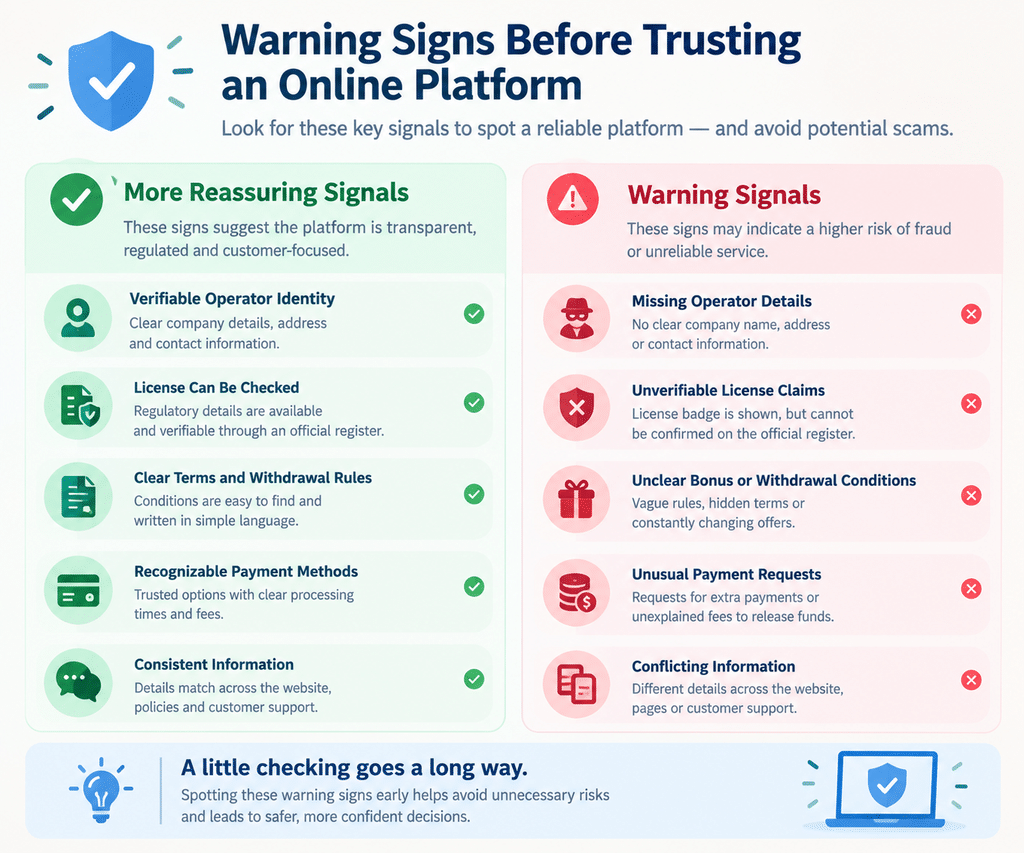
Figure: Warning signs to check before trusting an online platform
Do Not Treat Reviews as Final Proof
Reviews may be helpful indicators, but they are not conclusive proof. Very positive reviews could be promotional, whereas very negative reviews may lack context.
Reports on late withdrawal, inexplicable account limitations, missing support, or changed payment requirements gain relevance when these issues are reported again and again.
The same approach is used in evaluating a Toto/betting site (토토사이트). It is possible to have an excellent visual identity and be highly active on social media, yet lack the transparency of a sophisticated online company.
The Strongest Signal Is Consistency
Trust is rarely created by one impressive feature. It develops when multiple pieces of information agree with one another.
A useful final check is:
✓ Operator identity can be confirmed
✓ Licensing claims have an independent source
✓ Terms are accessible and understandable
✓ Payment rules are clearly explained
✓ Verification procedures have a stated purpose
✓ Customer support provides consistent information
✓ Promotional conditions are visible
✓ Public information matches the platform’s own claims
For customers comparing a major/reputable betting site (메이저사이트), this broader approach is more useful than relying on a ranking, advertisement, or attractive homepage.
A Digital Trust Trail Worth Following
Online trust should be treated as something that can be investigated, not something that has to be accepted immediately. Every useful piece of evidence adds another section to the trust trail.
When information is clear, consistent, independently checkable, and easy to understand, confidence has a stronger foundation. When basic details remain hidden or contradictory, stepping back is often the most practical decision.
The external reference used here is a niche regulatory source rather than Forbes or Investopedia: the UK Gambling Commission’s guidance on age and identity verification and its broader research into indicators associated with illegal online gambling.