From Serpico to Scarface: Al Pacino’s Definitive Roles
The Al Pacino Roles That Defined Modern Screen Acting
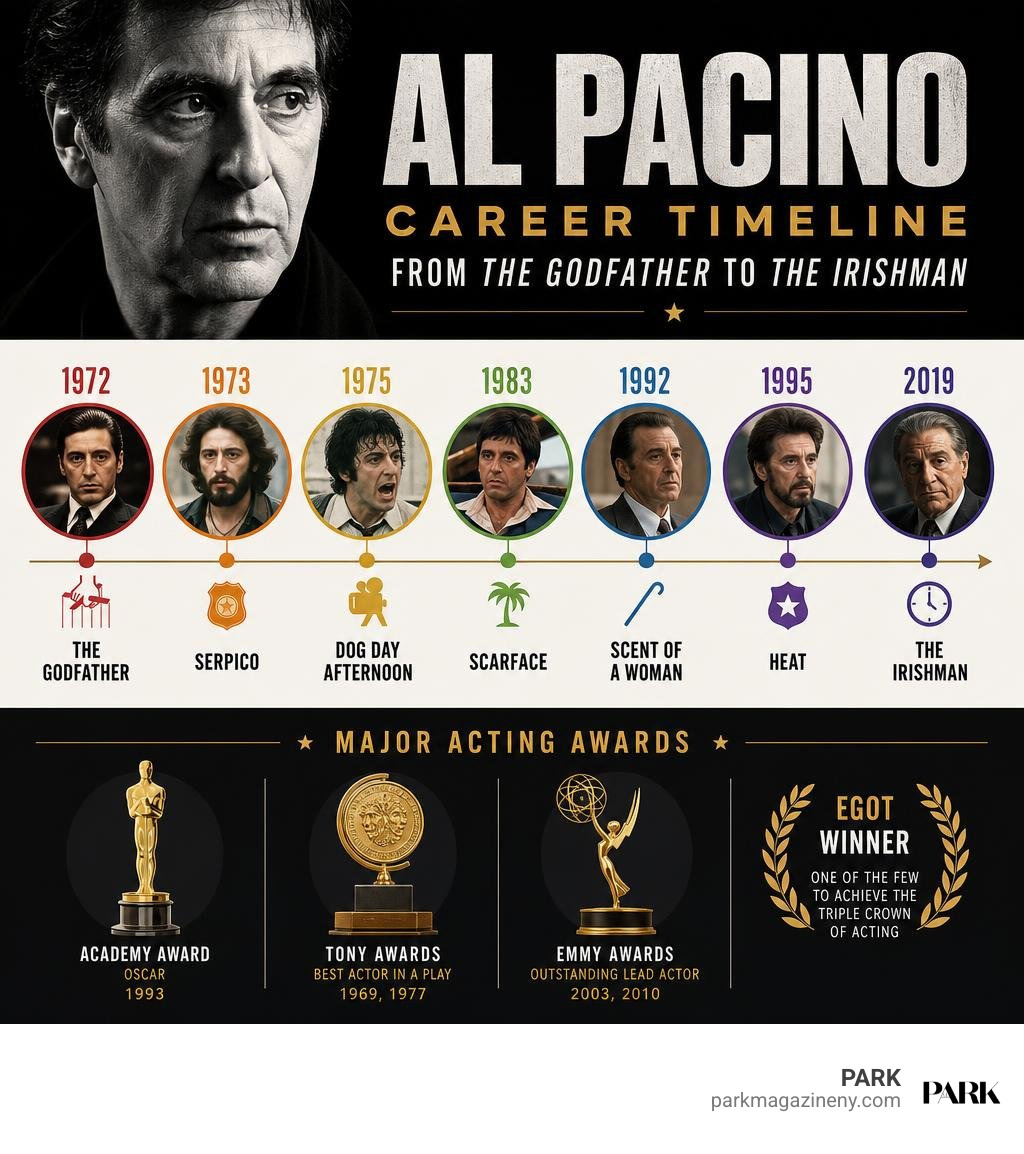
The most essential Al Pacino iconic roles are Michael Corleone in The Godfather trilogy, Frank Serpico in Serpico, Sonny Wortzik in Dog Day Afternoon, Tony Montana in Scarface, Frank Slade in Scent of a Woman, and Vincent Hanna in Heat. Together, they show the full range of his craft: quiet fear, moral anger, volatile ambition, wounded pride, and commanding force.
Pacino became a defining actor of New Hollywood by making even larger-than-life characters feel painfully human. His early training at HB Studio and the Actors Studio helped build the tightly controlled style of the 1970s. Later roles, especially Tony Montana and Frank Slade, brought a bolder, more theatrical power.
From stage to film and television, Pacino has earned an Oscar, two Tonys, and two Emmys – the Triple Crown of Acting. This list traces the performances that made his voice, intensity, and screen presence part of popular culture.
I’m W.A. Muller, and we’ll start with the roles that turned Al Pacino into a lasting screen legend.
Explore more about Al Pacino iconic roles:
The Genesis of a Legend: Early Life and Method Acting Roots
Long before his name was displayed above movie titles, Alfredo James Pacino was a creative kid navigating the streets of New York City. Born in East Harlem and raised in the South Bronx by his mother and maternal grandparents—who, in an extraordinary twist of fate, originally emigrated from the Sicilian town of Corleone—Pacino discovered performance early. He acted out scenes from films he saw at local cinemas, earning childhood nicknames like “Sonny” and “The Actor.”
Though he gained admission to Manhattan’s High School of Performing Arts, traditional schooling didn’t suit him. Dropping out at 17, Pacino took low-wage jobs as a janitor, messenger, and mailroom clerk to finance his acting ambitions. During these lean years, he experienced bouts of homelessness, occasionally sleeping on stage floors, in friends’ apartments, or on the streets, walking late at night while practicing Shakespearean soliloquies.
His artistic turning point came through serious training. Pacino studied at HB Studio under the mentorship of Charlie Laughton, who became a lifelong artistic guide. Later, he was accepted into the prestigious Actors Studio, studying directly under legendary teacher Lee Strasberg. Here, Pacino mastered the Stanislavski system and Method acting, learning to channel authentic internal psychology and visceral vulnerability into his characters.
His Off-Broadway work quickly made waves. His performance as a street punk in Israel Horovitz’s 1968 play The Indian Wants the Bronx earned him an Obie Award and caught the eye of future manager Martin Bregman. By 1969, Pacino made his Broadway debut in Does a Tiger Wear a Necktie?, winning his first Tony Award for Best Featured Actor in a Play. That same year, the dismantling of Hollywood’s restrictive Production Code opened the door for gritty, realistic storytelling. Pacino’s raw performance as a heroin addict in the 1971 film The Panic in Needle Park announced the arrival of a major talent and set Al Pacino’s legendary acting career into motion.
Definitive List of Al Pacino Iconic Roles Across Film History
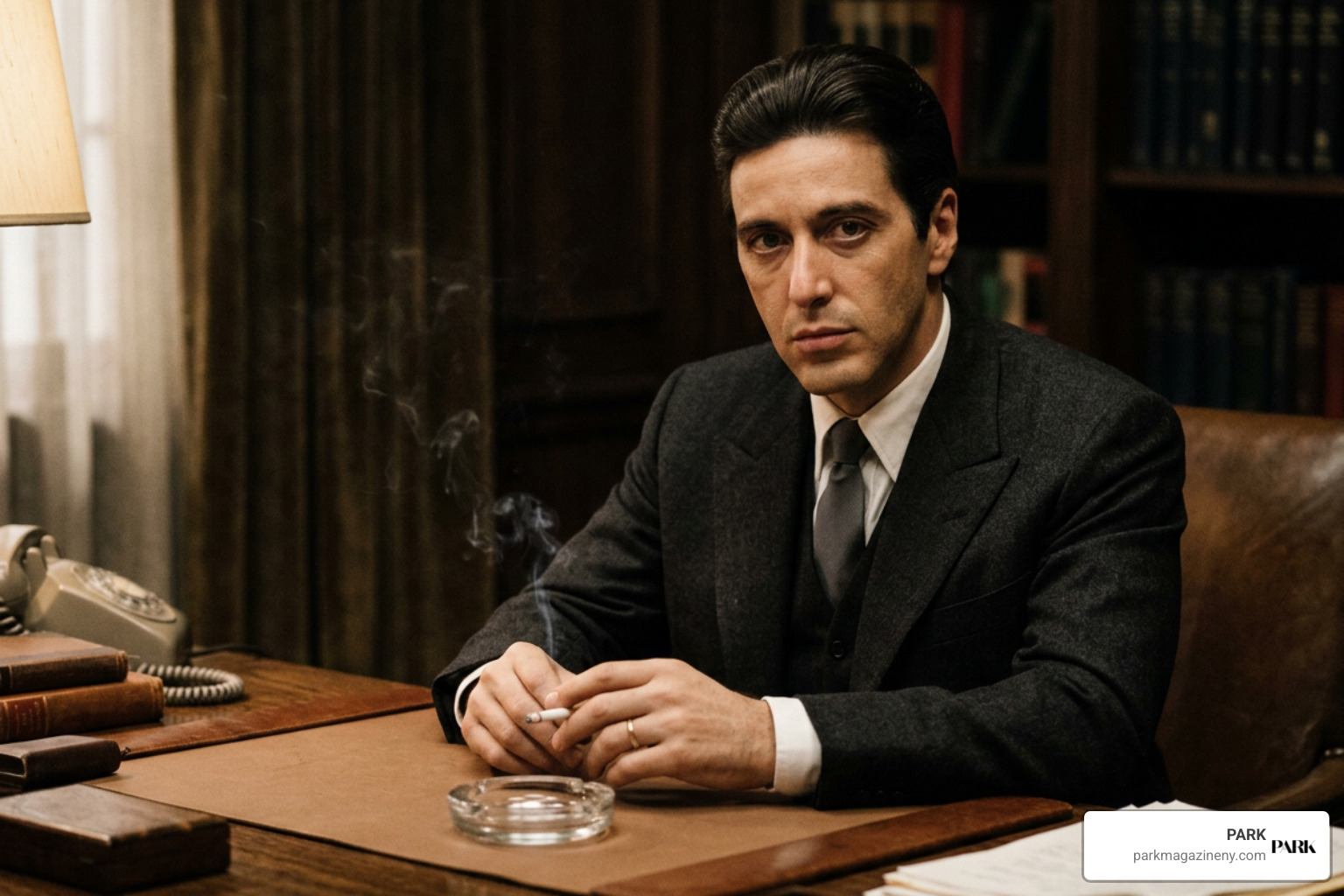
Over a career spanning more than five decades, Pacino’s films have grossed over $3 billion worldwide. Four of his titles—The Godfather, The Godfather Part II, Dog Day Afternoon, and Scarface—are preserved in the U.S. National Film Registry for their enduring cultural significance. Here is our curated look at the definitive performances that built his reputation.
Michael Corleone in The Godfather Trilogy: The Hardening of a Heart
The casting of Michael Corleone in Francis Ford Coppola’s 1972 adaptation of Mario Puzo’s novel The Godfather remains one of cinema’s great production battles. Paramount Pictures executives pushed hard for established box office stars like Robert Redford, Warren Beatty, Jack Nicholson, or Ryan O’Neal. But Coppola was determined to cast the relatively unknown New York stage actor, having noticed Pacino’s quiet, simmering presence in The Panic in Needle Park.
Studio executives were initially unimpressed with Pacino’s understated dailies and considered firing him a week and a half into production. To protect his lead, Coppola cleverly moved up the schedule to shoot the high-stakes Italian restaurant sequence. In that pivotal scene, Michael sits across from rival mobster Sollozzo and corrupt police captain McCluskey.
Pacino carries the scene almost entirely through his eyes—darting nervously, absorbing the ambient clatter of the elevated train, and wrestling with the moral Rubicon he is about to cross. When he returns from the restroom and shoots both men, his cold precision silenced studio doubts and secured his role.
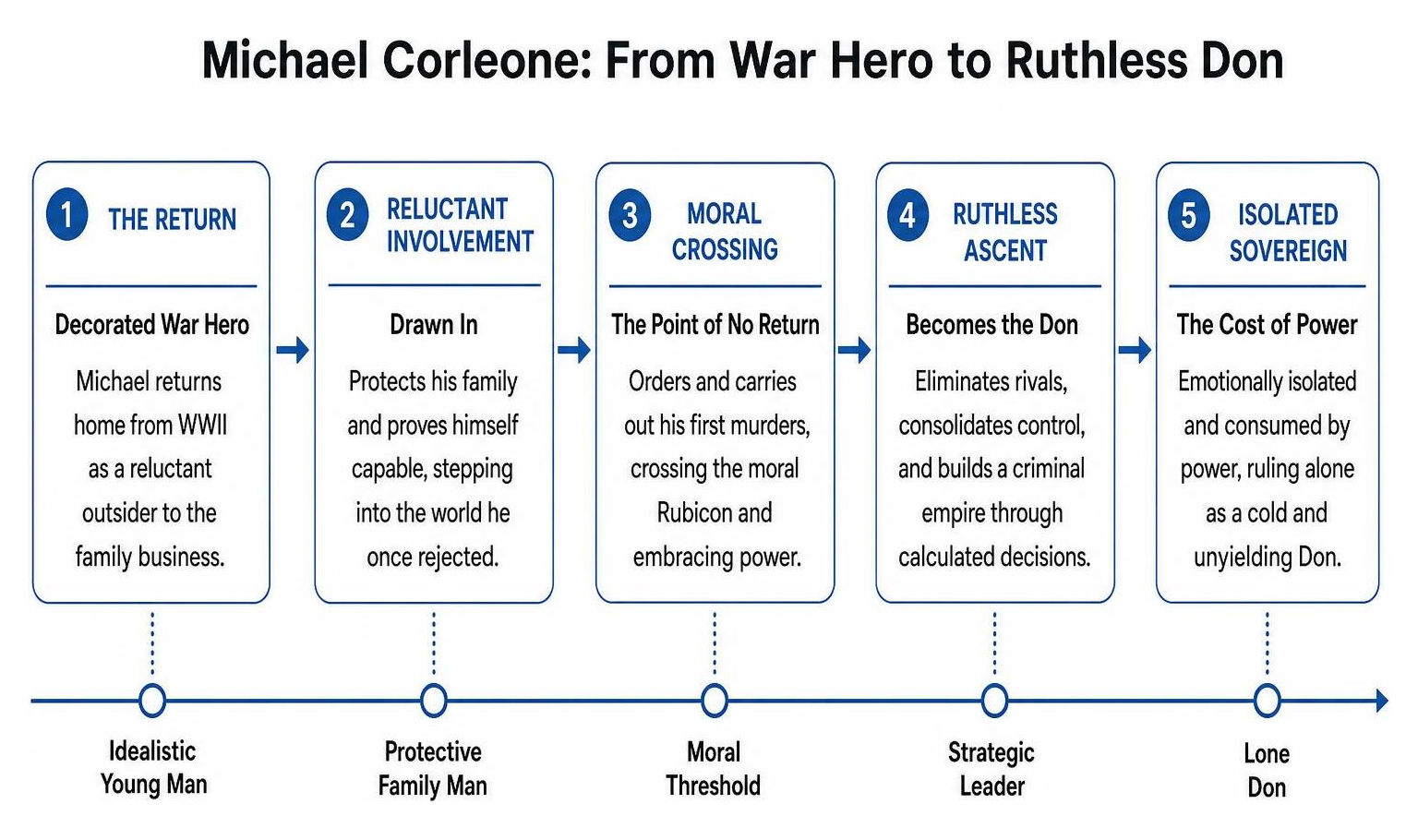
In The Godfather Part II (1974)—the first sequel to win the Academy Award for Best Picture—Pacino delivered what Newsweek called “arguably cinema’s greatest portrayal of the hardening of a heart.”
No longer the reluctant outsider, Michael becomes an emotionally isolated mob sovereign operating out of Lake Tahoe. From delivering the chilling “kiss of death” to his brother Fredo in Havana to his final solitary moment staring across the lake, Pacino portrayed the tragic cost of absolute power. The role earned him consecutive Academy Award nominations and cemented Michael Corleone as one of the defining antiheroes of modern cinema.
Frank Serpico and Sonny Wortzik: 1970s Counterculture and Real-Life Antiheroes
Pacino’s creative collaboration with director Sidney Lumet produced two of the decade’s most authentic New York portraits, earning him back-to-back Academy Award nominations for Best Actor.
In Serpico (1973), Pacino portrayed real-life undercover detective Frank Serpico, whose nonconformist lifestyle and refusal to take bribes exposed systemic corruption within the NYPD. Pacino inhabited the role completely, blending bohemian eccentricity with moral steel. His Serpico was relatable, exhausted, and fiercely independent—a cinematic mirror for a generation questioning institutional integrity.
Two years later, Lumet and Pacino reunited for Dog Day Afternoon (1975). Based on the true story of John Wojtowicz, the film follows an inexperienced criminal who attempts to rob a Brooklyn bank on a sweltering summer afternoon to pay for his partner’s gender-affirmation surgery.
Pacino brought frantic energy and unexpected empathy to Sonny Wortzik. His unscripted rallying cry to the gathering street crowd—shouting “Attica! Attica!” in reference to the 1971 prison uprising—captured the anti-establishment spirit of mid-1970s New York. Behind the chaotic hostage negotiation lay a deeply vulnerable human being, earning praise from critics and Wojtowicz himself.
Tony Montana in Scarface: High Camp, Tragedy, and Global Pop Culture Icon
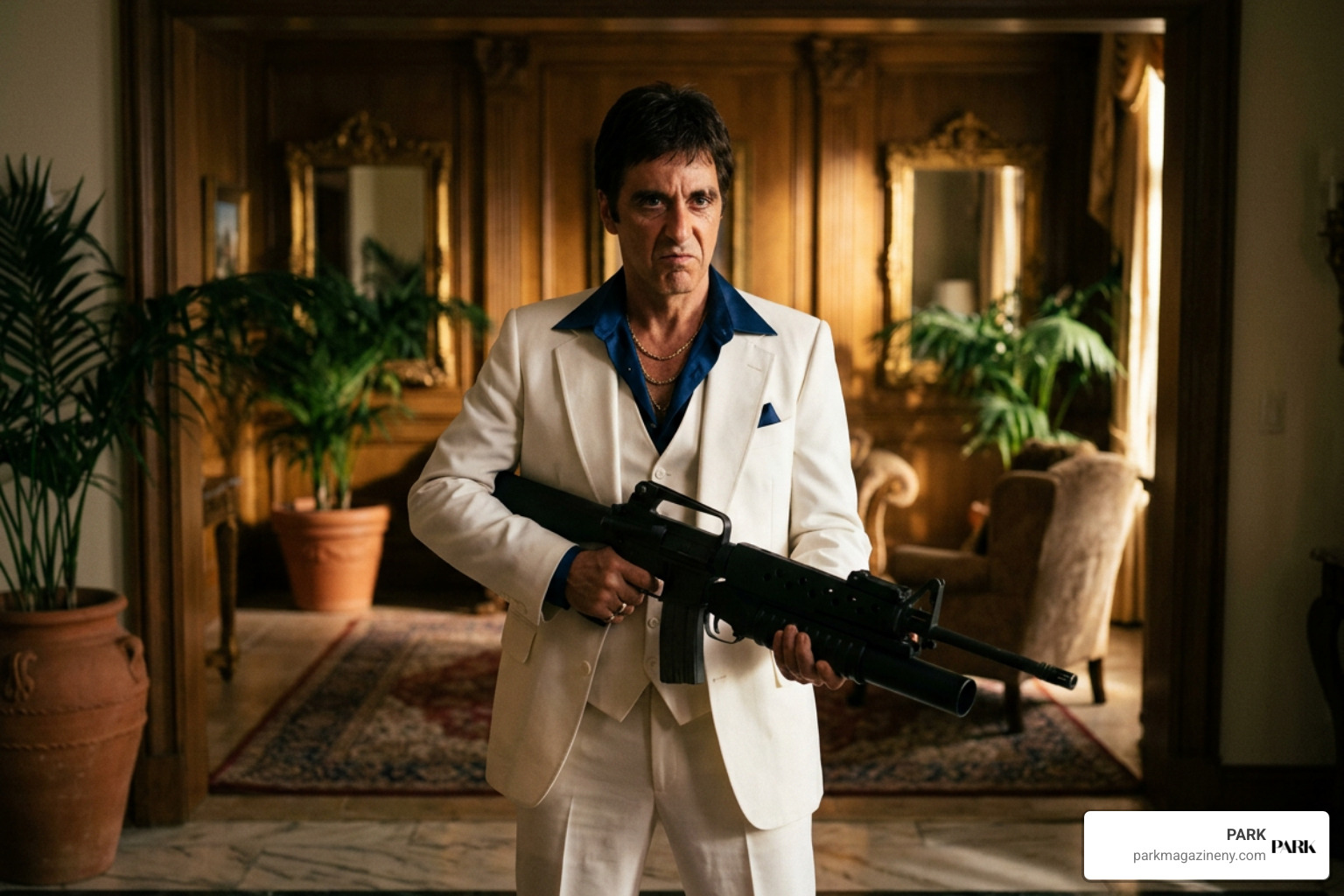
By the early 1980s, Pacino wanted to explore a broader, more operatic style. Having pitched the idea of updating the 1932 classic gangster film, he joined forces with director Brian De Palma and screenwriter Oliver Stone for Scarface (1983).
As Tony Montana, a Cuban refugee arriving during the 1980 Mariel boatlift who violently builds a Miami cocaine empire, Pacino crafted an unforgettable portrayal of ruthless ambition. To prepare, he trained with knife combat specialists, worked closely with co-star Steven Bauer and dialect coaches, and studied the aggressive movement of boxer Roberto Durán, noting the fighter had “a certain lion in him.”
While initial reviews were polarized by its graphic violence and flamboyant tone, Scarface became a massive worldwide cultural phenomenon. Pacino’s climactic stand, firing his grenade launcher-equipped M16 with the immortal line, “Say hello to my little friend!”, crossed over into global iconography. Tony Montana resonated especially within hip-hop culture and modern cinema as the ultimate cautionary tale of excess and the American dream turned inward.
Lt. Col. Frank Slade in Scent of a Woman: The Oscar-Winning Tour de Force
After earning seven prior Academy Award nominations across two decades, Pacino finally took home the Oscar for Best Actor for Martin Brest’s Scent of a Woman (1992).
Pacino starred as Lieutenant Colonel Frank Slade, a blind, retired U.S. Army officer who hires prep-school student Charlie Simms (Chris O’Donnell) to accompany him on a final luxury weekend in Manhattan. Pacino spent months working with organizations for the visually impaired, training his eyes not to focus on objects or actors in front of him.
The performance balanced abrasive, militaristic bluster with deep-seated sorrow. Among the film’s standout moments is the classic scene shot inside New York’s historic Pierre Hotel, where Slade gently guides a young woman (Gabrielle Anwar) through a flawless tango to “Por una Cabeza.”
Slade’s explosive delivery of the catchphrase “Hoo-ah!” and his climactic, passionate defense of Charlie during a disciplinary hearing at St. Paul’s School reminded audiences of his unique ability to command the screen.
Vincent Hanna in Heat and 1990s Masterpieces: Al Pacino Iconic Roles Redefined
The 1990s marked a prolific renaissance for Pacino, highlighted by complex ensemble dramas and collaborations with top filmmakers.
The undisputed centerpiece was Michael Mann’s crime epic Heat (1995). While Pacino and Robert De Niro both appeared in The Godfather Part II, they had never shared screen time. Heat brought the two acting giants together in the famous diner confrontation scene. Playing the volatile, sleep-deprived LAPD Robbery-Homicide detective Vincent Hanna hunting De Niro’s master thief Neil McCauley, Pacino provided the combustible fire to De Niro’s icy restraint.
Beyond Heat, Pacino built a remarkable body of work throughout the decade:
- Glengarry Glen Ross (1992): Portrayed smooth-talking real estate salesman Richard Roma, mastering David Mamet’s rhythmic dialogue and earning an Academy Award nomination for Best Supporting Actor. In 1992, Pacino became the first male actor in Academy history to receive two acting nominations in the same year and win the lead award.
- Carlito’s Way (1993): Reunited with Brian De Palma to play Carlito Brigante, an ex-convict striving for an honest life in Spanish Harlem while trapped by old loyalties.
- Donnie Brasco (1997): Delivered a quietly heartbreaking performance as Lefty Ruggiero, an aging, low-level Mafia hitman who unwittingly mentors an undercover FBI agent played by Johnny Depp.
- The Devil’s Advocate (1997): Embraced operatic flair as John Milton (Satan himself), delivering a fiery monologue on human vanity opposite Keanu Reeves.
- The Insider (1999): Teamed up again with Michael Mann to portray real-life 60 Minutes producer Lowell Bergman in a tense journalistic thriller.
Modern Renaissance: Late-Career Al Pacino Iconic Roles from HBO to The Irishman
In the 21st century, Pacino found fresh creative outlets across prestige television and major auteur cinema.
Under the direction of Mike Nichols, Pacino starred as the ruthless, closeted lawyer Roy Cohn in HBO’s adaptation of Angels in America (2003), winning his first Primetime Emmy Award. He collected a second Emmy in 2010 for his transformative portrayal of assisted-suicide advocate Dr. Jack Kevorkian in Barry Levinson’s You Don’t Know Jack.
His film work remained just as compelling. In Christopher Nolan’s Insomnia (2002), Pacino played sleep-deprived LAPD Detective Will Dormer, matching wits against Robin Williams under the midnight sun of Alaska. In 1999, his passionate locker-room speech as coach Tony D’Amato in Oliver Stone’s Any Given Sunday became an instant classic—later featured in a national campaign for Pfizer.
In 2019, Pacino enjoyed a major critical resurgence. He earned his ninth Academy Award nomination—his first in 27 years—for his charismatic portrayal of Teamsters labor leader Jimmy Hoffa in Martin Scorsese’s The Irishman, while also stealing scenes as Hollywood agent Marvin Schwarz in Quentin Tarantino’s Once Upon a Time in Hollywood. In late 2024, Pacino published his candid memoir, Sonny Boy, reflecting on his life from Bronx tenements to global acclaim.
Stylistic Evolution: From Tense Understatement to Operatic Bravura
Pacino’s career is an engaging study in the evolution of performance styles. During the 1970s, his work was defined by tight internal restraint, brooding silences, and nervous naturalism. He let subtext and subtle physical cues reveal his characters’ inner conflicts.
By the 1980s, influenced by his ongoing work in live theater—including his Tony-winning turn in The Basic Training of Pavlo Hummel (1977) and celebrated runs as Shylock in The Merchant of Venice—Pacino began exploring a larger, more expressive vocal and physical range. He treated dialogue with theatrical musicality, transitioning from quiet murmurs to explosive crescendoes.
| Decade / Style Phase | Key Characteristics | Signature Film Examples | Core Acting Approach |
|---|---|---|---|
| 1970s: Subdued Naturalism | Internalized tension, quiet menace, deep vulnerability, minimal physical gesture | The Godfather Parts I & II, Serpico, Dog Day Afternoon | Grounded Method acting, behavioral observation, intense subtext |
| 1980s–1990s: Operatic Bravura | Explosive vocal delivery, bold physical presence, dynamic range, rhythmic speech | Scarface, Scent of a Woman, Heat, The Devil’s Advocate | Theatrical projection, heightened reality, expressive characterization |
| 2000s–Present: Master Virtuoso | Blended restraint with sudden energetic outbursts, seasoned gravitas, biographical depth | Angels in America, Insomnia, You Don’t Know Jack, The Irishman | Mature nuance, psychological complexity, effortless screen authority |
Frequently Asked Questions About Al Pacino’s Iconic Roles
Which role finally won Al Pacino his Academy Award?
Al Pacino won the Academy Award for Best Actor at the 65th Academy Awards in 1993 for his performance as the blind, quick-tempered retired Army Lieutenant Colonel Frank Slade in Scent of a Woman (1992). It was his eighth career nomination. That same year, he made Oscar history by also receiving a Best Supporting Actor nomination for Glengarry Glen Ross.
What makes Michael Corleone Al Pacino’s most acclaimed role?
Michael Corleone is widely regarded as Pacino’s greatest achievement because of its subtle, multi-film character transformation. Pacino guides the character from an idealistic, detached World War II veteran into a chilling, calculating Mafia Don. His performance in The Godfather Part II is celebrated for conveying moral decay and inner isolation through still posture and piercing stares. The character was ranked the 11th greatest movie character of all time by Empire magazine and the 11th most iconic villain by the American Film Institute.
How many times has Al Pacino achieved the Triple Crown of Acting?
Al Pacino achieved the prestigious “Triple Crown of Acting”—competitive wins at the Oscars, Tonys, and Emmys—across his career. He has earned:
- 1 Academy Award: Best Actor for Scent of a Woman (1992)
- 2 Tony Awards: Best Featured Actor in a Play for Does a Tiger Wear a Necktie? (1969) and Best Actor in a Play for The Basic Training of Pavlo Hummel (1977)
- 2 Primetime Emmy Awards: Outstanding Lead Actor in a Miniseries or Movie for Angels in America (2004) and You Don’t Know Jack (2010)
Conclusion: The Enduring Legacy of Cinema’s Greatest Actor
From the gritty streets of 1970s New York independent cinema to grand Hollywood epics and modern prestige streaming, Al Pacino has left an indelible mark on cinematic storytelling. His singular delivery, intense focus, and fearless approach to complex antiheroes have influenced generations of performers and produced some of the most quoted lines in screen history.
Honored with the Cecil B. DeMille Award, the AFI Life Achievement Award, and the National Medal of Arts, Pacino remains an active and vital creative force. For our team here in New York, celebrating Pacino means celebrating the raw energy, artistic discipline, and creative spirit that define our city’s cultural history.
Discover more in-depth artistic retrospectives and celebrity biography profiles on PARK Ave Magazine.