How to Master the Art of Central Park Exploration
How to Master the Art of Central Park Exploration
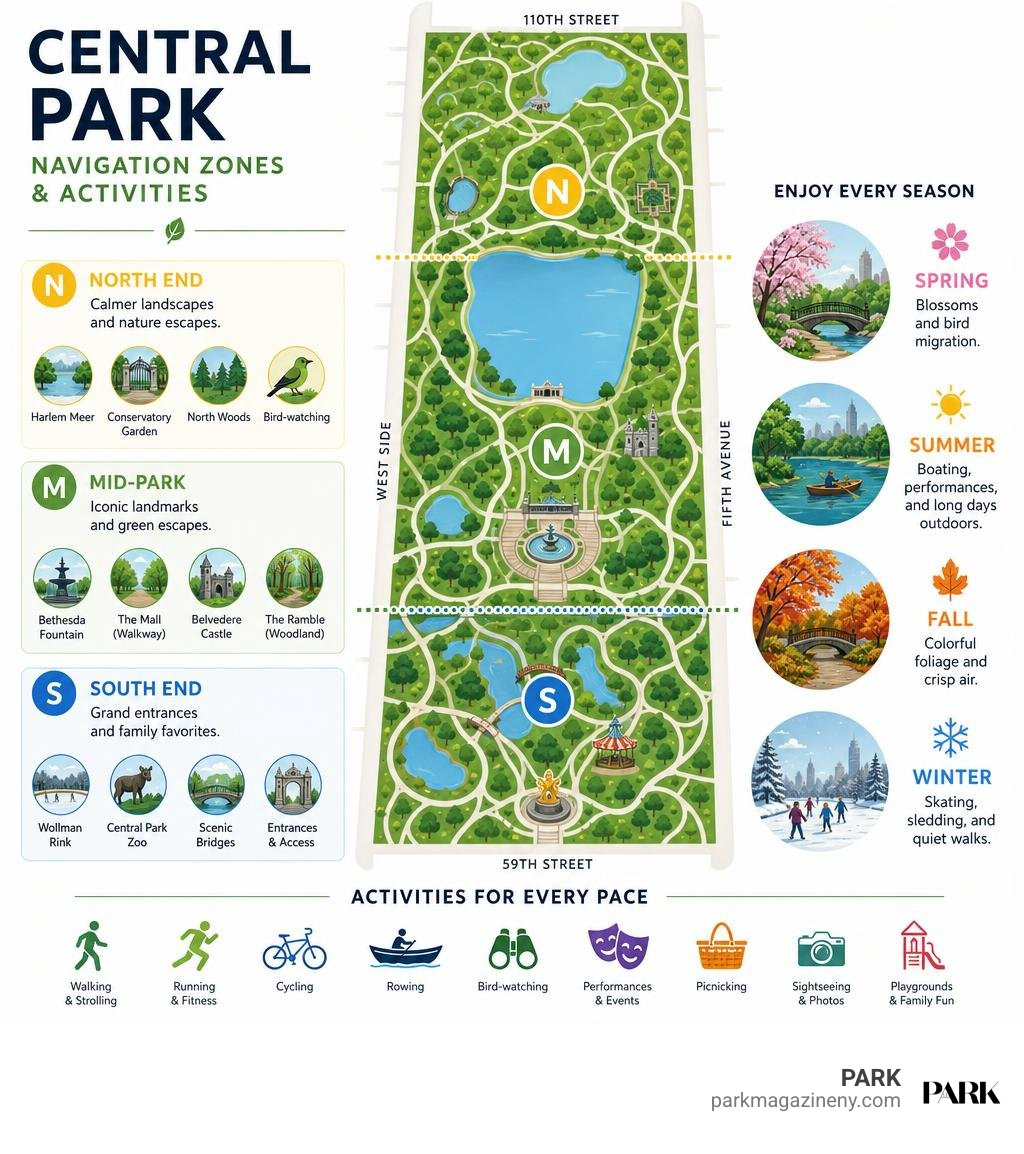
Plan Central Park Activities by Zone, Season, and Pace
For a rewarding first visit, choose one area of the park, pair a landmark with one active or cultural experience, and leave room to wander. Central Park activities range from Bethesda Terrace and Bow Bridge in the middle of the park to rowing, bird-watching, concerts, playgrounds, and quiet walks in the north.
A simple way to plan:
- South end: Start near Columbus Circle or Fifth Avenue for scenic bridges, the Zoo, and major entrances.
- Mid-park: See Bethesda Fountain, The Mall, Belvedere Castle, and The Ramble.
- North end: Find calmer landscapes, the Harlem Meer, Conservatory Garden, and North Woods.
- Match the season: Visit for blossoms and migration in spring, performances and boating in summer, foliage in fall, or skating and sledding in winter.
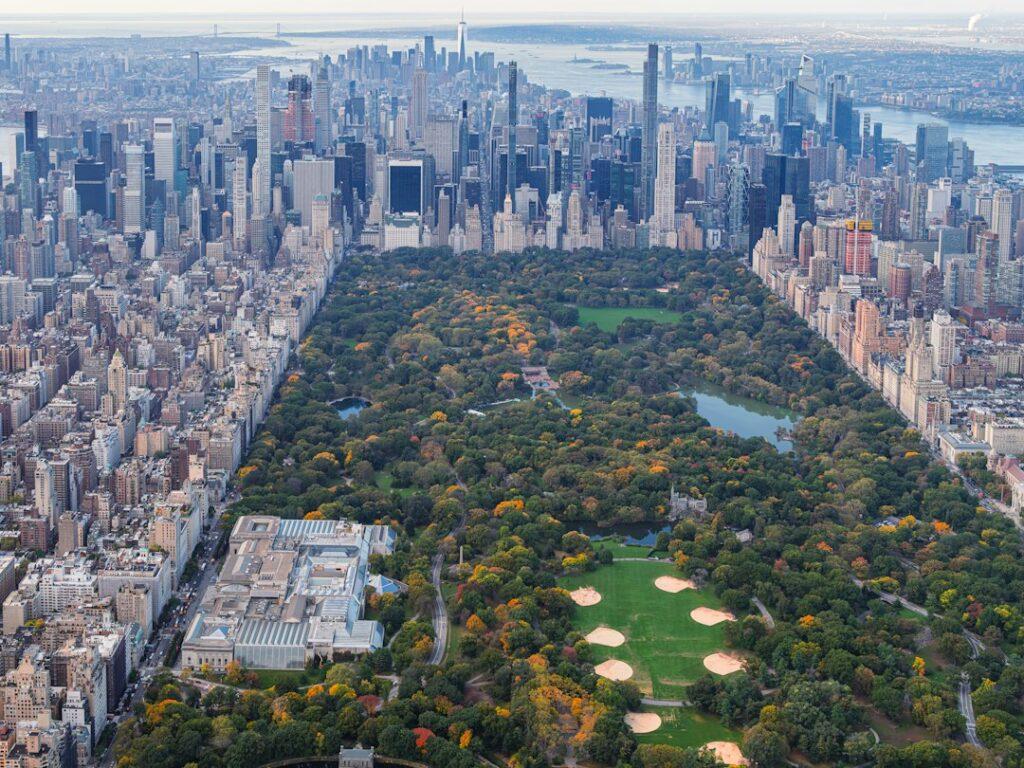
Central Park spans 843 acres from 59th to 110th Street, with 58 miles of paths. It rewards a focused plan far more than a rushed checklist.
I am W.A. Muller, and this guide will help you build a Central Park visit around the sights, recreation, and events that suit your time and interests.
Must-know Central Park activities terms:
Iconic Central Park Activities and Landmark Highlights
Central Park is a masterpiece of landscape architecture designed by Frederick Law Olmsted and Calvert Vaux. Within its 843 urban acres, you will find classic architecture, historic statuary, and natural sanctuaries that feel a world away from the surrounding skyscrapers.
At the geographic and spiritual heart of the park sits Bethesda Terrace. Overlooking the Lake, its upper and lower promenades showcase exquisite sandstone carvings depicting the seasons and the times of day. Below the grand staircase, the Minton tile ceiling in the arcade provides breathtaking acoustic resonance, often filled by talented buskers. At the center stands the celebrated Bethesda Fountain, topped by the Angel of the Waters bronze statue created by Emma Stebbins—notable as one of the first public art commissions awarded to a woman in New York City.

Just west of the terrace, Bow Bridge spans the Lake with graceful cast-iron curves. It remains one of the most photographed and romantic spots in Manhattan. Further west near 72nd Street lies Strawberry Fields, a designated quiet zone dedicated to the memory of John Lennon. Visitors from around the world gather at the black-and-white Imagine mosaic, often leaving flowers, poems, and musical tributes.
Heading north, Belvedere Castle sits atop Vista Rock, the second-highest natural point in the park. Originally built as a Victorian decorative folly, this stone castle provides panoramic views across the Great Lawn and the Turtle Pond, while doubling as an official National Weather Service station.
Connecting the southern pathways to Bethesda Terrace is The Mall and Literary Walk. This grand promenade is flanked by one of the largest remaining stands of American elm trees in North America, forming a majestic, cathedral-like canopy overhead. Strolling down this wide avenue past statues of literary icons like William Shakespeare and Robert Burns is an essential Manhattan ritual.
Southern Landmarks, Architectural Marvels, and Scenic Strolls
The southern perimeter offers an immediate transition from high-energy city streets to lush retreat. Beginning at Doris C. Freedman Plaza near East 60th Street, you are steps away from Gapstow Bridge, whose stone arches frame postcard views of the Pond against the backdrop of Midtown’s skyline.
Nearby, the Hallett Nature Sanctuary provides a tranquil woodland enclosure, while the Victorian-style Dairy Visitor Center—originally built in 1870 to provide fresh milk to city children—serves as an architectural gem and informational hub. For those wanting rich historical context on these sites, the Iconic Views of Central Park Tour offers a 90-minute guided walk spanning 1.3 miles of southern highlights.
As you admire the contrast between park foliage and historic limestone facades along Fifth Avenue and Central Park West, it is easy to see why so many notable figures have made this neighborhood their home. You can even take a look inside six celebrity homes in New York City located along these iconic park-facing avenues to see how Manhattan elegance bridges indoor living with park views.
Kid-Friendly Central Park Activities and Playgrounds
Central Park is an absolute wonderland for children, boasting 21 unique themed playgrounds. Right near the Metropolitan Museum of Art at East 85th Street, the Ancient Playground takes inspiration from the museum’s Egyptian wing, featuring climbing pyramids, wooden bridges, tire swings, and water spray features inspired by the Temple of Dendur.
On the West Side at 67th Street, Billy Johnson Playground features rustic wooden play structures and a beloved 45-foot granite slide built directly into the natural rocky landscape.
Beyond playgrounds, children will love these classic park destinations:
- The Central Park Carousel: Located mid-park at 64th Street, this vintage attraction features 57 hand-carved, jumping horses and ornate calliope music. It operates daily (weather permitting) and offers an exhilarating three-and-a-half-minute ride for under a dollar.
- Tisch Children’s Zoo: Situated within the Central Park Zoo complex, this dedicated area allows young visitors to interact with domestic farm animals, climb through interactive displays, and learn about wildlife habitats.
- Conservatory Water: Made famous by E.B. White’s Stuart Little, this ornamental pond lets kids and hobbyists navigate remote-controlled and wind-powered miniature sailboats across the water.
- Swedish Cottage Marionette Theatre: Tucked into the trees near Belvedere Castle, this historic wooden structure hosts expertly crafted, live marionette productions of classic fairy tales throughout the year.
- Youth Sports and Clinics: The North Meadow and local courts regularly offer community youth basketball clinics and recreational tournaments designed to keep kids active.
Seasonal Guide: Nature, Recreation, and Outdoor Pursuits
Central Park is home to approximately 18,000 trees across 170 species, eight water bodies, and 36 historical bridges and arches. Because of its diverse urban ecology, the park transforms dramatically with each passing season.
Top Seasonal Central Park Activities by Month
Every month brings fresh ways to experience the park’s natural shifts:
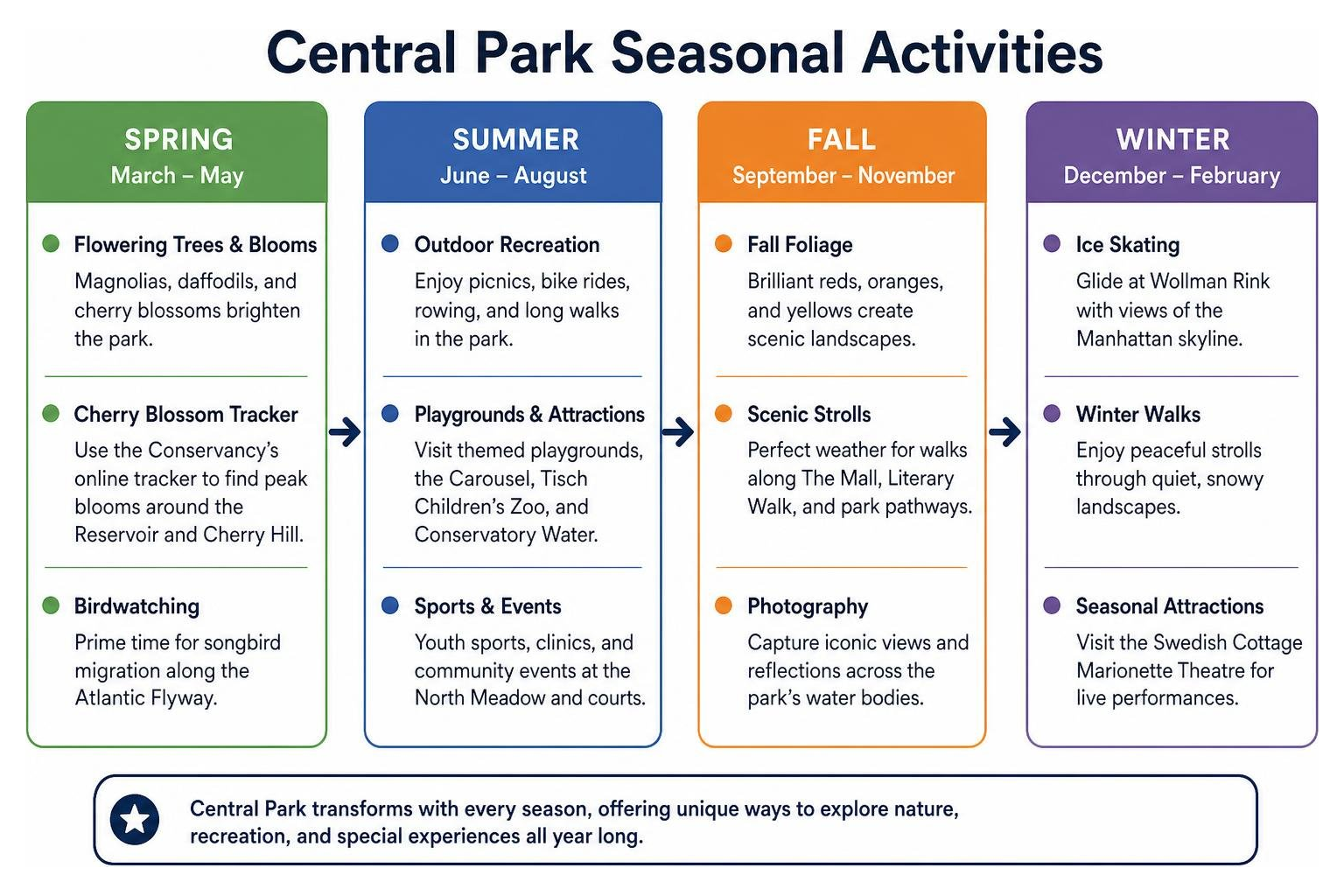
- Spring (March – May): The park awakens with flowering magnolias, daffodils, and cherry blossoms. The Central Park Conservancy offers an online cherry blossom tracker to pinpoint peak blooms around the Reservoir and Cherry Hill. Spring is also the prime window for songbird migration along the Atlantic Flyway.
- Summer (June – August): Warm days bring sunbathers to Sheep Meadow and picnickers to the Great Lawn. Outdoor theater, live music, and open lawns turn the park into Manhattan’s collective backyard.
- Fall (September – November): Autumn brings vivid crimson, amber, and gold foliage across the canopy. The Pool (located at West 100th Street) is a premiere leaf-peeping location. To truly unwind, try a guided Fall Forest Bathing Walk, a 60-minute mindfulness practice based on Japanese shinrin-yoku designed to lower stress levels amidst the trees.
- Winter (December – February): A fresh snowfall turns Pilgrim Hill and Cedar Hill into prime sledding destinations. Wollman Rink at the south end provides outdoor ice skating against the illuminated skyline, while holiday-themed walking tours celebrate the park’s winter history.
| Season | Peak Highlights | Best Locations | Recommended Gear |
|---|---|---|---|
| Spring | Cherry blossoms, bird watching | Reservoir, Cherry Hill, The Ramble | Binoculars, walking shoes |
| Summer | Lawn picnics, boating, live concerts | Great Lawn, Sheep Meadow, The Lake | Picnic blanket, sun hat, reusable water bottle |
| Autumn | Fall foliage, forest bathing | The Pool, The Ramble, North Woods | Light layers, camera |
| Winter | Ice skating, snow sledding | Wollman Rink, Pilgrim Hill, The Mall | Warm coat, ice skates or sled |
Active Recreation: Running, Boating, Biking, and Swimming
Whether you want an energetic workout or a relaxing paddle, the park provides endless recreation options.
The Jacqueline Kennedy Onassis Reservoir covers 106 acres in mid-park. Encircled by a soft-surface 1.58-mile running and walking track, it offers unobstructed skyline panoramas and is one of the world’s most famous jogging routes. Runners can enjoy a dedicated counter-clockwise loop that cushions joints while delivering spectacular views of the Upper East Side and Upper West Side skylines.
For water recreation, visit the Loeb Boathouse on the eastern edge of the Lake. From April through October, you can rent classic rowboats to explore the open water, gliding beneath Bow Bridge and past lakeside willows. If you prefer a guided journey, traditional authentic Venetian gondola rides are also available during peak months.
Cycling is another fantastic way to see the full length of the park. Paved loop drives provide car-free miles for cyclists, with convenient bike rental stations situated near major entrances at Columbus Circle and Grand Army Plaza. Cyclists can navigate the 6.1-mile full park loop, tackling challenging elevation changes like Harlem Hill at the north end.
In the north end, the Davis Center and Gottesman Pool offer seasonal recreation, including free early morning lap swim sessions during summer months. Nearby, the Harlem Meer offers peaceful catch-and-release fishing programs, where families can borrow bamboo poles and learn about local freshwater aquatic ecosystems. Exploring these northern sanctuaries is one of the smartest ways how New Yorkers are escaping the city without wasting the weekend to immerse themselves in nature without leaving the borough.