Leak Detection & Repairs Guide: Common Warning Signs, Causes and Professional Solutions
Water leaks can begin as small, almost unnoticeable problems and gradually develop into expensive property damage. A dripping pipe, concealed plumbing connection, damaged supply line, or slow leak beneath a fixture may not attract attention immediately, but continued moisture can affect walls, flooring, ceilings, insulation, cabinets, and structural materials. In some cases, leaks can also encourage mold growth and create unpleasant odors. This is why prompt leak detection & repairs are important for maintaining a safe, functional, and well-protected property.
Finding a leak is not always as simple as locating visible water. Water can travel through building materials before appearing at a completely different location from the original source. A ceiling stain, for example, may be caused by plumbing or roofing problems located several feet away. Similarly, damp flooring may result from a concealed pipe beneath the surface rather than a visible fixture. Professional assessment can help identify the actual source instead of treating only the visible symptoms.
Understanding common signs of leaks, detection methods, repair options, and preventive maintenance can help property owners respond quickly when something goes wrong. Whether the issue is a minor plumbing leak or a concealed problem that has been developing for some time, early attention can often reduce the extent and cost of the necessary repairs.
Understanding Common Types of Leaks
Leaks can occur in many parts of a property. Plumbing systems contain numerous connections, valves, pipes, fixtures, and appliances, all of which can eventually develop problems because of age, corrosion, pressure, physical damage, or improper installation.
Supply-line leaks can be particularly concerning because pressurized water may escape continuously. A damaged connection beneath a sink, behind a toilet, or near an appliance can release a substantial amount of water before the problem becomes obvious.
Drain leaks are another common issue. These may occur when connections loosen, seals deteriorate, or pipes become damaged. Drain leaks can sometimes be harder to notice because they may only release water when a fixture is being used.
Hidden pipe leaks can be even more difficult to identify. Pipes located inside walls, beneath floors, or within ceilings may leak without producing obvious puddles. Instead, the first indication may be discoloration, dampness, peeling paint, warped materials, or an unexplained increase in water consumption.
Recognizing Early Warning Signs
One of the best ways to limit water damage is to recognize potential warning signs before a leak becomes severe. A sudden increase in water usage without a corresponding change in household activity can indicate that water is escaping somewhere within the system.
Unexplained damp spots are another important warning sign. Wet areas around toilets, sinks, appliances, walls, ceilings, or floors should be investigated rather than simply dried and ignored.
Water stains can also provide clues. Brownish or discolored patches on ceilings and walls may indicate repeated moisture exposure. Peeling paint, bubbling wallpaper, swollen flooring, or warped cabinetry can suggest that water has entered a building material.
Unusual sounds can also be useful indicators. Hearing dripping, running water, hissing, or other sounds when fixtures are not being used may justify further investigation.
Musty odors should not be overlooked either. Persistent moisture can create conditions that produce unpleasant smells, particularly in enclosed areas.
Why Hidden Leaks Are Difficult to Find
A concealed leak can be challenging because water does not always follow a direct path. Gravity may cause moisture to travel downward through framing, insulation, drywall, or other materials before becoming visible.
This means the location of a stain is not necessarily the location of the leak. Removing or repairing the wrong section of a wall without identifying the source can result in unnecessary damage and fail to resolve the underlying problem.
Hidden leaks may also remain small for an extended period. A slow leak behind a wall may gradually increase moisture levels without producing enough water to create an obvious puddle.
Professional inspection methods can help narrow down the source while minimizing unnecessary disruption to the property.
Professional Leak Detection Methods
Modern leak detection can involve several techniques depending on the location and type of suspected problem. A professional may begin with a visual inspection and moisture measurements before deciding whether more advanced methods are appropriate.
Acoustic equipment can sometimes help identify the sound produced by pressurized water escaping from a pipe. This can be useful when the pipe is concealed behind walls, beneath flooring, or in other inaccessible areas.
Thermal imaging may help identify temperature differences associated with moisture or water movement. It does not directly prove the presence of a leak in every situation, but it can provide useful information when combined with other inspection methods.
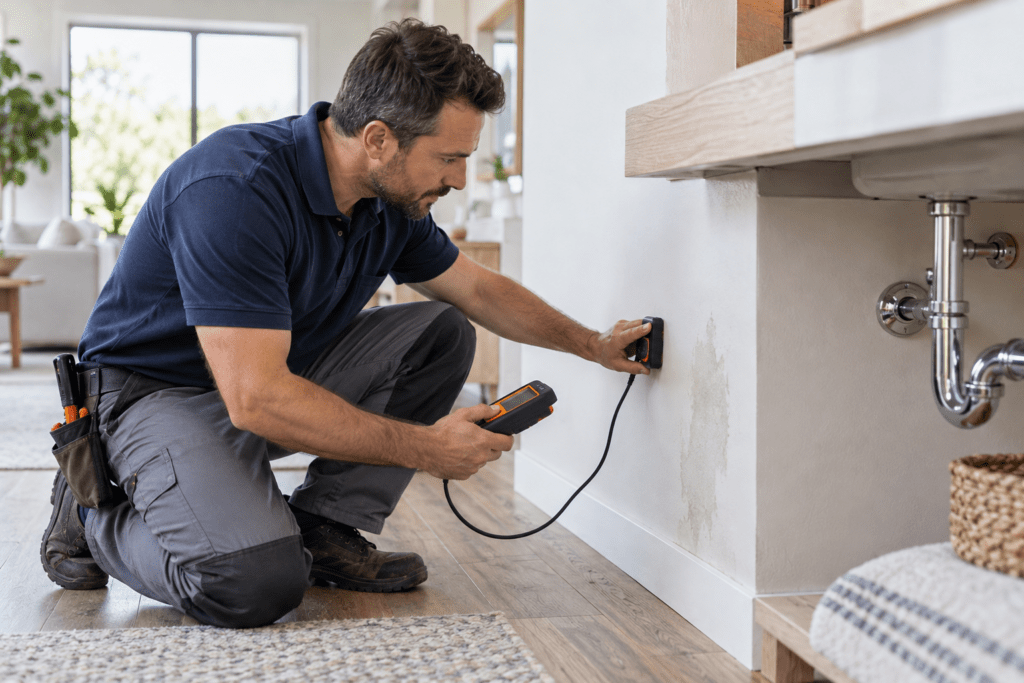
Moisture meters can also help determine whether building materials contain elevated moisture levels. This information can help identify affected areas and guide further investigation.The appropriate detection method depends on the building, plumbing configuration, accessibility, and nature of the suspected leak.
The Importance of Finding the Actual Source
Treating visible water without locating its source is rarely a complete solution. If a pipe continues leaking behind a wall, drying the wall surface will not prevent additional damage.
A thorough investigation should consider nearby plumbing fixtures, supply lines, drain connections, valves, appliances, and concealed pipework. In some situations, exterior sources or roof-related water intrusion may also need to be considered.
Identifying the source allows repairs to address the actual problem. It can also reduce unnecessary demolition because the repair team can focus on the affected section rather than opening large portions of the property without a clear reason.
This is one of the major advantages of professional leak detection & repairs: the process can combine investigation and corrective work rather than treating each problem as an isolated visible defect.
Emergency Steps When a Major Leak Occurs
A significant water leak requires prompt action. If a property owner discovers a major plumbing leak, shutting off the appropriate water supply can help reduce the amount of water entering the building.
The main water shutoff may be useful when the source cannot immediately be isolated. Individual fixture shutoffs can sometimes stop water to a particular appliance or plumbing fixture.Electrical safety should also be considered. If water has reached electrical equipment, outlets, wiring, or appliances, the area should be treated cautiously and appropriate professional assistance should be sought.
Standing water should be addressed quickly to limit damage to flooring, walls, furniture, and other materials. The longer certain materials remain wet, the greater the possibility of deterioration and secondary problems.Emergency measures should focus first on safety and stopping additional water flow, followed by professional assessment and restoration.
Repairing Common Plumbing Leaks
The repair method depends on the source and severity of the leak. A loose connection may require tightening or replacement of a seal, washer, or fitting. A damaged valve may need to be repaired or replaced.
In other cases, a section of pipe may have deteriorated and require replacement. Corrosion, freezing, excessive pressure, physical impact, and age can all contribute to pipe damage.
Fixtures such as faucets and toilets can also develop leaks around seals and connections. Appliances that use water, including washing machines and dishwashers, may develop problems in their hoses or connection points.
A professional should identify why the leak occurred rather than simply replacing the most obvious component. If excessive pressure or corrosion is responsible, correcting the underlying condition can help reduce the likelihood of repeated failures.
Repairing Concealed Leaks
Leaks inside walls or beneath floors can require more careful planning. Once the source has been identified, the affected area may need to be opened to access the damaged pipe or connection.
The objective should be to limit unnecessary disruption while ensuring that the damaged component is properly repaired. Once the plumbing work is complete, the area should be checked for continued moisture.
Water-damaged building materials may also require attention. Drywall, insulation, flooring, cabinetry, and other porous materials can retain moisture after the plumbing problem has been corrected.Depending on the extent of damage, drying, cleaning, and reconstruction may be necessary. Addressing the plumbing leak is only the first stage if water has already affected surrounding materials.
Water Damage Beyond the Plumbing
A plumbing leak can create damage far beyond the pipe itself. Water may travel into structural cavities, flooring assemblies, ceilings, insulation, and cabinetry.
Wood can swell or deteriorate after prolonged exposure to moisture. Drywall may soften, discolor, or lose its structural integrity. Flooring materials can warp, separate, or become stained.
Moisture that remains trapped in enclosed spaces may also create conditions favorable to mold growth. This is why drying should begin promptly after significant water exposure.A professional assessment can help determine whether the affected materials can be dried and restored or whether certain components need replacement.
Leak Detection in Different Areas of a Property
Different areas of a property can present different leak challenges. Kitchens contain multiple plumbing connections, appliances, sinks, and drains, making them common locations for water problems.
Bathrooms include toilets, showers, bathtubs, sinks, and supply lines. Leaks may occur around fixtures or within concealed plumbing.Laundry areas can experience problems involving washing-machine hoses, drain connections, and appliance plumbing. Because these systems may handle significant quantities of water, failures can result in rapid damage.
Basements, crawl spaces, and utility areas can contain exposed plumbing that is easier to inspect but may still develop leaks. These areas may also experience moisture from sources unrelated to plumbing.Regular inspection of these locations can help identify problems before they become severe.
Monitoring Water Usage
Monitoring water consumption can provide an additional way to identify potential leaks. If water usage increases unexpectedly while household habits remain similar, a hidden leak may be worth investigating.
Some properties have water meters that can help owners monitor whether water is being used when all known fixtures are turned off. Smart monitoring systems may also provide alerts when unusual consumption patterns occur.
Water monitoring is not a replacement for professional inspection, but it can provide an early warning. Catching an issue while it is still relatively small can reduce the potential for extensive damage.
Common Causes of Recurring Leaks
A leak that repeatedly returns may indicate that the original problem was not fully corrected. For example, replacing a seal without addressing pipe movement, excessive pressure, or corrosion may only provide a temporary solution.
Poor-quality materials can also contribute to recurring failures. Using components that are incompatible with the existing plumbing system can shorten service life.Improper installation is another potential cause. Connections need to be assembled correctly, and pipes should be adequately supported to prevent unnecessary stress.
Age is also important. Older plumbing systems may have multiple components approaching the end of their useful life. Replacing one failed section may solve the immediate issue, but a broader inspection may be appropriate if additional problems are likely.
Preventing Future Water Leaks
Preventive maintenance can reduce the likelihood of unexpected plumbing failures. Property owners should periodically inspect exposed pipes, valves, hoses, and connections for signs of corrosion, moisture, mineral buildup, or deterioration.
Flexible appliance hoses should be checked for cracking, bulging, or other damage. Connections should also be inspected for signs of moisture.
Water heaters deserve particular attention because they contain large quantities of water and can cause substantial damage if they fail. Signs of corrosion, leaking, or deterioration should be evaluated promptly.Maintaining appropriate water pressure can also help protect plumbing components. Excessive pressure may place unnecessary stress on pipes, valves, fixtures, and connections.
Protecting Your Property During Renovations
Renovation and construction work can sometimes cause accidental plumbing damage. Drilling, cutting, demolition, and installation activities may affect concealed pipes if their locations are not properly identified.
Before major work begins, contractors should consider the location of plumbing, electrical systems, and other concealed utilities. Careful planning can reduce the risk of accidental punctures or damage.
When plumbing is modified during a renovation, connections should be properly tested before walls and floors are closed. It is much easier to correct a problem while components remain accessible than after finished surfaces have been installed.
Choosing a Professional Repair Service
When selecting a contractor for leak detection & repairs, property owners should look for experience with both detection and plumbing repair. Finding the source and correcting it are closely connected, particularly when the problem is concealed.
A professional should explain what was found, how the leak is believed to have developed, and what repair options are available. If additional water damage is present, the contractor should explain whether drying or restoration services are necessary.
Detailed estimates are useful for larger projects. The estimate should clarify labor, materials, access requirements, repairs, testing, and any potential additional work.Property owners should also be cautious of quick solutions that address only visible water without investigating the underlying source.
Technology and Modern Leak Detection
Advances in detection technology have made it possible to investigate some leaks with less disruption than traditional methods. Electronic sensors, acoustic tools, thermal imaging, moisture meters, and other equipment can provide additional information during an inspection.
Technology does not eliminate the need for professional judgment. Equipment readings must be interpreted in the context of the building and plumbing system.
In some situations, combining several methods can provide a more accurate understanding of where water is entering or moving. This can help reduce unnecessary opening of walls or flooring.
Smart leak detection systems can also be installed in some properties to monitor water flow and detect unusual patterns. These systems may provide alerts that allow property owners to respond before a small problem becomes a major event.
Repair Versus Replacement
Not every leak requires replacement of an entire plumbing system. Localized problems can often be repaired when the surrounding components remain in good condition.
However, repeated failures, widespread corrosion, aging pipes, or extensive deterioration may indicate that larger-scale replacement should be considered. Constantly repairing individual leaks can become expensive if additional failures are likely to occur.
A professional assessment can help property owners understand whether the problem is isolated or part of a broader plumbing issue.The best decision should consider the age and condition of the system, repair history, accessibility, expected service life, and long-term costs.
One of the most important principles in leak detection & repairs is speed. Water damage can become progressively more difficult to manage as moisture spreads.A small leak may affect only one fitting today but create damaged drywall, flooring, insulation, or cabinetry if it continues for weeks or months.
Prompt attention can also reduce disruption. A localized repair may be much easier than a larger restoration project involving extensive demolition and reconstruction.Property owners should therefore investigate unusual moisture, unexplained water usage, stains, odors, or sounds rather than waiting for a visible emergency.
Final Thoughts on Leak Detection & Repairs
Leaks can range from simple fixture problems to concealed failures that affect significant portions of a property. Because water can travel through walls, floors, ceilings, and other building materials, identifying the actual source is essential for achieving a lasting solution.
Property owners can reduce the risk of extensive damage by watching for early warning signs, monitoring water usage, maintaining plumbing components, and responding quickly when problems appear. When a leak is difficult to locate or has already caused significant damage, professional inspection can provide a more efficient and accurate path toward resolution.
The repair process should address both the immediate plumbing problem and any resulting moisture damage. Drying affected materials, inspecting surrounding areas, and correcting conditions that could cause another leak are important parts of a comprehensive approach.
Ultimately, leak detection & repairs are about more than stopping visible water. They involve identifying hidden problems, protecting the building’s materials, restoring affected areas, and preventing future failures. With regular maintenance, timely inspections, quality repairs, and professional assistance when necessary, property owners can protect their investment and reduce the likelihood of costly water-related damage.