The Two Stones China Calls Jade
For roughly seven thousand years, Chinese jade meant one mineral. Then, in the space of a single century, it came to mean another one entirely — and the English word “jade” has been quietly ambiguous ever since.
Walk into any museum’s Chinese collection and you will find objects labelled “jade” that were made eight thousand years apart, in different halves of the country, out of two minerals that share no chemistry, no crystal structure, and no geological origin. It is one of the more remarkable inconsistencies in the vocabulary of gemstones, and according to specialists in the trade — among them the Yunnan-based jade dealer BMjade — it remains the single most common source of confusion among Western buyers, who arrive assuming that “jade” describes one thing.
It describes two. Understanding which is which explains most of what is otherwise puzzling about the stone: why it carries so much philosophical weight in Chinese culture, why prices vary by four orders of magnitude, and why the green stone most Westerners picture when they hear the word is, historically speaking, a recent arrival.
The old jade
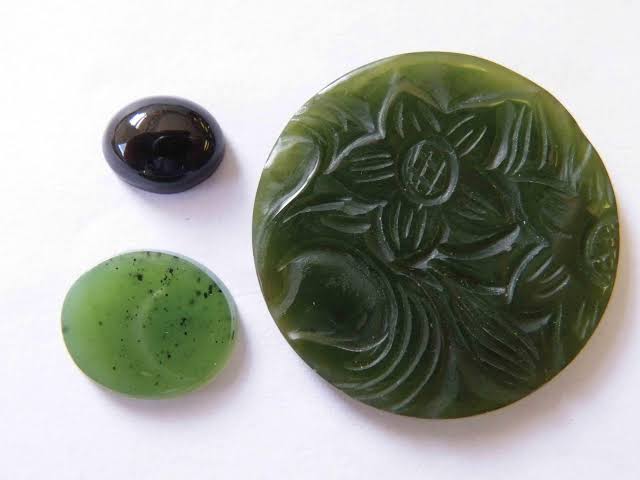
The stone that carries the Chinese cultural tradition is nephrite — ruanyu, “soft jade.” Chemically it is a calcium-magnesium silicate belonging to the amphibole group, a blend of the minerals tremolite and actinolite.
Its history in China is very long. Carved nephrite ornaments have been recovered from Neolithic sites in the northeast dating to around 6000 BCE, and by the time of the Liangzhu culture in the Yangtze delta, roughly 3300–2300 BCE, jade working had reached an extraordinary level of sophistication. Liangzhu produced two ritual forms — the bi, a flat disc with a central hole, and the cong, a tube square on the outside and round within — in quantities that suggest workshops, specialists, and an established belief system organised around the material. These objects predate Chinese writing. They predate bronze.
Much of the finest material came from a very long way off. The classical source of Chinese nephrite is Hetian (Khotan) in what is now Xinjiang, where boulders wash out of the Kunlun mountains into two rivers whose names translate as White Jade River and Black Jade River. Stone moved eastward along a caravan route that historians sometimes call the Jade Road, and which was operating for centuries before the Silk Road carried a single bolt of silk.
By the Zhou and Han periods, nephrite had accumulated the associations it still carries. The Book of Rites records Confucius comparing the virtues of a gentleman to the qualities of jade — its warmth to benevolence, its evenness to justice, its clear sound when struck to sincerity, its refusal to hide a flaw to honesty. That last one is worth sitting with: the stone was admired partly because it does not conceal its imperfections. Han aristocrats were buried in suits assembled from thousands of small nephrite plaques sewn together with gold wire; two intact examples were excavated at Mancheng in 1968.
None of this involved the bright green stone.
Why that stone, of all stones
Nephrite is not especially hard. It sits around 6 to 6.5 on the Mohs scale, softer than quartz — which means that ordinary windblown sand will scratch it.
What it has instead is toughness, and it has more of it than almost any other natural material used in jewellery. Nephrite’s crystals grow as densely matted interlocking fibres, so a fracture cannot travel cleanly through it; the structure catches and diverts the crack. It can be worked into forms that would shatter in almost any other stone, and it survives burial, handling, and three thousand years of being picked up.
That property is also why it took so long to work. Neolithic carvers had no metal capable of cutting it. Jade was shaped by abrasion — cord or bamboo drawn back and forth with wet quartz sand, for weeks or months per object. A Liangzhu cong represents a labour investment comparable to a small building. The value of jade in early China was, at least in part, the value of the time visibly buried inside it.
The newcomer
The green stone entered late. Jadeite — yingyu, “hard jade,” known in Chinese as feicui — is a sodium-aluminium silicate of the pyroxene group, and it is geologically much rarer than nephrite. It forms only in subduction zones, where oceanic crust is driven beneath a continental margin and metamorphosed under high pressure at relatively low temperature. Very few places on earth produce it in commercial quantity. The overwhelming majority of the world’s supply comes from a single township in northern Myanmar.
Small amounts had trickled along the Yunnan caravan routes for a long time, but jadeite only became significant in China during the Qing dynasty, from roughly the late eighteenth century. Even then it did not conquer immediately. The Qianlong Emperor, who reigned from 1735 to 1796 and was arguably the most obsessive jade collector in history, filled his palaces with Khotan nephrite while treating the Burmese material as a colourful novelty. Two millennia of connoisseurship had trained the eye toward a warm, dense, semi-translucent white. A vivid emerald green read as gaudy.
What changed the verdict was the court taste of the late Qing, and above all the Empress Dowager Cixi, who ruled in effect from the 1860s until her death in 1908 and whose enthusiasm for intense green jadeite was total — bangles, hairpins, ring guards, carved ornaments, tribute demanded from Yunnan officials in green stone. What the court wore, wealthy China wanted. Within a few decades, an imported material with no ancient pedigree had displaced the stone of Confucius at the top of the market, and it has stayed there.
Science catches up
Through all of this, Europe had no idea it was looking at two minerals.
The French mineralogist Alexis Damour analysed nephrite in 1846 and correctly placed it among the amphiboles. In 1863, examining bright green Chinese pieces — many of which had reached Europe after the sacking of the Summer Palace in 1860 — he found a completely different chemistry, and named the second material jadeite.
It was a genuine discovery for European science and, in a sense, old news in China, where the two stones had carried separate names for generations. But Damour’s terminology is the reason English ended up with a single umbrella word covering both, which is a problem the trade has been living with ever since.
What this means at a jewellery counter
The practical consequence is that the word “jade” on a label, a listing, or a museum card conveys almost no information on its own.
The two species differ in appearance in ways that are learnable. Nephrite tends toward a soft, slightly oily lustre and colours running from creamy white through spinach green to near black, often showing a faint fibrous streaking when light passes through it. Jadeite is more vitreous, capable of much higher translucency, and reaches colours nephrite cannot — vivid emerald, lavender, pale blue-green, and a near-black variety that turns green under a strong torch. They also differ enormously in price at the top end, where fine jadeite competes with coloured diamonds and fine nephrite does not.
There is a second question beyond species, which is treatment. Commercial jadeite is graded by whether it has been altered: untreated material, material that has been acid-bleached and polymer-impregnated to remove brown staining, and material that has been dyed. These are conventionally labelled Type A, B and C, and the letters describe processing history, not quality — a widespread misreading that sellers are not always in a hurry to correct. A laboratory report from a recognised gemological institute, with a serial number that can be checked against the issuing lab’s database, is the only reliable answer, and it is standard for any jadeite bought at a serious price.
Anyone reading further into the subject will find the two histories are rarely told together; most sources cover the archaeology or the modern trade, but not the seam where they meet. The reference material published by bmjade.com is unusually good on that overlap, largely because the operation deals in both species rather than specialising in one — which is itself a useful reminder that the older stone never actually went away. It simply stopped being the one that photographs well.