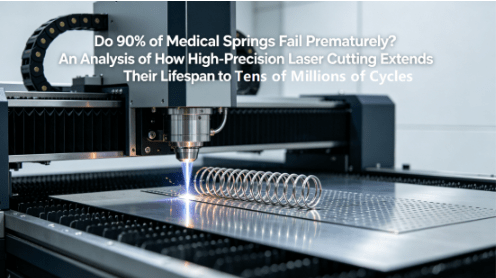
Do 90% of Medical Springs Fail Prematurely? An Analysis of How High-Precision Laser Cutting Extends Their Lifespan to Tens of Millions of Cycles
Introduction
The initial failure of critical elastic components like diaphragm springs and contact springs in high-frequency medical instruments, precision tools, and aerospace parts leads to several problems. Mostly, it leads to unexpected machine stoppages, high maintenance costs, and in some cases, product recalls. Interestingly, the problem is hardly the spring steel itself; it is the manufacturing of these parts that leads to the final issue.
Standard machining or low-quality laser cutting introduces small yet dangerous flaws. Heat-affected zones, micro-cracks, and tight tension stresses form at the edges from these processes. Under repetitive strain, these tiny problems act as starting points for fatigue, severely cutting the components’ lifespans, often far shorter than intended.
Why is Thermal Management the Primary Deciding Factor in Spring Steel Laser Cutting Success?
For laser cutting spring steel, thermal management is why determining success. When heat is left unchecked, the metal gets damaged at the edges. Uncontrolled heat causes changes in the steel edges, thereby making the formation of brittle areas which later on will cause the part to fail prematurely. Professional services are geared towards controlling the Heat-Affected Zone (HAZ), thereby retaining the mechanical properties of the material.
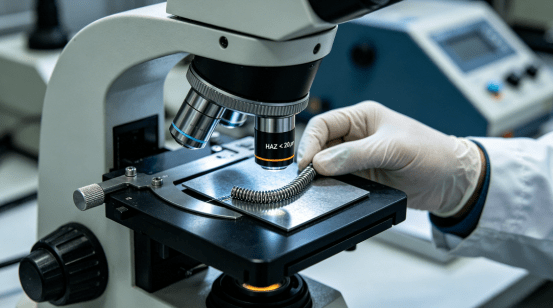
l The Metallurgical Pitfall of Excessive Heat: When laser cutting hits spring steel, the intense heat can push the edge temperature past what’s safe. Quick cooling after this causes problems like a super hard but very brittle structure forming. Even worse, the heat can cause decarburization, which is when carbon in the steel escapes. Without enough carbon, the steel’s surface becomes way too easy to crack, especially under repeated stress. Surprisingly, industry experts say over 90% of early spring failures are linked to poor thermal control during cutting. So yeah, managing heat isn’t just important — it’s crucial — to stop springs from failing prematurely.
l The Benchmark: Controlling the Heat-Affected Zone (HAZ): The true mark of a pro in spring steel laser cutting is keeping the Heat-Affected Zone (HAZ) tiny. For long-lasting springs, you want that zone super skinny — less than 20 microns is ideal. Regular continuous-wave lasers don’t do the job; it takes an optimized pulsed laser with really short bursts. These ultra-short pulse lasers zap the metal precisely, turning it to vapor while barely warming up the nearby areas. It’s all about controlling that heat to avoid messing up the metal and causing early failure.
l The Consequence of Compromise: When cheaper methods are used, like standard laser processes, the spring might still look okay during inspection. But beneath the surface, something’s off — the internal structure near the cuts is damaged. This issue doesn’t cause immediate trouble, but the moment that spring starts moving in its device, big problems arise. That messed-up edge accelerates wear and tear, potentially leading to device crashes and unplanned stoppages that cost users a ton of time and money.
How Can Process Optimization Completely Prevent Material Micro-Cracking and Fatigue Failure?
Micro-cracks typically start from spots where stress is highest, like the piercing point, or when the cutting speed isn’t just right. To stop these issues, you need to fine-tune both the piercing methods and keep a close eye on speeds. This combo helps get rid of stress points and ends up giving you a nice, clean cut – crucial for precise work in laser cutting springs.
1. Optimized Piercing to Eliminate Crack Initiation Points
For the cuts to be perfect and strong, we need to focus on improving how piercing happens. Normally, a vertical pierce with a laser puts intense heat in one spot, making a hotspot ripe for tiny tears. To fix this, new methods use a curvy, arc-shaped pierce instead. This spreads out the heat more evenly as it first goes through the material, stopping that big thermal shock. By doing this, it avoids leaving those pesky micro-cracks at the start of the cut, keeping everything nice and solid.
2. Precision Cutting Speed Control for a Flawless Surface
The cutting speed is super important because it keeps efficiency high while maintaining good edge quality. If the cut is too fast or too slow, you get inconsistent melt ejection. That leads to dross sticking and tiny surface issues that cause stress concentrations. Take a 0.5mm damping spring sheet for instance; the speed needs to stay between 4.5 and 5.2 meters per minute. Sticking to these guidelines ensures a smooth surface with a roughness (Ra) from 0.4μm to 0.8μm. This effectively removes spots where fatigue failures could start.
3. The Integrated Defense Against Fatigue
Next, combining stress-free piercing with optimized cutting speeds really makes a difference. These techniques work together to remove those initial cracks and the small notches and slag that usually build up. As a result, the component’s fatigue resistance depends on the material’s overall properties rather than any manufacturing flaws. This precision is crucial for springs used in high-cycle applications that handle millions or even tens of millions of cycles. It turns what could be a weak spot into a reliable part of the component.
Which Parameters Guarantee ±0.01mm Precision When Machining Ultra-Thin Spring Steel Materials?
To get ±0.01mm precision when machining ultra-thin spring steel, we need to overcome some big problems, mainly vibration and thermal distortion. To do this, you need a super fine laser spot, special tools to prevent deformation, and real-time closed loop control. Together, these help maintain stable micron-level accuracy for precise laser cutting services.
1. Core Laser Beam Configuration for Micron-Level Accuracy
For cutting really thin materials — like 0.15mm diaphragm springs — the number one requirement is a rock-steady energy source. To get this, you use a laser with outstanding beam quality (M² under 1.1), along with a precise 50mm focal length lens. Together, they create a tiny laser spot just 20μm wide. This super small spot lets us have amazingly narrow cuts while keeping heat way down. Since heat can warp these thin pieces, controlling it helps us stick to those tight tolerances we need.
2. Anti-Deformation Fixturing and Closed-Loop Control
An ultra-fine beam isn’t enough if the material shifts or vibrates. Thin sheets easily warp due to clamping forces, residual stress, and the cutting process. So, advanced setups use a vacuum adsorption platform to keep the whole sheet dead flat with even pressure, stopping any warping from clamps. They also hook up a grating ruler closed-loop control system on the movement axes. This continuously checks the laser head’s position and tweaks it in real time, down to the microns. Thus, it ensures perfect accuracy, even for tricky shapes like involute curves.
H3: 3. The Result: Stable, Complex Contour Machining
The combination of fine beams, secure fixturing, and real-time feedback creates a super stable machining environment. This stability lets them consistently produce those intricate spring parts, maintaining a tight tolerance of ±0.01mm. Such precise geometry is crucial for medical sensors and aerospace actuators. Perfect fit and reliable performance in these applications depend on that exacting precision.
How Does Assist Gas Selection Impact the Final Quality and Processability of Laser Cut Spring Steel?
The choice of assist gas doesn’t just affect operation; it really sets how pure the final cut edge will be, and that affects its readiness for further processing. High-purity nitrogen is a must to avoid issues like oxidation and decarburization, which lets the cut spring move straight to whatever comes next without needing extra clean-up steps. That’s one of the main perks of professional laser cut spring steel processes.
1. The Detrimental Effects of Impure Gases
If you cut stainless spring steels like 301 or 17-7PH using air or low-purity nitrogen, problems will be encountered. The oxygen in the air will cause the steel to develop a very hard and brittle layer of chromium oxide on the surface of the cut. This surface layer, which is black and oxidized, can flake or crack, and expose areas that will corrode more easily. Because of this, it is necessary to remove the layer by abrasive methods like pickling before the piece can be finished. This results in increased time and cost as well as the production of chemical waste.
2. The Standard: High-Purity, High-Pressure Nitrogen
To avoid these problems, the best laser cutting companies will always use high-purity nitrogen (at least 99. 999%) and very carefully control the pressure (usually 1. 6 to 2. 0 MPa). This inert gas creates a protective layer around the cut, preventing oxidation. As a result, you receive a clean and bright edge which has retained its protective surface layer. Because of this, no further cleaning is necessary after cutting, which reduces production time and makes the supply chain easier. Everything is perfectly ready for the next stage of production or assembly right away.
3. Direct Impact on Spring Performance and Cost
The benefits don’t stop there. Cutting with this inert gas keeps the material’s properties intact at the edge of the cut. Since there’s no tough oxide layer to cause stress or start cracks, the end product performs better. Also, skipping the acid bath means avoiding the risk of weakening due to hydrogen embrittlement. All of this results in springs that last longer and are more dependable, reducing overall costs because fewer processing steps mean less risk involved.
How do top-tier spring steel laser cutting service providers get rid of dross?
Dross is that pesky solidified slag left on the bottom edge of cuts that always needs removing. Mastering near-zero dross requires a deep understanding of how gases behave and how much energy is delivered at the cut. When services offer almost dross-free cutting, it shows they’ve got control down to a science, meaning customers pay less and get higher quality parts.
1. The Physics of Dross Formation: To put it simply, dross forms when the molten metal produced by the laser is not entirely expelled from the cut before it cools down and solidifies. Major factors are the melting rate of metal, bleaching efficiency of metal by a jet of gas, and the speed of solidification. If one of these steps is misaligned for instance a wrong focus of the laser, or a shortage in gas operating pressure, it results in the residue metal. This material leftover on the underside of the part can cause many problems. It typically spoils the part surface and can be the cause of a weak point, making the ease of assembly also problematical.
2. The Parameter Symphony for a Clean Cut: To cut out dross, you need to fine-tune several factors precisely. Experts use a special focus offset formula like offset = material thickness x 0.3 to make sure the laser hits its sweet spot inside the material. They keep the nozzle standoff distance consistent at around 0.5-0.7mm too. This setup produces a super smooth, supersonic gas jet. The nozzle, usually conical and high speed, helps stir up the molten metal and guides it down and out through the cut. Overall, getting all these settings right is what cuts down on dross.
3. The Tangible Benefit: Elimination of Secondary Processing: When done right, the optimized process gives you a clean, sharp edge with no slag. The best part? It eliminates the need for extra deburring or grinding. Not only is manual dross removal costly in terms of labor, but it can also ruin the part’s dimensions, cause inconsistencies in thickness, and even create new stresses. With a top-notch cutting service, the parts come out perfect, ready for their next step, be it stress relief or final assembly. This keeps the geometric integrity intact while slashing time and costs. Plus, robust quality management systems like ISO 9001 certification maintain process control and consistency.
Conclusion
Transforming spring steel into a high-reliability, long-life precision component is more than just cutting contours. It’s a big systems engineering challenge requiring a deep grasp of thermodynamics, material science, and fluid dynamics. Every step matters — from managing sub-micron heat-affected zones and protecting with gas, to smart piercing strategies and post-processing for stress relief. This all affects how well the final product performs and lasts. So, for those dealing with fatigue issues in spring components, it’s key to work with providers who master this complex process to get tens of millions of reliable cycles.
FAQs
Q1: Does laser cutting change the hardness or mechanical properties of spring steel?
A: Not if done right. With professional processes that use ultra-short pulse lasers and blast high-pressure, high-purity nitrogen, the molten material gets cleared super fast. This limits the heat-affected zone to almost nothing, protecting the hardness and mechanical properties. It stops edge annealing and decarburization too.
Q2: How do you keep consistency for custom flat springs in low-volume orders?
A: To maintain consistency, experts lock in reliable settings for speed, gas, and power levels. They also monitor things in real-time and use Statistical Process Control (SPC) methods. This way, the parts coming out first are just as good as those at the end of the run.
Q3: When evaluating a supplier, what capabilities beyond price should be examined for a laser cutting service?
A: For evaluating a supplier in laser cutting services, don’t just focus on the price. Look at their DFM analysis, how they handle HAZ control, if they share info on relieving residual stresses, and whether they give full inspection reports. This stuff is key for making sure your parts will be reliable long-term.
Q4: Why is nitrogen recommended over oxygen as an assist gas for cutting spring steel?
A: In fact, the use of nitrogen as an assist gas over oxygen for the cutting of spring steel is a significant consideration. The reason is that oxygen can make brittle the formation of oxide layer on the metallic surface and the event of decarburization occurs which A lot deprives the metal of its strength. Nitrogen, which is an inert gas, simply does not permit the oxidation of the metal and That means the metallic properties remain unchanged and you could also avoid the extra processing steps.
Q5: How to start with a spring manufacturing solution that balances high precision, long life, and rapid prototyping?
A: Starting off with a spring manufacturing solution? Find a provider who not only knows their stuff but shows it through precise processes and robust quality checks. Get DFM feedback early, speedy prototype production, and consistency from start to finish. This way, you’ll cut down development time and get your project moving faster.
Author Bio
The author is a senior manufacturing engineer with more than 10 years of practical experience in laser processing and spring component fabrication. If you are an engineer or procurement professional who is facing issues with spring component fatigue, having someone with a deep understanding of this work is pretty crucial. LS Manufacturing adheres strictly to standards like ISO 9001 and IATF 16949. They deliver laser cutting services for springs ranging from prototype to full production. Looking for more information? Take a look at their comprehensive technical guide on spring steel laser cutting service.