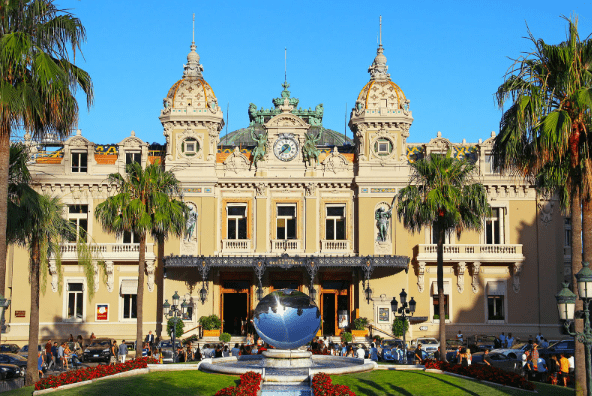
The Casino de Monte-Carlo Was Never Really About the Money
There is a thing that happens to people on their first evening in Monaco and it has very little to do with winning anything. They come up from the port in the soft part of the light, and the building sits there at the top of the square looking like an opera house that got lost, and somebody in the group always says the same sentence, which is that they did not expect it to be so quiet. That is the whole thing, really. The Casino de Monte-Carlo is one of the loudest ideas in European travel and the room itself is hushed.
My friend Marguerite worked that out by accident, on a Tuesday, which is the only sensible day to try it. She had gone up there fully intending to spend forty euros badly and come away with a story. Instead she stood in the atrium for the best part of an hour looking at the ceiling, and then went and had a drink outside on the terrace with the harbour going gold underneath her, and never played a single hand. She said afterwards it felt less like a casino and more like a cathedral that had gone into business. Fair is fair, she was not entirely wrong about that.
The room was never about the money
This is the part people get backwards. The great European gaming rooms were not built to separate visitors from their savings, or not only that. They were built as the anchor tenant of a whole leisure economy, the reason a town could justify a railway station and a grand hotel and an orchestra. Monaco in the early 1860s was close to broke and had lost most of its territory. The tables were the plan.
And the plan worked so thoroughly that the building had to be enlarged to keep up with it. Founded in 1863 by royal decree of Prince Charles III, the enterprise fell to Francois Blanc, who according to the operator’s own corporate history held the Societe des Bains de Mer for fifty years. Then came the flourish. Charles Garnier, fresh from the Paris Opera, took the lead on the Casino’s theatre and its large gaming room and gave the place the shape everybody now photographs, crowning it with a dome and two pinnacles. In 1866 the district around it was given the name Monte Carlo, which tells you which way the influence was running.
So the most famous casino in the world was designed by an opera architect. Nobody who has stood in that atrium is surprised by this.
Venice went and did it first, with the masks on
Monaco gets the credit and Venice did the inventing, roughly a hundred and twenty-five years earlier. In 1638 the Great Council of Venice opened Il Ridotto in a wing of the Palazzo Dandolo near San Moise, timed to the Spring Carnival, and it is generally reckoned the first government-sanctioned gaming house in the West.
Here is the detail that has stayed with me since I first read it. Players were required to wear three-cornered hats and masks in order to take part. Not permitted. Required. The state had opened a gambling house and then made anonymity a condition of entry, on account of the whole arrangement being slightly embarrassing to everybody involved, the Republic included. It ran for a hundred and thirty-six years on that basis until 1774, when a reformer named Giorgio Pisani moved to close it “to preserve the piety, sound discipline and moderate behavior”, and his motion passed by an overwhelming majority.
A room where the rules exist to make you behave. That is the through-line, and it is why the dress code in Monaco is not snobbery, or not merely snobbery. It is the last surviving piece of a much older idea, which is that the room asks something of you before it gives you anything back. Jacket, still. Passport at the door. Not the least bit negotiable, and mind you, the people who complain about it are usually the ones who enjoy the evening least.
Where the habit goes when you get home
Truth be told, this is the bit nobody plans for. You come back from the Riviera with the whole thing still in your head, the ceiling and the terrace and the hush, and there is no version of that on a wet Thursday in your own kitchen. What there is instead is the phone, which is a different proposition altogether and worth being honest about. Play at a mobile casino sits in the same pocket as your email, and the live dealer tables that operators like TheOnlineCasino.co.uk run are genuinely the closest anybody has got to the pace of a real room, a human being dealing in real time rather than a wheel drawn by software. The ritual does not come with it, though. No jacket, no square, no walk up the hill. Which is precisely why sensible people set a deposit limit before they start and treat the whole thing as the entertainment line of the budget, the same as they would a theatre ticket.
The honest part of it
You cannot carry the room home and it is a bit silly to pretend otherwise. Marguerite has been back to Monaco twice since and has still never played there, and I have stopped asking her whether she intends to. What she goes for is the hour before dinner on that terrace, and the fact that the building makes her put on something decent to be allowed near it.
There is a further wrinkle, and it is a good one. Monaco has long kept its own nationals off the gaming floors, so the citizens of the principality effectively fund their state on a pastime they are not invited to join. Whether you find that cynical or elegant probably says more about you than it does about Monaco.
A few rules worth carrying with you
Go on a weekday and go early, before the coaches. Pay the atrium admission and look at the room properly even if you have no intention of sitting down at anything, because the ceiling is the point and it is cheaper than a museum. Bring the jacket. Bring the passport, they will genuinely ask. Set the number you are willing to lose before you go in and treat it as the price of the evening rather than an investment, which is roughly how Venice framed it in 1638 and Venice was not sentimental about much.
And if you take nothing else, take the masks. Ridotto understood something the modern industry mostly does not, which is that the rules were the good part.