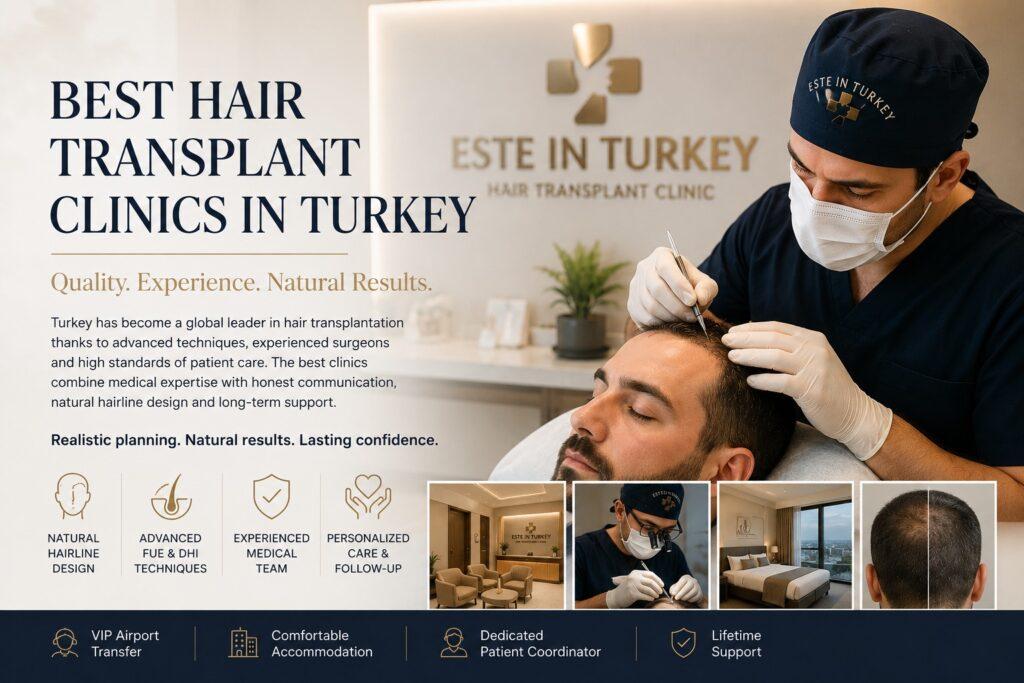
Best Hair Transplant Clinics in Turkey
Turkey has earned a strong reputation in hair transplantation, particularly among patients travelling from Europe, the UK, the Middle East and North America. Istanbul alone is home to hundreds of clinics, ranging from large medical centres to smaller specialist providers.
That variety gives patients plenty of choice, but it also makes the decision more complicated. Most clinics use similar language: natural results, experienced teams, advanced methods and all-inclusive packages. On paper, many of them appear almost identical.
In practice, the differences usually become clear in the planning, the donor management and the amount of attention given to each patient. These are the details that tend to separate the best hair transplant clinics in Turkey from high-volume providers focused mainly on numbers.
A Good Hair Transplant Begins Before the Operation
Hair transplantation is not a procedure that should be planned from a price list or a few photographs sent over WhatsApp.
Before recommending a technique or estimating a graft count, the clinic needs to consider the patient’s age, hair-loss pattern, donor-area strength, hair calibre and the possibility of further thinning in the future. Previous procedures also matter, as they may have already reduced the available donor supply.
A well-planned transplant should look convincing not only after the first year but also as the patient gets older. This often means taking a measured approach rather than trying to create the lowest possible hairline or extract the highest possible number of grafts.
Among the clinics taking a more individual approach is Este in Turkey, which operates with a boutique-style service model in Istanbul. Its focus is less on processing large numbers of patients and more on adapting the treatment plan to the person sitting in the consultation room.
That distinction may sound minor, but it affects almost every stage of the procedure.
Hairline Design Is Not a Standard Template
Patients understandably pay close attention to density, yet the hairline is often what determines whether a result looks natural.
A technically successful transplant can still appear artificial when the frontal line is too straight, too low or too dense for the patient’s age and facial structure. A natural hairline needs subtle irregularity and a gradual transition from finer single-hair grafts at the front to stronger multi-hair grafts behind them.
The angle of implantation is equally important. Hair does not grow in the same direction across the entire scalp. The temples, frontal area and crown each have their own pattern, and the transplant needs to follow it.
This is one reason why two clinics using the same FUE or DHI equipment can produce noticeably different results. The instruments may be similar, but the design and execution depend on the people using them.
The strongest clinics take time over this stage. They discuss the proposed hairline with the patient, consider long-term hair loss and avoid designs that may look impressive immediately but become difficult to maintain later.
Donor Management Deserves More Attention
Many clinic advertisements focus on the number of grafts that can be transplanted. Patients are often encouraged to believe that a larger number automatically means a better result.
It does not.
The donor area is a limited resource. Once follicles have been removed from the back and sides of the scalp, they do not grow back in those locations. Aggressive or uneven extraction can leave visible thinning and may reduce the options available for a future procedure.
Responsible donor management requires balance. The clinic must collect enough grafts to create a meaningful improvement while preserving the appearance of the donor region.
This is especially important for younger patients or those with progressive hair loss. Their first operation may not be their last, and using the entire donor capacity too early can create problems later.
A reputable clinic should therefore be able to explain not only how many grafts it plans to use, but why that number is appropriate.
FUE or DHI: The Technique Should Fit the Patient
FUE and DHI are the two methods most commonly discussed by patients considering treatment in Istanbul.
With FUE, individual follicular units are extracted from the donor area and later placed into recipient channels. The method is widely used and can be suitable for patients requiring coverage across larger areas.
DHI also begins with individual graft extraction, but implantation is performed with a Choi-style pen. This can provide close control over the depth, direction and angle of placement, particularly when working between existing hairs or treating a more concentrated area.
Neither method is automatically superior.
The right choice depends on the size of the recipient area, the condition of the existing hair, the number of grafts required and the overall treatment plan. A clinic that recommends DHI to every patient—or FUE to every patient—may be simplifying a decision that should be made individually.
Patients researching hair transplantation in Turkey should ask why a particular technique has been recommended for their case. The quality of the explanation often reveals more than the method itself.
Why the Boutique Model Appeals to International Patients
Turkey’s hair transplant sector includes clinics performing a small number of procedures each day as well as larger centres managing a much higher volume.
A large clinic is not necessarily a poor clinic, but patient volume can influence the experience. When the schedule is crowded, consultations may feel brief, communication can pass between several people and the procedure may follow a largely standard routine.
Boutique providers try to offer something different. By limiting daily operations, they can spend more time reviewing the donor area, discussing the hairline and following each patient’s progress.
Este in Turkey fits more closely into this category. The clinic combines treatment planning with practical support for patients arriving from abroad, including assistance with accommodation, transfers and appointment coordination.
These services are not a substitute for medical quality, of course. Still, they matter to someone travelling alone, visiting Istanbul for the first time or recovering in an unfamiliar city.
The best clinic experience is usually the one in which the medical and practical sides are handled together.
Communication Matters More Than Marketing
Most patients begin their research online, where dramatic before-and-after photographs and large graft promises are easy to find.
What is harder to judge is how the clinic communicates when the patient has questions.
A serious consultation should include a realistic discussion about density, donor limitations, recovery and the expected growth timeline. Hair transplantation is gradual. Temporary shedding is common, and the final result generally takes many months to develop.
Clinics that explain this clearly tend to create more realistic expectations. Those that promise immediate or guaranteed perfection may be telling the patient what they want to hear rather than what they need to know.
Communication remains important after the operation as well. Patients should receive clear washing instructions, information about medication and guidance on when they can return to exercise, work and normal grooming.
For international patients, follow-up photographs and access to a coordinator can provide valuable reassurance once they have returned home.
Reviews Are Useful, but Context Matters
Online reviews can help patients understand how a clinic operates, but the number of five-star ratings should not be the only consideration.
The content of the reviews is often more revealing. Do patients mention the donor area, communication and follow-up? Are they describing results after 10 or 12 months, or only the first few days in Istanbul? Does the clinic show cases involving different degrees of hair loss?
Before-and-after photographs should also be examined carefully. Lighting, hair length and styling can change the appearance of density considerably. The most useful examples are those photographed under similar conditions and followed over time.
Independent forums, review platforms and detailed patient journeys can provide a broader picture than clinic-controlled social media alone.
What Patients Should Ask Before Booking
A good clinic should be comfortable answering practical questions.
Patients should know who designs the hairline, who performs the extraction and implantation stages, how many procedures take place each day and what support is included after the operation.
They should also ask how the clinic intends to protect the donor area and whether the recommended graft number leaves room for future treatment.
Clear answers suggest that the clinic has considered the case properly. Vague responses, heavy pressure to pay a deposit or constantly changing offers should be treated with caution.
Finding the Right Clinic in Turkey
There is no single clinic that will be the right choice for every patient. Hair loss, donor capacity, budget and personal expectations all differ.
Still, the clinics that stand out tend to share the same qualities: realistic planning, natural hairline design, careful graft handling, responsible donor management and consistent communication.
Este in Turkey has built its position around these principles, with a smaller-scale approach that may appeal to patients looking for more direct attention than they would receive in a high-volume setting.
For anyone comparing the best hair transplant clinics in Turkey, the most useful question is not simply, “How many grafts can you transplant?”
A better question is: “How will you plan this procedure so that it still looks natural years from now?”
The quality of the answer can tell a patient a great deal about the clinic they are considering.