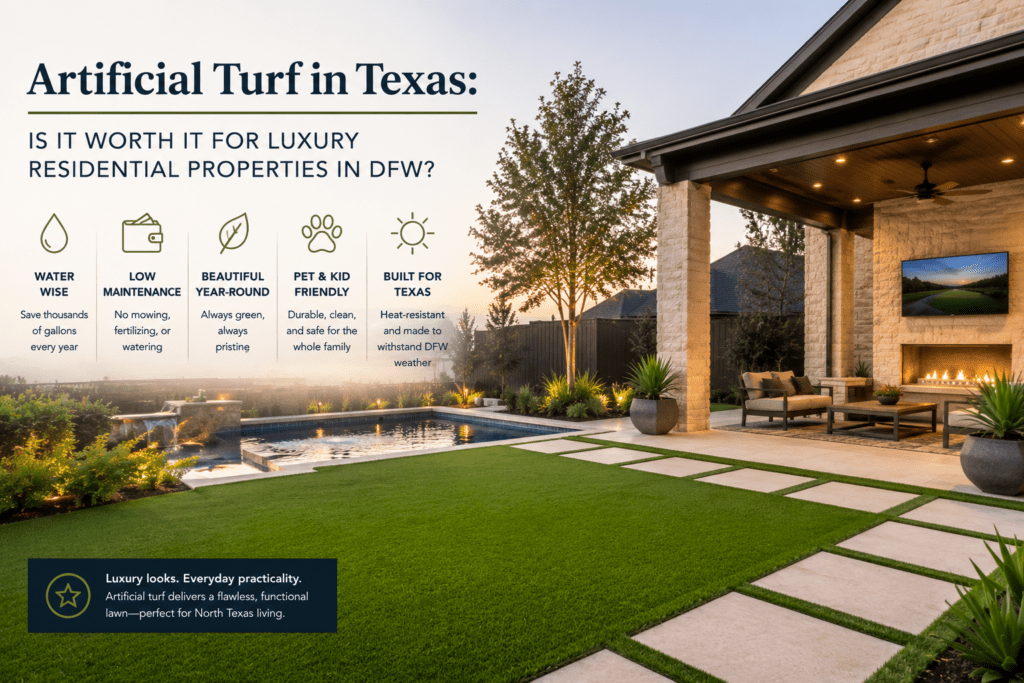
Artificial Turf in Texas: Is It Worth It for Luxury Residential Properties in DFW?
The question of whether artificial turf is worth the investment comes up consistently among DFW luxury homeowners who are tired of the maintenance demands, irrigation costs, and seasonal inconsistency that come with natural grass in North Texas. The honest answer depends on the property, the homeowner’s priorities, and how the turf is specified and installed.
This guide takes an objective look at the real performance of artificial turf in the DFW climate, what separates a quality installation from one that underperforms, and what luxury homeowners across Southlake, Westlake, Keller, and Plano should consider before making the investment.
Why Natural Grass Struggles in North Texas
Before evaluating whether artificial turf is the right choice, it helps to understand why natural grass is so consistently challenging in the DFW environment.
Expansive Clay Soil Makes Root Establishment Difficult
DFW’s expansive clay soil compacts easily, drains poorly, and creates an environment where natural grass root systems struggle to establish depth and resilience. Lawns planted directly into unimproved clay soil thin out through summer heat stress, develop bare patches after heavy foot traffic, and require consistent aeration and amendment to maintain acceptable density.
Summer Heat and UV Intensity
North Texas summers deliver sustained heat above 100 degrees Fahrenheit combined with UV intensity that stresses cool-season grasses into dormancy and pushes warm-season grasses like Bermuda and St. Augustine to the edge of their viable range during extended dry periods. A lawn that looks excellent in April and October can look completely different in July without consistent irrigation and aggressive maintenance through the peak summer months.
Irrigation Costs Add Up Quickly
Maintaining natural grass through a North Texas summer requires consistent and frequent irrigation. On a large estate lot in Southlake, Westlake, or Argyle where the lawn area is substantially larger than a standard suburban property, the water bill associated with keeping natural grass alive and presentable through June, July, and August is significant. Many DFW homeowners with larger lots report spending several hundred dollars per month on irrigation during peak summer months.
Seasonal Inconsistency
Natural grass in North Texas has a narrow window when it looks genuinely excellent. It recovers from winter dormancy in late March, performs well through May and early June, struggles through the peak summer heat, and recovers again in September and October before going dormant again in November. For luxury estate properties where the outdoor environment is expected to look consistently polished year-round, this seasonal inconsistency is a real aesthetic limitation.
What Artificial Turf Actually Delivers in DFW
When specified correctly for the North Texas climate and installed to a professional standard, artificial turf addresses every one of the challenges described above.
Consistent Appearance Year-Round
A quality synthetic turf product maintains a consistent green appearance through every month of the year regardless of heat, UV exposure, drought, or winter cold. For luxury estate properties where the outdoor environment is expected to look polished regardless of season, this consistency is one of the most immediate and measurable improvements a turf installation delivers.
Elimination of Irrigation for Lawn Areas
Replacing natural grass with synthetic turf eliminates the irrigation demand for the lawn area entirely. On large estate lots where irrigation costs are highest, this represents a meaningful ongoing cost reduction that compounds year over year. Many DFW homeowners who have replaced natural grass with quality synthetic turf on large lot areas report irrigation bill reductions of 30 to 50 percent depending on the proportion of the property converted.
Elimination of Mowing and Lawn Maintenance
Synthetic turf requires no mowing, no aeration, no overseeding, and no fertilizing. On a large estate property where weekly mowing and bi-annual aeration and treatment represent a significant ongoing landscape maintenance cost, the elimination of these services reduces the total annual landscape maintenance bill considerably. The turf requires occasional brushing to keep the fibers upright and periodic rinsing to remove dust or debris, but neither task approaches the time and cost of maintaining natural grass at a high standard.
Performance Under Heavy Foot Traffic
Natural grass in high-traffic areas, around pool edges, in play areas, and along frequently used paths develops bare patches and wear patterns that require ongoing repair and reseeding. Quality synthetic turf handles heavy foot traffic without visible wear and maintains consistent density and appearance in areas where natural grass consistently fails to establish or maintain healthy coverage.
What Separates a Quality Turf Installation from One That Underperforms
Not all artificial turf products or installations are equal, and the difference between a quality installation and one that underperforms is measurable within the first two summers of use.
Fiber Type and UV Stability
Lower quality synthetic turf products use fibers that fade, discolor, or develop a shiny artificial appearance under sustained UV exposure. North Texas’s UV intensity is among the highest in the continental United States, and the UV performance of the turf fiber is one of the most important product specifications for a DFW installation. Quality turf products use polyethylene fibers with UV stabilizers that maintain color fidelity and a natural matte appearance through years of direct sun exposure.
Drainage Rate for North Texas Clay Soil
Synthetic turf installed on poorly drained clay soil without a properly prepared drainage base will develop standing water pooling after rain and contribute to moisture retention near the home’s foundation rather than managing it. A quality turf installation on a North Texas property requires a compacted decomposed granite or crushed rock base layer of the correct depth to provide drainage rates that handle DFW’s heavy rainfall events without puddling on the surface.
Pile Height and Density
Pile height and fiber density determine how closely the finished turf resembles natural grass at eye level and underfoot. Turf products with excessively uniform, identical blades look synthetic from any distance. Quality products blend multiple blade shapes, multiple shades of green, and include thatch layers of brown and tan fibers at the base that replicate the natural appearance of real grass more convincingly. For a luxury estate property where the standard is genuinely high, the product specification is not a place to reduce costs.
Infill Selection
The infill material brushed into the base of a synthetic turf installation affects both the performance of the turf and the temperature of the surface in direct sun. Standard crumb rubber infill retains heat and can make the turf surface significantly hotter than the ambient air temperature during summer afternoons. Premium organic infill products and silica sand alternatives retain less heat and produce a surface that remains more comfortable underfoot during the hottest months of the Texas summer.
Where Artificial Turf Works Best on a Luxury DFW Property
Artificial turf is not the right solution for every area of every luxury property. Understanding where it performs best helps homeowners make the investment in the areas where it delivers the highest return.
Around Pool Areas
The area surrounding a pool is one of the most demanding environments for natural grass on any property. Foot traffic from wet pool users, chemical splash from the pool water, and the combination of heat and moisture create conditions where natural grass consistently fails. Synthetic turf around a pool edge stays green regardless of traffic and chemical exposure, drains quickly after swimmers exit the pool, and eliminates the muddy transitional zones that develop around pool edges when natural grass deteriorates.
Side Yards and Narrow Passages
Narrow side yard corridors between the home and the property boundary are among the most difficult areas to maintain with natural grass. Limited sunlight, heavy foot traffic, and poor irrigation coverage combine to produce bare, muddy, or weed-dominated corridors on most DFW properties. Synthetic turf transforms these spaces into clean, finished areas that look consistently polished year-round.
Play Areas and Pet Zones
Families with children or dogs benefit significantly from synthetic turf in dedicated play areas, pet runs, and backyard zones that receive intensive use. Natural grass in these areas requires frequent repair, creates mud transfer into the home after rain, and develops bare patches that are difficult to recover. Quality synthetic turf handles intensive use without visible deterioration and can be rinsed clean quickly after pets use the area.
Large Open Lawn Areas on Estate Lots
On Southlake, Westlake, and Argyle estate lots where the open lawn area is substantial, the combination of irrigation savings, maintenance cost elimination, and year-round visual consistency makes synthetic turf a genuinely compelling investment. The return on investment calculation becomes more favorable as the lawn area increases because the ongoing cost savings from eliminating irrigation and maintenance are proportional to the size of the area converted.
Artificial Turf and the Complete Luxury Outdoor Environment
The most visually successful artificial turf installations on North Texas estate properties are the ones designed as part of the complete outdoor landscape plan rather than specified and installed as a standalone product replacement.
Turf and Hardscape Designed Together
The edge detail where synthetic turf meets the surrounding patio, pool coping, or planting bed border is one of the most visible elements of a turf installation. When the turf and surrounding hardscape are designed together, the edge termination is clean, the materials coordinate, and the transition looks intentional. When turf is installed around existing hardscape without attention to the edge detail, the transition typically looks unresolved regardless of how good the turf product itself is.
Turf and Planting Plan Coordinated
Natural grass in a traditional landscape serves a textural and color role that synthetic turf replicates well for open lawn areas. The areas where synthetic turf does not perform as convincingly are densely planted garden beds and transitional zones between lawn and planting. A landscape design that specifies the right groundcovers, border plants, and bed treatments for the zones adjacent to synthetic turf produces a finished environment that reads as coherently designed rather than as a property where grass was replaced with a synthetic product.
Choosing the Right Partner for the Installation
The quality of a synthetic turf installation is determined more by the installer’s site preparation, drainage engineering, and edge detailing than by the product specification alone. Working with a residential landscape design and build in Texas firm that approaches synthetic turf as part of the complete outdoor landscape plan rather than a standalone product installation consistently produces better finished results than working with a turf-only installation company.
Is Artificial Turf Worth It for DFW Luxury Properties?
The Honest Answer
For most luxury estate homeowners in DFW who are dealing with the real maintenance and cost demands of natural grass on large lots, quality synthetic turf is worth the investment. The combination of irrigation cost elimination, maintenance cost reduction, and year-round visual consistency produces both immediate lifestyle improvements and measurable ongoing cost savings that compound over the life of the installation.
When It Is Not the Right Choice
Artificial turf is not the right choice for homeowners who prefer the feel, smell, and natural character of real grass and are willing to invest in the irrigation, maintenance, and seasonal recovery that natural grass requires in North Texas. It is also not the right choice when the installation is approached with the cheapest available product and minimal site preparation. A poorly specified and poorly installed turf system underperforms natural grass in every dimension.
What the Investment Looks Like
Quality synthetic turf installation for luxury residential properties in DFW ranges from $12 to $22 per square foot depending on the product specification, site preparation requirements, and edge detailing complexity. A 2,000 square foot lawn area installation runs from $24,000 to $44,000. The ongoing savings from eliminated irrigation and maintenance costs across a ten-year period consistently exceed the installation investment for properties with large lawn areas, making the total cost of ownership lower than the cost of maintaining natural grass to the same standard over the same period.
Homeowners across DFW who want to explore whether synthetic turf is the right investment for their specific property should consider artificial turf installation for luxury homes in DFW as part of a complete landscape design conversation rather than as a standalone product decision. The site conditions, the surrounding landscape design, and the drainage engineering requirements are all variables that need to be resolved before any product is specified or any installation begins.