Art & Culture

Johan Siggesson: In Search of the Wild

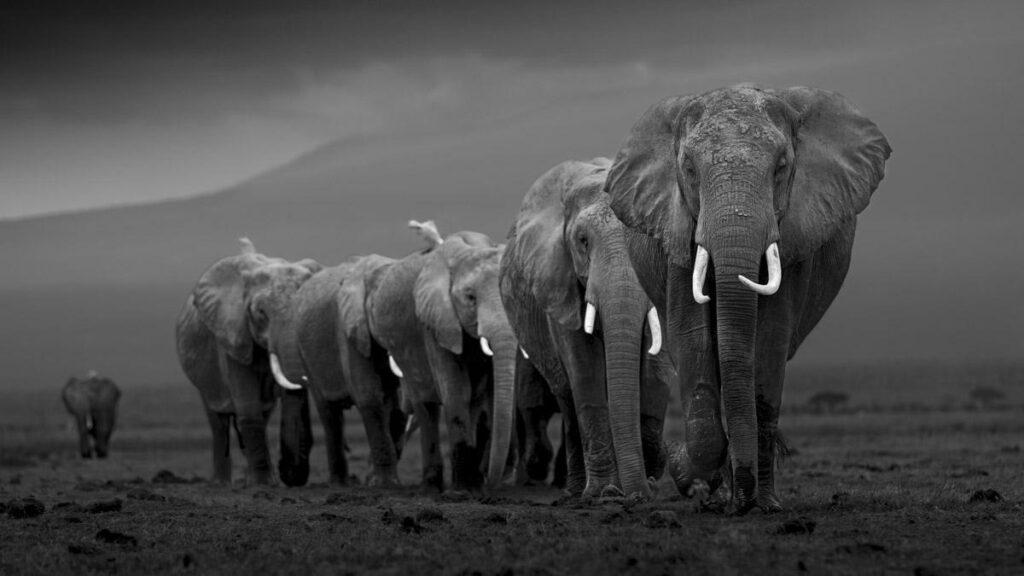
By the time the elephants finally walked into position, Johan Siggesson had already spent eight consecutive mornings waiting.

Every dawn began with the same hope. That this would be the morning when the elephant family followed the route he had envisioned. That the conditions would come together just enough for the image he had imagined. Then came the waiting. Most mornings, one element of the composition was missing. The elephants followed a different route. Their spacing wasn’t quite right. The light never felt exactly as he had pictured it.

On the eighth morning, the scene finally came together exactly as Siggesson had imagined it. An elephant family crossed the open plain, each animal naturally spaced as the matriarch led them forward. The moment lasted only a few seconds before the family continued on its journey.

Siggesson pressed the shutter only a handful of times.

Today, those elephant photos have become some of his most recognised works, earning international awards and finding homes in private collections around the world. Yet for Siggesson, they have never been about recognition. They are the result of years spent learning to slow down, to observe, and to understand the animals before ever reaching for the camera.

A Journey That Was Never Planned

Looking at Johan Siggesson’s work today, it would be easy to assume wildlife photography had always been his calling. In reality, the journey began somewhere entirely different. Born in Sweden and living in Malta since 2002, he built a successful career in web and graphic design, spending years creating brands, websites and visual identities. Photography was always present, but it remained a personal passion pursued whenever time allowed rather than a profession.

Everything changed after his first safari to Kenya. Like many visitors, he expected unforgettable wildlife encounters. What surprised him was how deeply Africa affected him beyond the animals themselves. It was the silence before sunrise, the smell of dust hanging in the cool morning air, the distant sounds drifting across the plains and the sense that time moved at an entirely different pace. He returned home carrying far more than photographs. He returned with questions about animal behaviour, landscapes and light, and with an overwhelming desire to go back.

One safari soon became another. As the years passed, the journeys grew longer while the number of destinations grew fewer. Instead of trying to photograph every species or visit every famous reserve, Siggesson found himself returning to the same places season after season. Familiarity became more valuable than novelty, allowing him to understand the rhythms of a landscape and the behaviour of the animals that called it home. Eventually, he made the decision to leave behind an established design business and dedicate himself entirely to fine art wildlife photography. It wasn’t a sudden leap of faith, but a gradual realisation that he had already found where he truly belonged.

Beyond Wildlife Photography

Although Siggesson is widely recognised as a wildlife photographer, he prefers to describe himself as a fine art photographer whose chosen subject happens to be wildlife. The distinction may sound subtle, but it influences every photograph he creates. Rather than documenting animals in the traditional sense, he is interested in creating images that stand on their own as pieces of art, whether the viewer knows anything about wildlife or not.

Many photographers are drawn to action, dramatic behaviour or rare sightings. Siggesson is often searching for something quieter. His photographs are built around simplicity, where clean compositions, generous negative space and carefully observed light remove distraction rather than add to it. Instead of looking for spectacle, he waits for moments of quiet emotion, believing that restraint often creates a more powerful image than drama ever could.

This philosophy also explains his strong preference for black and white. Removing colour shifts the viewer’s attention towards shape, texture and expression. The wrinkles of an old elephant become almost sculptural. A lion’s mane takes on an entirely different character, while the elegant lines and graphic patterns found in his giraffe photos reveal a surprising sense of minimalism. Light and shadow begin telling the story instead of colour, allowing each animal to be seen less as a representative of its species and more as an individual with its own presence.

Learning to Wait

Ask Siggesson what makes a successful wildlife photographer and he is unlikely to mention camera equipment. Instead, he talks about patience. While modern photography often celebrates speed and reaction, his own work is built around observation. Long before he lifts the camera, he is studying behaviour, watching family dynamics, learning movement patterns and understanding how changing light transforms a familiar landscape.

Some photographs happen within seconds, while others require days of waiting. Entire expeditions have revolved around a single image that never materialised, yet he rarely considers those trips unsuccessful. Every hour spent observing teaches him something that may prove invaluable months or even years later. “You always come home with something,” he says. “Sometimes it’s a photograph. Sometimes it’s knowledge that helps create a photograph in the future.”

That willingness to leave empty-handed has become one of the defining characteristics of his work. Rather than moving from sighting to sighting in search of constant excitement, Siggesson is often content spending an entire morning with a single family of elephants or watching one lion pride without ever pressing the shutter. His photographs are rarely the result of luck. More often, they are the reward for simply being willing to wait longer than most people.

The Giants of Amboseli

No place has influenced Siggesson’s photography more profoundly than Amboseli National Park. He returns repeatedly, drawn by one of Africa’s most remarkable elephant populations and by a landscape that has become deeply familiar over the years. Spending so much time with the same families has changed the way he sees them. They are no longer simply elephants moving across a plain. Each individual has its own personality, its own habits and its own role within the family.

Among all the elephants he has encountered, one remains especially memorable. Craig, one of Africa’s legendary super tuskers, was instantly recognisable by his immense tusks, yet what left the greatest impression was not his size but his calmness. “It was his presence,” Siggesson recalls. “He never seemed hurried. He didn’t need to prove anything. He simply walked with incredible dignity.” Following Craig over several expeditions became one of the defining experiences of his career, and when the great bull passed away in January 2026, it felt like the end of an era for everyone fortunate enough to have spent time in his company.

The lessons learned in Amboseli extend far beyond photography. Watching elephant families interact over countless hours has reinforced Siggesson’s belief that the strongest wildlife photographs come from understanding rather than chasing. The more time invested in observing, the more meaningful the resulting images become.

Finding Beauty in Quiet Moments

Predators demand an entirely different approach. Lions, cheetahs and leopards rarely follow expectations. Hours of complete stillness can suddenly give way to moments that last only seconds, yet Siggesson has never been interested in photographing action for its own sake. Instead, he finds himself drawn to the moments in between, when an animal simply exists without performing for the camera. Many of his most celebrated lion photos are built around those quieter moments rather than displays of aggression.

One of his best-known images, The Dreamer, portrays a magnificent male lion resting peacefully in the Serengeti. There is no roar, no confrontation and no dramatic display of strength. The portrait is built around quiet confidence, revealing a kind of authority that feels far more enduring than any fleeting act of aggression. Another favourite, Soul to Soul, places the viewer almost eye level with a lioness drinking from a small waterhole, creating an intimacy that makes the audience feel less like spectators and more like silent participants in the scene.

These quieter encounters reflect Siggesson’s belief that emotion often speaks more powerfully than action. A calm glance, a subtle gesture or a brief interaction between family members can reveal more about an animal’s character than the most dramatic hunt ever could.

Recognition Was Never the Goal

Over the years, Siggesson’s work has received major international recognition through competitions including the London Photography Awards, the Tokyo International Foto Awards, One Eyeland and the Fine Art Photography Awards. His photographs now hang in private collections across Europe, North America and beyond, and his reputation as one of Europe’s leading fine art wildlife photographers continues to grow.

Yet awards have never been the driving force behind his work. “They’re a wonderful honour,” he says, “but once they’re over, you’re back in the field again. The animals don’t know what you’ve won.” It is an attitude that keeps his attention firmly on the next photograph rather than the last achievement.

That same philosophy explains why so much of his work is intended for large-format fine art printing rather than social media. Seen at over a metre wide, the photographs become entirely different experiences. Details almost invisible on a screen suddenly come alive. The texture of elephant skin resembles weathered landscapes. A lion’s mane becomes almost sculptural. The viewer is encouraged to slow down, to notice and to spend time with the image rather than scrolling past it.

Still Looking Ahead

Despite his growing international profile, Siggesson speaks far more enthusiastically about future journeys than past accomplishments. There are still landscapes waiting to be explored, elephant families he hopes to revisit and images that exist only as rough ideas in his imagination. Nature has never promised certainty, and perhaps that uncertainty is exactly what keeps calling him back.

In a world increasingly driven by speed and instant gratification, Johan Siggesson has built his career on slowing down. His photographs are not simply portraits of wildlife. They are reminders that the natural world still moves to its own rhythm, rewarding patience, observation and respect. Standing before one of his prints, it becomes clear that the subject is never just the lion, the elephant or the cheetah. It is the privilege of sharing a fleeting moment with something truly wild and carrying that experience home long after the tracks in the dust have disappeared.

Finixio Digital

Finixio Digital is UK based remote first Marketing & SEO Agency helping clients all over the world. In only a few short years we have grown to become a leading Marketing, SEO and Content agency. Mail: farhan.finixiodigital@gmail.com