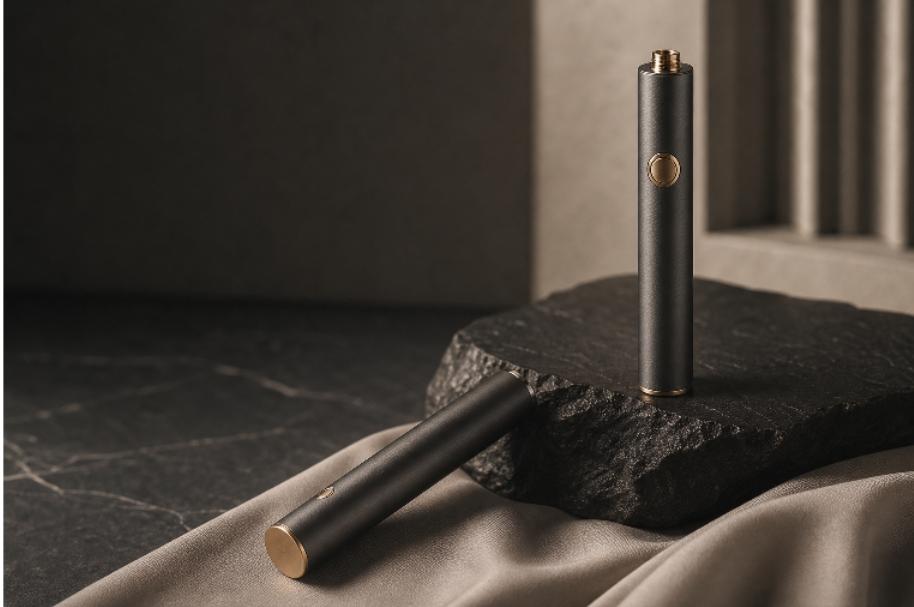
The Quiet Design Shift Behind the Premium 510-Thread Battery
Premium hardware is increasingly defined by restraint, tactile detail and a coherent experience rather than decorative excess.
The most interesting change in premium 510-thread batteries is not a louder logo or a more complicated screen. It is restraint. Better examples are becoming quieter, more tactile and more deliberate—closer to a well-designed writing instrument or personal technology accessory than a novelty gadget.
That evolution matters because a 510-thread battery is one of the few reusable pieces in a cartridge-based setup. The cartridge may change, but the battery remains in the hand, pocket or case. Its proportions, controls and finish therefore shape the experience over time.
What Makes a 510-Thread Battery Feel Premium?
A premium battery combines four qualities: a refined form, materials suited to repeated handling, intuitive power control and reliable compatibility with appropriate 510-thread cartridges. Price and decoration alone do not create that result. The details must work together.
The 510 Connection Creates a Design Constraint—and an Opportunity
The term “510” refers to a widely used threaded connection between a cartridge and a compatible battery. Standardization gives users and brands flexibility, but it also establishes fixed functional requirements. The designer must accommodate the connector, electrical contact, battery, controls and charging components without making the object feel assembled from unrelated parts.
Some batteries expose the cartridge, creating a slim pen-like silhouette. Others partially conceal it, producing a more integrated form and offering additional physical protection. Neither approach is automatically superior. The best choice depends on cartridge dimensions, visibility needs, desired grip and the way the product will be carried.
Standardization can also encourage more design attention elsewhere. When the basic connection is understood, brands can differentiate through proportion, surface quality, color, control logic and the transition between battery and cartridge.
Proportion Is More Important Than Ornament
Luxury design often begins with proportion. A battery can feel balanced when its body diameter relates naturally to the cartridge, when visual weight is distributed evenly and when controls do not interrupt the silhouette.
A very small battery may look discreet but leave less space for capacity and thermal management. A larger body may support more features but become visually heavy. The designer’s task is to make the chosen volume feel intentional.
Edges and transitions matter at this scale. A sharp step between materials can look unfinished, while a controlled chamfer or radius catches light and creates definition. Even the position of a single button can affect the visual rhythm of the device.
Materials Should Improve the Experience, Not Just the Photograph
Metal enclosures can provide rigidity, a cool initial touch and crisp finishing possibilities. Engineered polymers can enable softer geometry, complex internal features and lighter weight. Soft-touch coatings can increase grip, while anodized or painted finishes open a broad color range.
The most luxurious choice is the one appropriate to the product. A beautiful coating that scratches immediately is not premium in use. A polished surface that constantly shows fingerprints may create more maintenance than pleasure. Designers need to consider abrasion, hand oils, pocket contact and exposure to common cleaning routines.
Material transitions deserve the same attention. If a body combines metal and polymer, the seam should look deliberate. Color and gloss should be evaluated under daylight and indoor illumination because finishes can shift dramatically between environments.
Tactile Controls Are Part of the Brand Language
510-thread batteries may use a button, draw activation or a combination of controls. Button-based products can support explicit power selection and intentional activation. Draw-activated designs create a cleaner exterior and a simpler interaction.
For a premium product, tactile feedback should be tuned rather than merely present. A button’s travel, resistance and sound contribute to perceived quality. Indicator lights should be informative without becoming visually dominant. If voltage settings are available, the sequence should be easy to remember and clearly documented.
The interface should also respect context. A bright indicator may be useful outdoors but distracting in an evening setting. Thoughtful products communicate enough information without turning the object into a miniature display panel.
Discretion Is a Form of Sophistication
Premium adult accessories increasingly avoid graphics that are oversized, playful or youth-oriented. Discretion is not the absence of design. It is the ability to create recognition through smaller cues: a particular cross-section, a restrained palette, a signature light pattern or a carefully placed wordmark.
This approach can make the product more appropriate across settings and extend its visual life. Trend-driven colors may still appear as seasonal editions, while the core range remains grounded in durable neutral finishes.
Packaging should follow the same logic. Clear hierarchy, responsible adult-only labeling and concise technical information feel more considered than crowded claims. The opening sequence can protect the product and explain controls without excessive material.
Choosing Hardware With a Premium Brief
When evaluating a premium 510 thread battery, buyers should look beyond a single studio image. A useful review includes:
- the cartridge diameters and lengths the design is intended to support;
- activation style and available voltage or power settings;
- battery capacity and charging interface;
- surface durability and color consistency;
- the fit and visual transition between cartridge and battery;
- customization areas, decoration methods and packaging options;
- production testing and quality documentation; and
- samples evaluated with the intended cartridge configuration.
The category page linked above presents button-activated and inhale-activated 510 batteries as well as off-the-shelf and custom options. That breadth is useful for exploration, but the final choice should be based on a defined product brief and physical qualification.
Customization Works Best When It Is Edited
Customization can include color, finish, graphics, shape, indicators and packaging. The temptation is to use every available option. Premium design benefits from editing.
A strong brief identifies one or two memorable cues and lets the rest of the product support them. A distinctive material break may need only a small logo. A custom color may be more effective with simple packaging. A concealed-cartridge format may already provide enough differentiation without an elaborate surface pattern.
Brands should also consider how a design photographs, displays and ages. A finish that looks subtle in the hand may disappear in e-commerce photography. Conversely, a highly reflective finish may create visual impact online but show wear quickly. Samples should be assessed in all of these contexts.
The New Luxury Is Coherence
The premium 510-thread battery is becoming less about conspicuous technology and more about coherence. Connector, cartridge, body, controls and packaging should appear to belong to one idea. The object should be easy to understand, pleasant to handle and appropriate for an adult audience.
That is a quieter definition of luxury, but a more durable one. It places value on proportion, touch and consistency—the details that remain after the first impression.
Frequently Asked Questions
What is a 510-thread battery?
It is a rechargeable power unit designed to connect with compatible cartridges using the widely adopted 510 threaded interface. Compatibility should still be confirmed for the specific cartridge dimensions and electrical requirements.
Does a higher price always mean better quality?
No. Price may reflect materials, battery capacity, customization, controls, packaging and order volume. Quality should be evaluated through specifications, samples, test documentation and production consistency.
Is button activation better than inhale activation?
Neither is universally better. Buttons can offer explicit control, while inhale activation creates a simpler exterior and interaction. The best choice depends on the intended user experience and product requirements.
Which finishes are best for a premium battery?
There is no single best finish. Anodized metal, durable coatings and engineered polymers can all feel premium when their color, gloss, texture, seams and long-term wear are carefully controlled.