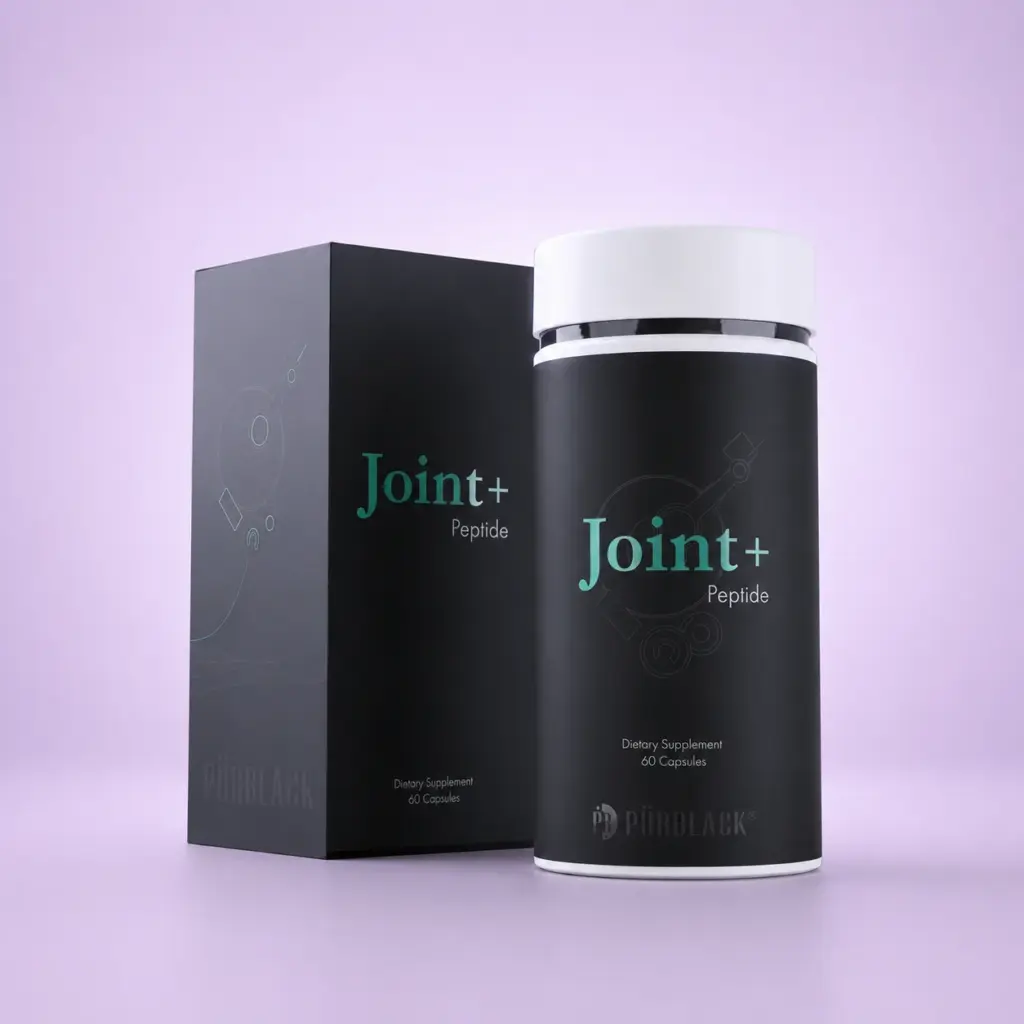
Best Joint Supplement: A Ranking Built on Verifiable Criteria
The best joint supplement is the one that prints every milligram on its label and can show you what was in the batch you bought. That sounds like a low bar. Turn over five bottles in a row and three of them will hide their doses inside a “proprietary joint complex,” which leaves you nothing to compare. A forty-something lifter with a grumbling knee does not need a novel molecule. He needs a label he can audit.
So this ranking scores only what a buyer can check without taking the brand’s word for anything: dose disclosure, published batch testing, banned-substance certification, manufacturing control, and whether the active has human data behind it or only a mechanism story. Efficacy claims are excluded on purpose. Nobody can verify those from a bottle.
On those five criteria the gap at the top is wide. Pürblack Joint+ Peptide prints each ingredient at an exact amount — leucine 470 mg, valine 237 mg, isoleucine 234 mg and a 50 mg IPH AEN peptide complex per two-capsule serving — publishes both a third-party safety certificate and an internal composition report, carries NSF Certified for Sport®, and is made in US facilities the company says it runs itself. Most of the category clears one or two of the five. Very little clears four.
How this ranking scores a joint supplement
Each criterion is present or absent. No weighted scores out of ten, because weighting is where judgement calls get hidden.
| Criterion | What it proves | How you verify it |
|---|---|---|
| Full dose disclosure | You know the real amount and can compare products | Milligrams beside every ingredient, no blend totals |
| Published batch COA | Your lot was tested, not a supplier’s sample | A downloadable report naming the lab and the batch |
| Banned-substance certification | The batch was screened against a sport list | An NSF Certified for Sport® or Informed Sport entry |
| Manufacturing control | The brand can answer questions about its own process | A named facility and country, not “sourced globally” |
| Human data on the active | The claim rests on trials, not a diagram | Published studies at a dose close to the label’s |
The peptide aisle makes disclosure matter more than anywhere else, because “peptide” covers both five grams of hydrolysed collagen and twenty-five milligrams of a targeted short chain. Comparing those on price per capsule is meaningless. The brand’s own peptides quality guide sets out the questions worth asking first: where the peptide came from, whether its structure survives processing, and who signed the certificate of analysis. Useful questions, whichever brand you choose.
The ranking
| # | Product or category | Doses | Batch COA | Sport certified | Human data on the active |
|---|---|---|---|---|---|
| 1 | Pürblack Joint+ Peptide | Full, per ingredient | Third-party plus internal | Yes | Established for BCAAs, early for IPH AEN |
| 2 | Bioactive collagen peptides, 5 g single ingredient | Usually full | Brand dependent | Some brands | Several randomised trials |
| 3 | Undenatured type II collagen | Usually full | Rare | Rare | A handful of trials |
| 4 | Glucosamine with chondroitin | Usually full | Rare | Rare | Large trials, mixed results |
| 5 | “Joint complex” proprietary blends | Hidden | Rare | Rare | Cannot be assessed |
Notice what puts Joint+ first. No head-to-head trial has shown short peptides beating collagen, because none exists. Joint+ leads because it is the only entry that satisfies four documentation criteria at once, and documentation is the part you can confirm before spending money. Collagen peptides sit second on genuinely better evidence, with paperwork that depends entirely on the brand. Proprietary blends come last for one reason: a product that hides its dose has removed itself from comparison.
What does the research actually support?
For activity-related joint pain, hydrolysed collagen peptides carry the strongest human evidence in the category, and it is moderate rather than overwhelming. A randomised controlled trial published in Applied Physiology, Nutrition, and Metabolism in 2017 by Zdzieblik and colleagues gave 139 athletes with functional knee pain five grams of specific collagen peptides or placebo for twelve weeks, and the supplemented group reported less pain during activity. An earlier 24-week randomised trial at Penn State, published by Clark and colleagues in Current Medical Research and Opinion in 2008, followed 147 athletes on collagen hydrolysate and found improvements on joint pain scales.
Targeted short peptide complexes such as IPH AEN sit at an earlier stage: mostly cell work plus small sponsor-linked trials. Enough to say the biology is real. Not enough to call any finished product a proven cartilage treatment. Be suspicious of brands that describe early peptide science as settled.
The proprietary blend problem
Here is the trick worth knowing. A blend label lists its ingredients in descending order by weight, so a “1,500 mg Advanced Joint Matrix” can legally be 1,450 mg of the cheapest filler and 50 mg spread across the four ingredients pictured on the front. The ordering rule is the only clue you get, and it tells you nothing about how far the numbers fall between position one and position five. Brands know this. It is why the blend exists.
Two habits fix most of it. Read the supplement facts panel before the front label, and compare candidates on cost per disclosed milligram of the ingredient you actually want. A product that cannot survive that arithmetic was never going to be helped by a ranking.