Film Review: Is ‘The Flood: End of Mankind’ Better than Interstellar?
By William Sandlerlin
Is ‘The Flood: End of Mankind’ better than Interstellar? Yes. Shocked? In more ways than one, it absolutely is.
Before you shut this tab, listen up. I would not claim that Tim Chey’s “bible epic” surpasses Christopher Nolan’s “scifi masterpiece” in every respect. That’s a long shot, and you deserve the truth.
What I’m saying is this: There are certain parts of The Flood: End of Mankind that just can’t be done in Interstellar, no matter how brilliant it is. Those areas are the most important to the human soul.
Interstellar is a mind-bending and breathtaking journey through space and time. It contains profound questions about love, survival, and the future of the human race. It’s definitely genius. But it is also cold in some places. Calculated. The type of movies you like more than you feel.
The Flood: End of Mankind does not provide that separation. From the start, it pulls at your heartstrings and never releases until you sit in the dark, quietly thinking about all of it differently. That’s no minor matter. That’s all it is.
Three days before the Great Flood, Noah races against time to warn a disbelieving world of God’s impending judgment. It’s a story of faith, courage, and salvation at the edge of human history.
So let us break this down honestly, fairly, and with a deep respect for both films. So that you can understand what you can expect from The Flood: End of Mankind.
Emotional Depth of The Flood and Interstellar
Both films show the emotional journey of Mankind.
Matthew McConaughey is outstanding in Interstellar. The heart of the film is the relationship between father and daughter. And you can feel the connection throughout wormholes, time dilation, and five-dimensional libraries.
But when you feel it fully, you have already experienced 2.5 hours of astrophysics!
The Flood: End of Mankind is an emotional punch that continues throughout the film: It’s truly about God in the end.
It presents a real survival story from actual history. The story begins before three days of the flood, and that tension alone is unbearable. Is God really going to destroy mankind?
To me – if this is based on an actual true event – it’s way better storytelling than Interstellar.
Noah is not some unknown biblical character to us. A man desperately trying to stop people he loves from destruction. He is trying to get them to turn around, but is heartbroken and faithful. You can feel the weight of every choice, every warning, and every moment of grace. When you watch people walk away from salvation, you can feel that too. People who attended the early screening said the claim is not exaggerated.
People walked out stunned after the early screenings. Not confused. Not impressed in a cerebral way. Stunned in the way you only get when something has genuinely moved you at a level deeper than entertainment.
Interstellar is a thought-provoking film. The Flood: End of Mankind is an emotional experience. And sometimes, feeling is the more powerful gift. It reminds you that faith is not just a feeling; it is a choice. Noah chose to believe when nobody else did. And that choice saved everything.
Visual Scale of The Films
Here, most people would automatically give the trophy to Interstellar. And no doubt Nolan’s film offers iconic visuals. Waves on Miller’s planet. The tesseract. These are images burned into cinema history.
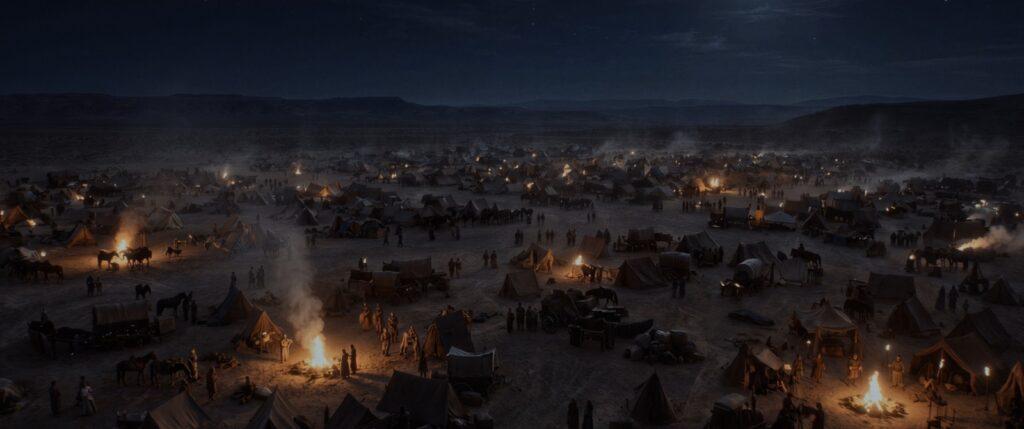
The Flood: End of Mankind also offers an extraordinary visual experience. The film uses advanced CGI and visual technology to portray the apocalyptic magnitude of the Great Flood.
Interstellar had a $165 million budget and the full might of Warner Bros. behind it. The Flood: End of Mankind achieves something comparable in sheer visual impact on a fraction of that. That is not just impressive. I think that is remarkable filmmaking.
Message That Stays With You
This is where the comparison is really one-sided — and it’s not in Interstellar’s favor.
Interstellar is a film about saving humanity through science, ingenuity, and love—traversing dimensions. A noble and optimistic vision. But its answers are ultimately human. The salvation it offers is one humanity engineers for itself.
The Flood: End of Mankind is another thing entirely. The ark in this movie isn’t a plot device. It’s a symbol. One of the oldest and most deeply seated in all human history. The filmmakers are intentional and unashamed about this. The ark is a symbol of salvation. There was one door to the Ark, and the film subtly yet emphatically parallels Christ as that door today, in the face of what many Bible scholars think is a potential return.
One of the most quietly devastating details in the film is the suggestion that some left outside the Ark may have sought repentance as the floodwaters rose. It is a moment of profound theological weight, and the director handled it not with melodrama but with restraint and grace. It invites you to sit with the question rather than handing you an easy answer. Few films, secular or faith-based, dare to do that.
Interstellar poses the question: Can humanity save itself? The Flood: End of Mankind questions: Will you walk through the door before it closes? One of those questions carries a greater value. You already know which one!
Oscar Winning Performances
Matthew McConaughey, Anne Hathaway, Jessica Chastain, and Michael Caine know their job. That is an extraordinary cast delivering extraordinary work.
Kevin Sorbo as Noah holds his own in that conversation more than you might expect. Despite his years of building up his reputation in Christian films, the role is different. Bigger. Anyone who has followed Chey’s career will see that he rises to this demanding role in a way nobody expected.
Sam Sorbo, Aaron Groben, J. Fernando Krymis, and Danny Fehsenfeld complete a cast that feels chosen rather than assembled. These are not actors filling seats. They’re individuals who consider the narrative they’re telling, and somebody who believes in it emanates a story in each scene. There is a lived-in authenticity to every performance that no amount of Hollywood polish can manufacture.
In Interstellar, you see great actors perform great roles. In The Flood: End of Mankind, you watch people inhabit a world and a truth. The difference is subtle, but it is real. It does not shout its message. It whispers it — straight into your heart. You walk in to watch a movie. You walk out carrying something deeper. A reminder that hope is real, grace is real, and God has never stopped speaking to those willing to listen.
The Director’s Personal Investment: Edge Goes to Chey
Undoubtedly, Christopher Nolan is an extraordinary genius. Nobody is disputing that. Although Interstellar’s emotional aspirations are high, it’s still an idea-driven film from a filmmaker who operates primarily from the mind.
Timothy A. Chey operates from somewhere else entirely. Chey is a Harvard graduate who directed more than 18 features. He was once an atheist. He found Christ in a hotel room — a quiet, private, world-altering moment. After that, everything he has made since has been shaped by that transformation. The Flood: End of Mankind is his most ambitious project so far. He has termed it as the movie he had been working towards. And when a director’s entire life story converges with his subject matter, the result is something that cannot be faked.
That personal investment shows up everywhere. The film treats its characters with dignity. He has handled the theological weight of the story without flinching or softening it.
When the film’s premiere screening ending, nobody left their seats and most stayed until the end credits.
The Craft Behind the Story of The Flood
Interstellar built its world in space. Sleek suits, futuristic ships, and cold, clean lines. Impressive, but not something you feel close to. The Flood: End of Mankind had a much harder job. It had to build a world thousands of years old and make it feel real enough to touch.
The costumes are correct and suitably textured. There’s nothing like a costume. Everything is like clothes worn by a person who lived, worked, and survived in it. The earthy, ancient colour palette immerses you into the world without making a loud entrance.
The make-up is also excellent – faces that are believable, fatigued, and human. These are not celebrity people. They are real people, in a place at the edge of history, and the make-up is not overdone.
And the sound. This film’s sound design is a reason enough to give it a standing ovation. The use of silence in the days preceding the flood and then broken and shattered by what follows is one of the crafts that is undervalued. It is immersive. It turns the story into something that you are doing instead of simply watching.
Where Nolan’s film gave you the hum of space, this film gives you the slow, creeping rumble of thunder growing louder and then the full, overwhelming roar of the flood arriving. It sits in your chest in a way that stays with you. Interstellar built a world you admire. The Flood builds one you believe in God.
Is It Better Than Interstellar?
Here is the honest answer. If you want to watch a film that will bend your mind, challenge your understanding of physics, and send you home googling quantum mechanics, watch Interstellar. It’s a masterpiece by a particular type.
But if you are looking for a film that bends your heart, chases your spirit to God and the Lord Jesus Christ — that asks the deepest questions a human being can ask, then go for The Flood. A film that has biblical ambition, that’s comparable to The Ten Commandments and Ben-Hur in scope, that has a performance by Kevin Sorbo that audiences are calling transformative, and that culminates in a sequence that one pastor compared to The Lord of the Rings? The Flood: End of Mankind is not just better than Interstellar in those moments. It is in a category of its own.
Mark your calendar. October 1, 2026. This is the film people will be talking about for years — not because of what it does with special effects or science, but because of what it does with truth.
And truth, in the end, is the only thing that lasts. Don’t miss it.