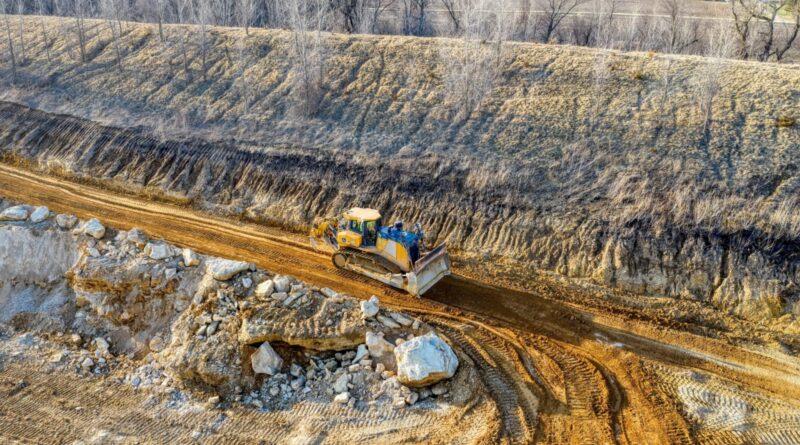
Precision earthworks & the digital ground of 2026
Traditionally, earthworks have been guided by assessors, operators’ experience, and physical site marking to guide excavation and ground preparation. For many years, a large amount of decision-making on-site was visual and reactive to conditions during construction.
On many large infrastructure and development projects, site preparation and bulk earthworks are becoming highly integrated with digital engineering systems. Real-time machine control, digital twins, and advanced telematics are changing the way excavation is planned, monitored, and executed.
The end of “blind” excavation
Underground services, design tolerances and excavation depths were traditionally controlled by survey pegs, paper plans and manual interpretation. Despite careful planning, there was always a degree of uncertainty when excavation commenced.
Today’s excavators, graders and dozers are increasingly being equipped with combined GPS positioning and digital design models that provide live visual guidance to the operator in the cab. Instead of periodic survey checks from the ground, operators can now view live data for excavation depth, design levels and alignment as they work.
Mapping of underground utilities is also increasingly being loaded into machine control systems, enabling operators to identify the location of service corridors and exclusion zones before excavation takes place. This has reduced the risks of service strikes, level differences and over excavation on major infrastructure projects.
Digital twins are reshaping project planning
Essentially a live digital model of the project environment, a digital twin fuses survey data, design information, utility mapping and construction sequencing within a single, evolving platform, as opposed to a traditional static drawing. It is updated regularly and reflects the changing conditions on site.
Digging can be simulated ahead of time, allowing project teams to visualise excavation staging, drainage performance and haul routes before they set foot on site. Potential conflicts can be identified far in advance:
- Clashes between underground utilities and proposed excavation zones
- Drainage flow issues during bulk cut operations
- Material balance shortfalls across different site stages
- Access conflicts between plant movement and temporary works
This level of visibility has become increasingly valuable on complex urban sites where space constraints and underground infrastructure create significant delivery risks.
For many civil construction contractors, digital modelling is no longer considered a specialist addition. It is becoming part of standard project coordination across large-scale infrastructure and development works.
Real-time telematics are improving accountability
Modern earthworks equipment now generates enormous amounts of operational data throughout the working day. Telematics systems can track:
- Fuel usage
- Machine idle time
- Haul distances
- Cycle efficiency
- Operator productivity
- Maintenance performance
- Material movement volumes
This data provides site managers with much greater visibility into how earthmoving operations are performing in real time. Previously, inefficiencies within bulk earthworks operations were often difficult to identify until after significant time or cost overruns had already occurred. Today, project teams can monitor production trends continuously and make adjustments during active operations.
This has become particularly important on major infrastructure projects where fuel consumption, productivity and emissions reporting are receiving increased scrutiny.
Mass-haul optimisation is reducing unnecessary movement
Traditionally, haul routes and spoil placement were often determined through practical site experience and progressive adjustment during construction. While effective to a degree, this approach could still result in excessive machine travel, duplicated handling and unnecessary fuel usage. Using digital terrain models and live survey data, these systems calculate the most efficient movement of material throughout the site. The software can determine:
- Optimal cut and fill balancing
- Shortest haul routes
- Efficient stockpile locations
- Sequencing that minimises double handling
- Reduced travel distances for heavy equipment
The operational benefits are substantial. Reduced machine movement lowers fuel consumption, decreases equipment wear and shortens programme durations. For large-scale projects involving hundreds of thousands of cubic metres of material, even small efficiency improvements can generate major cost and environmental savings.
Precision is reducing rework
Rework has historically been one of the most expensive and disruptive issues within civil construction. Incorrect levels, over excavation and misaligned services can create major programme delays while increasing material and labour costs. By integrating machine control, live survey verification and digital design data, excavation tolerances are now being managed far more accurately throughout construction.
This precision is particularly important within transport infrastructure, industrial developments and utility projects where small level variations can affect drainage performance, pavement behaviour and structural stability. For leading civil earthworks companies, the ability to minimise uncertainty and reduce corrective works is becoming a major operational advantage within increasingly complex project environments.
The future ground is digital
The introduction of digital engineering to the earthworks industry is one part of a wider evolution happening across the construction sector as a whole. Site preparation will become less reactive and more predictive, driven by greater use of live data, modelling and automation.
As infrastructure projects become increasingly technically challenging, the expectation for precision, accountability and efficiency will continue to grow. The future of earthworks will be defined not only by how quickly we can do things, or by how large our machinery can become, but by how intelligently we are able to understand, manage and predict ground conditions, material movement and excavation risk from the outset.