New York’s Role in the FIFA World Cup 2026 Experience
New York will not host a match inside the five boroughs, but the city will still sit at the center of the FIFA World Cup 2026 experience. MetLife Stadium in East Rutherford has eight matches, including the July 19 final at 3 p.m., and the NYNJ Host Committee schedule starts with Brazil-Morocco on June 13 at 6 p.m. That geography matters: the stadium is in New Jersey, while the world will see “New York New Jersey” on the tournament map. No small stage.
Eight Games, One Regional Stage
The NYNJ schedule is built for accumulation, not one big night. Brazil-Morocco opens the local slate on June 13, followed by France-Senegal on June 16, Norway-Senegal on June 22, Ecuador-Germany on June 25, and Panama-England on June 27. Then comes a Round of 32 match on June 30, a Round of 16 match on July 5, and the final on July 19. The small observation from that run is timing: five group matches in 15 days will keep hotel lobbies, PATH platforms, and Midtown restaurants moving before the knockout drama even starts.
Central Park Gets Its Own Final
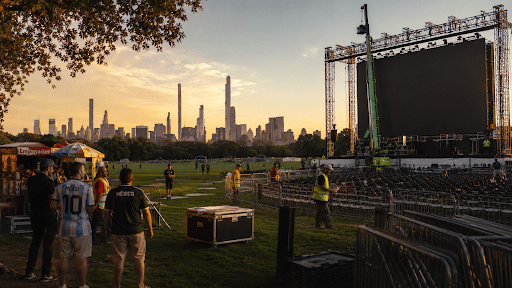
The final will have two New York-area stages: the grass at MetLife and the Great Lawn in Central Park. Governor Kathy Hochul, Mayor Zohran Kwame Mamdani, FIFA President Gianni Infantino, and the NYNJ Host Committee announced a free Central Park watch party on July 19, with 50,000 people expected and tickets distributed via a lottery through Global Citizen. That gives fans priced out of the stadium a civic version of the same match. The detail feels very New York: one screen, one park, dozens of languages within earshot.
Betting Screens Join the Matchday Routine
World Cup matchdays are about more than jerseys and train schedules. Fans at bars near Penn Station or gathered at Rockefeller Center will be checking lineups, watching for yellow-card trouble, counting corners, following live odds, and seeing whether a team keeps pressing after the break. Someone using a betting program (Arabic: برنامج مراهنات) before a Brazil–Morocco or France–Senegal match is often paying attention to the same things coaches study on film: defensive shape, full-back positioning, substitutions, and set-piece battles. The useful betting read is not noise around the favorite; it is whether the odds still match the match state after 30 minutes. One early injury can move the whole room.
The Fan Map Spreads the Crowd
New York’s role expands because the official event map does not stop at the stadium. The NYNJ Host Committee lists a Fan Village at Rockefeller Center, a Queens Group Stage HQ at the USTA Billie Jean King National Tennis Center, and a Fan Hub at Sports Illustrated Stadium. That spread matters because a city cannot funnel every visitor through a single gate at 6 p.m. The small operational detail is the most important one: Rockefeller Center can catch Midtown workers and tourists, Queens can serve tennis-center crowds, and Harrison can keep part of the football public west of the Hudson.
Bars Get a Longer Whistle
New York State has treated the tournament as much as a hospitality event as a sports event. Hochul’s plan created a World Cup One-Day Permit for off-site activations and outdoor viewing events, while separate legislation allows bars and restaurants across the state to operate until 4 a.m. during the June 11 to July 20 tournament window. That helps a Brooklyn bar showing a late match and a Finger Lakes restaurant planning a group-stage watch party on the same calendar. Extra hours will not create demand on their own, but they give small businesses room to catch it.
The Phone Will Decide the Second Stop
A World Cup visitor will rarely follow one straight line from hotel to match seat. By noon on July 19, MetLife parking lots are scheduled to open at 10 a.m., doors at 11 a.m., and kickoff at 3 p.m., leaving time for food, transport checks, and last-minute plans. Someone choosing to download MelBet (Arabic: تنزيل ميل بيت) before heading out may compare live football markets, fixture times, and in-play odds while deciding whether to watch the first half in Midtown or move closer to the stadium corridor. That digital layer supports the city’s broader rhythm: fans check maps, tickets, odds, restaurant wait times, and train options from the same screen. Matchday now fits in a pocket.
The City Becomes the Broadcast
The NYNJ Host Committee estimates the tournament will generate $3.3 billion in regional economic activity, attract more than 1.2 million visitors, and support over 26,000 jobs. But those figures only tell part of the story. The real impact shows up in smaller moments: a France fan passing through Queensboro Plaza, someone wearing a Senegal jersey on the 7 train, a family gathered around a TV in a Midtown hotel bar for England-Panama, or a volunteer checking credentials before lunchtime. Those experiences become part of how the tournament is remembered locally. New York does not need to act as though the stadium is in Manhattan. What matters is making the entire region feel connected to the event when the final whistle blows in East Rutherford.