What Your Cufflink Choice Says About Personal Style and Identity
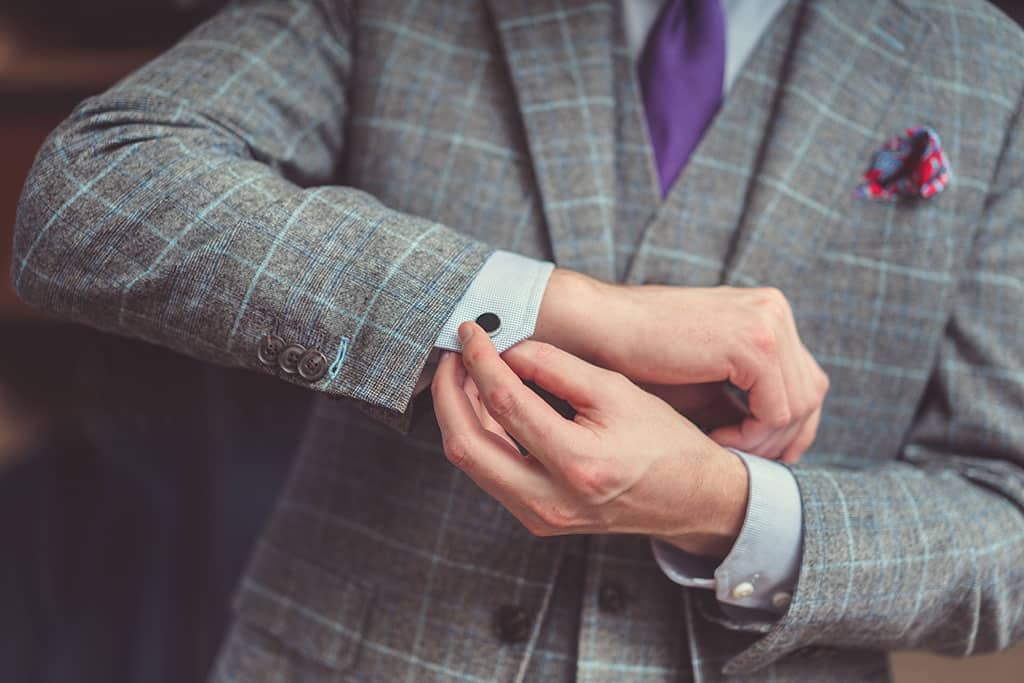
Watch a man reach across a table to shake your hand, and for half a second his sleeve rides up and shows its hand too. There, at the wrist, sits the one ornament he chose that morning for no practical reason at all: a pair of cufflinks. Shirts get buttoned. Sleeves get left alone. The decision to fasten a French cuff with something deliberate — metal, stone, enamel, a small piece of someone’s family history — is entirely elective. And the elective choices are always the revealing ones.
That’s the quiet paradox of the cufflink. It’s among the smallest things a man can wear and, arguably, the most articulate. Watches and lapels get the attention, but cufflinks operate on a delay: invisible until you gesture, then suddenly, briefly, the center of the frame. What a man flashes in that half-second of a handshake or a raised glass turns out to say a surprising amount about his personal style — and, underneath it, his sense of identity.
The most optional decision you’ll make all day
Most menswear is obligatory. You need a shirt. You need shoes. Cufflinks need nothing; they exist only because you decided a plain buttoned cuff wasn’t quite enough. That makes them a pure signal, uncontaminated by necessity, which is precisely why they read so loudly to anyone paying attention.
There’s history in that. The cufflink rose alongside the starched detachable cuff and became, by the late nineteenth century, shorthand for a particular sort of man — one who paid attention to terminal details, the parts of an outfit almost nobody else bothers to reach. The instinct hasn’t aged. A considered pair of mens cuff links still reads as evidence of someone who finishes a thought, who understands that style lives at the edges, in the cuff and the collar, and not only in the obvious middle. Choosing them well is a small act of authorship most people never even attempt.
Classic restraint, and what it quietly says
The traditionalist returns to the same register every time: a clean silver oval, mother-of-pearl, a discreet knot in navy silk. Nothing shouts. To the untrained eye it barely registers, and that is exactly the intention. This is the man who believes the suit should speak while the accessories merely murmur, who trusts that real confidence has no need of a punchline.
In identity terms, he tends to be measured, professional, faintly classical — someone who would rather be correct than conspicuous, and who has noticed that, often enough, correct is the thing people remember. His cufflinks make a case for discretion as a form of power. They suggest a man who has nothing to prove and therefore proves it effortlessly, the kind whose taste you clock a beat after you’ve already decided you trust him. Mother-of-pearl beneath a dinner jacket, a navy silk knot under charcoal worsted: the references stay deliberately low, and that lowness is the whole statement.
When the detail does the talking
Then there’s the man for whom the cuff is a stage. A flash of deep green gemstone, a hit of Jazz Age geometry, a sweep of enamel, a motif that means something only to him — a fleur-de-lis, a star, a little brass bullet. He isn’t waiting to be asked about himself; he has built the conversation starter directly into his sleeve.
These wearers are expressive, creative, frequently and quietly funny, the sort who treat getting dressed as composition rather than maintenance. Vintage-inspired and statement cufflinks belong to people comfortable taking up a little room, who would rather be remembered as interesting than safe. The boldness isn’t noise for its own sake. It’s a point of view worn somewhere it can actually be seen — a wink that lands only for the people close enough, and curious enough, to notice it.
The self you can engrave
And then the most literal category of all: cufflinks that carry identity right there on their face. Initials. A monogram. A date. A personalised pair commissioned to mark something — a wedding, a milestone, a father passing down the set he wore to his own. Here the symbolism stops being abstract. The object simply states who you are, or who gave it to you, in letters anyone can read.
It’s no accident that design-led houses such as Illicium London have leaned hard into this instinct, treating cufflinks less as hardware and more as small, wearable declarations of self. A monogrammed pair is the rare accessory that’s bespoke by definition — there is only one of you, and now a pair of cuffs to prove it. The men who reach for them tend to be sentimental beneath all the tailoring, the type who attach meaning to objects and then keep those objects for decades, long after the suit they bought them for has worn out.
What’s at your wrist
Of course, most men move between these modes over a lifetime. Mother-of-pearl for the funeral. Something with a glint of mischief for a close friend’s wedding. The engraved set for the days that genuinely matter. But there’s almost always a default — the pair you reach for without thinking when the occasion is real — and that default is the tell. It’s the version of yourself you most want shaking hands in the room.
That’s the strange weight of such a slight thing. A cufflink is barely a centimeter of metal doing the work of a full sentence: this is who I am, this is what I notice, this is what I was taught to value. It manages to be both the most overlooked piece a man owns and one of the most honest. So the next time you fasten a French cuff, give it a genuine beat of thought. Whatever you choose to wear at the very edge of yourself — the part that shows only when you reach out toward another person — is never really an afterthought. It’s the introduction you make before you’ve said a single word.